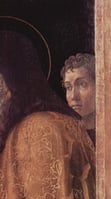
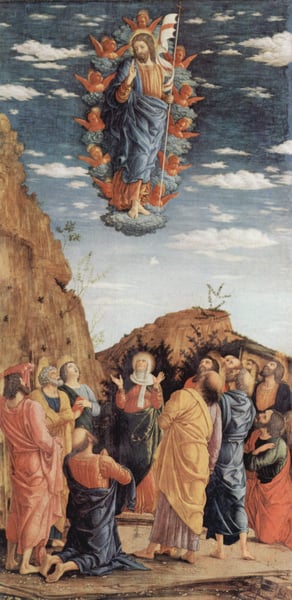
The Ascension, left hand panel from the Altarpiece
Details
Expertenanalyse zu Andrea Mantegnas The Ascension, left hand panel from the Altarpiece
Stil: Early Renaissance · Genre: religious painting
Expert Analysis of "The Ascension, left hand panel from the Altarpiece" by Andrea Mantegna
Andrea Mantegna’s The Ascension—here preserved as the left-hand panel of a larger altarpiece—exemplifies the fusion of rigorous perspective with an almost archaeological classicism that defines his pivotal role in Early Renaissance art. Although the precise altarpiece is not specified, Mantegna’s treatment of this subject is unmistakable in its intellectual ambition and emotional gravity.
Compositional and Perspective Innovation
Mantegna was a master of sotto in sù (foreshortening from below), and in this panel he deploys it to make the miraculous physically convincing. Christ’s ascending figure is sharply foreshortened—feet and drapery thrust forward, torso receding—so that the viewer looks up into the space of the miracle. This dramatic angle, often called "Mantegna’s sky," forces the surrounding Apostles and the Virgin to react with gestures of awe and grief, their solid, sculptural forms anchored by the artist’s meticulous rendering of anatomy and drapery folds. The perspective system, with its vanishing point located at Christ’s navel or just below, creates a unified spatial field that draws the eye upward, mirroring the theological ascent.
Classical and Archaeological Precision
True to his humanist training, Mantegna fills the background with Romanesque or antique architectural fragments—marble plinths, carved pilasters, and a rocky landscape punctuated by ruins. These details are not mere decoration; they anchor the sacred event in a specific, historically layered world, reflecting the Early Renaissance belief that Christianity fulfilled the classical past. The stone-like quality of the figures (often described as "painted statues") gives the scene a timeless, monumental weight, as if the event is carved in marble rather than painted in tempera.
Emotional and Theological Significance
Unlike later, more ethereal Ascensions, Mantegna’s version is intensely human. The left-hand panel typically shows the Virgin and a cluster of Apostles; their faces register shock, sorrow, and wonder—not serene acceptance. This emotional realism, combined with the stark, crystalline light that models every form, makes the divine intervention feel immediate and corporeal. The panel’s role as part of a polyptych (likely flanking a central panel of the Crucifixion or Resurrection) would have reinforced the narrative arc of salvation.
Significance within the Early Renaissance
Mantegna’s work stands at the intersection of two great currents: the scientific study of perspective (championed by Alberti and Piero della Francesca) and the emotional intensity of religious narrative (inherited from Donatello). In The Ascension, he reconciles intellectual rigor with visceral devotion, anticipating the High Renaissance’s balanced synthesis of form and emotion. The left-hand panel, though a fragment, encapsulates his unique contribution—a vision that is at once classical, dramatic, and profoundly painterly.
Museum / Gallery
Visuell ähnlich
20 Werke mit ähnlicher Komposition und Farbpalette
The Almighty with Prophets and Sybils
Pietro Perugino
Journey of Moses and circumcision of her second child
Pietro Perugino
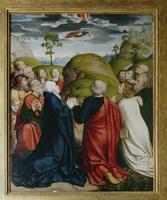
Ascension
Jan Joest
Calvary Triptych (left wing)
Justus van Gent
Calvary Triptych (left panel)
Hugo van der Goes
The Assumption of the Virgin
Defendente Ferrari
Calvary Triptych (right wing)
Justus van Gent
Calvary Triptych (Right panel)
Hugo van der Goes
Madonna in Glory with the Child and Saints
Pietro Perugino
Third Appearance of Christ
Dirk Bouts
The Youth of Moses
Sandro Botticelli
The Crowning of the Virgin
Raphael
Pala di Sant Agostino (Adoration of the Magi)
Pietro Perugino
Moses's Journey into Egypt
Pietro Perugino
Virgin in Glory with Saints
Giovanni Bellini
Coronation of the Virgin
Titian
Gazing Ball (Perugino Madonna and Child with Four Saints)
Jeff Koons
Pala di Corciano (Assumption of Mary)
Pietro Perugino
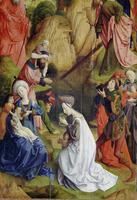
Calvary Triptych (detail)
Justus van Gent
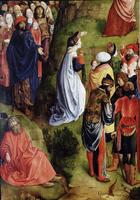
Calvary Triptych (detail)
Justus van Gent