
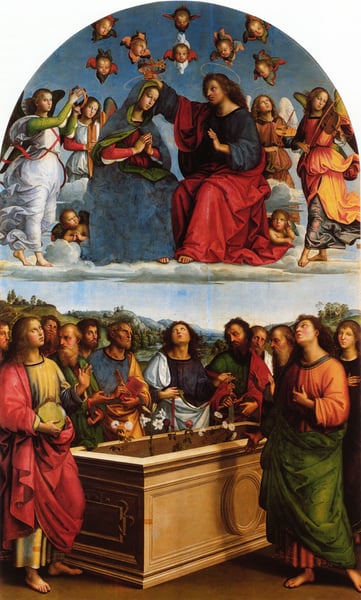
Titian sanatçısının Coronation of the Virgin eseri hakkında uzman analizi
Tarz: High Renaissance · Tür: religious painting
"Coronation of the Virgin by Titian is a masterwork of the High Renaissance that exemplifies the era’s shift toward dynamic, human-centered spirituality. Painted for the Franciscan church of Santa Maria Gloriosa dei Frari in Venice, this religious painting transforms a traditional heavenly scene into a deeply emotional, earthly encounter.
Significance within the High Renaissance:
-
Revolutionary color and light: Titian abandons the rigid symmetry and gold backgrounds of earlier Gothic coronations. Instead, he bathes the Virgin and Christ in a warm, natural light that radiates from the figures themselves. The vibrant reds, blues, and whites are not mere symbols but tactile presences, making the divine feel immediate and accessible.
-
Humanized majesty: Unlike the static, hierarchical compositions of the early Renaissance, Titian places the Virgin at the same eye level as Christ. Her humble gesture of receiving the crown is neither passive nor submissive—it is a quiet, confident acceptance. Christ’s tender, downward gaze and the angels’ swirling, energetic crowd create a moment of intimate dialogue rather than distant ceremony.
-
Venetian innovation: Where Florentine High Renaissance painters (like Raphael) emphasized linear perspective and sculptural form, Titian prioritizes painterly texture and atmospheric depth. The soft, blurred edges of the clouds and the shimmering, almost brushy treatment of the garments announce the Venetian school’s emphasis on color (colore) over disegno (drawing).
-
Altarpiece as visionary experience: As a large altarpiece, the painting was meant to inspire devotion. Titian achieves this by merging the celestial court with the viewer’s space: the angels seem to spill out of the frame, and the Virgin’s fragile humanity invites empathy. This emotional accessibility became a hallmark of Counter-Reformation art, but here it is already fully realized in the High Renaissance spirit of balanced naturalism and grace.
Ultimately, Coronation of the Virgin stands out because it makes a doctrinal event feel like a heartfelt exchange. Titian’s genius lies in using the full vocabulary of the High Renaissance—monumental scale, idealized figures, coherent space—while infusing it with a Venetian warmth and psychological nuance that would influence generations, from Tintoretto to Rubens."
Görsel olarak benzer
İlişkili kompozisyon ve renk paletine sahip 20 eser
The Crowning of the Virgin
Raphael
Gazing Ball (Perugino Madonna and Child with Four Saints)
Jeff Koons
Madonna in Glory with the Child and Saints
Pietro Perugino
The Assumption of the Virgin
Defendente Ferrari
Pala di Corciano (Assumption of Mary)
Pietro Perugino
The Almighty with Prophets and Sybils
Pietro Perugino
Pala di San Francesco al Monte (The Coronation of the Virgin)
Pietro Perugino
The Ascension, left hand panel from the Altarpiece
Andrea Mantegna
Virgin in Glory with Saints
Giovanni Bellini
Death of the Virgin
Andrea Mantegna
St. Augustine Altarpiece (left wing)
Luca Signorelli
Assumption of the Virgin
Palma Vecchio
Madonna and Child with Saints and Angels
Luca Signorelli
The Virgin and Child with Saints Jerome
Andrea Mantegna
The vision of St. Bernard
Pietro Perugino
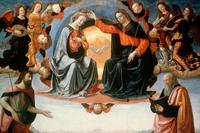
The Coronation of the Virgin
Domenico Ghirlandaio
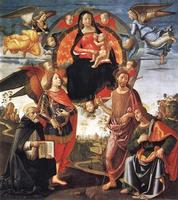
Madonna in Glory with Saints
Domenico Ghirlandaio
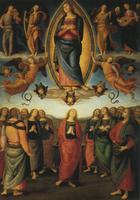
Polyptych Annunziata (Assumption of Mary)
Pietro Perugino
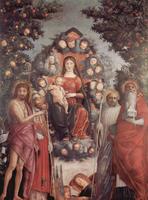
Madonna with saints St. John theBaptist, St. Gregory I the Great, St. Benedict
Andrea Mantegna
Glorification of St. Ursula and her Companions
Vittore Carpaccio