Expertenanalyse zu Andrea Mantegnas The court of the Gonzaga
Stil: Early Renaissance · Genre: genre painting
Analysis of "The court of the Gonzaga" by Andrea Mantegna
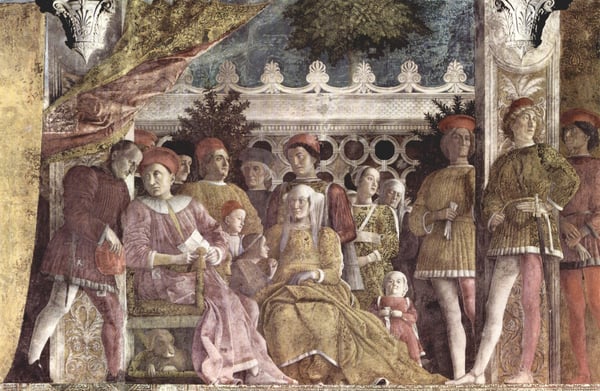
Mantegna’s The court of the Gonzaga stands as a landmark of Early Renaissance genre painting. At a time when most large-scale works were religious or mythological, this fresco cycle (part of the Camera degli Sposi in Mantua) turns an unflinching, intimate lens on the daily life of a ruling family. The stylistic hallmarks of the Early Renaissance—rigorous linear perspective, classical architectural framing, and a newfound naturalism in human expression—are deployed here not for a sacred narrative but to celebrate and record a contemporary secular moment: the Gonzaga court in its domestic and political setting.
What makes the work significant is its pioneering fusion of genre content with the high-art principles of the Early Renaissance. Mantegna elevates a seemingly casual family scene—including pets, servants, and courtiers—to monumental status, imbuing it with symbolic gravity through his signature foreshortening and trompe-l’œil ceiling. The painting’s realism, especially the psychological interactions among figures, anticipates later genre scenes by artists like Carpaccio and even the conversational paintings of the 17th-century Dutch. By treating the present-day court as worthy of the same meticulous perspective and classical dignity reserved for altarpieces, Mantegna effectively democratizes the visual language of the Renaissance, making The court of the Gonzaga a crucial early example of secular portraiture as high art.
Visuell ähnlich
20 Werke mit ähnlicher Komposition und Farbpalette
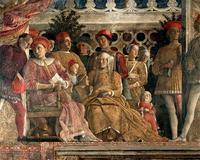
The court of the Gonzaga (detail)
Andrea Mantegna
Condemnation of St. Lawrence by the Emperor Valerian
Fra Angelico
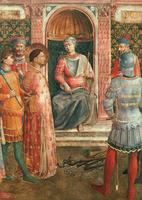
St. Lawrence on Trial
Fra Angelico
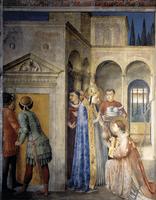
Saint Lawrence Receiving the Treasures of the Church from Pope Sixtus II
Fra Angelico
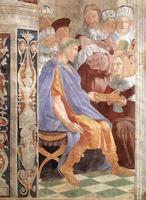
Justinian Presenting the Pandects to Trebonianus (Stanza della Segnatura)
Raphael
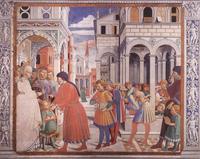
The School of Tagaste
Benozzo Gozzoli
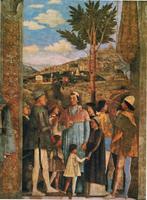
Meeting of Duke Ludovico II Gonzaga with Cardinal Francesco Gonz (fragment)
Andrea Mantegna
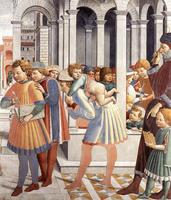
The School of Tagaste (detail)
Benozzo Gozzoli
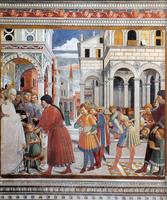
The School of Tagaste
Benozzo Gozzoli
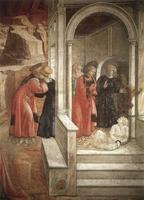
Disputation in the Synagogue (detail)
Filippo Lippi
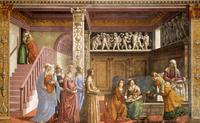
The Birth of Mary
Domenico Ghirlandaio
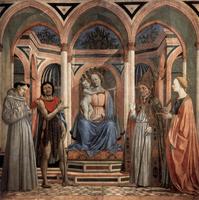
Madonna and Child with St. Lucy, St. Francis, St. Nicolas and St. John the Baptist, from Santa Lucia dei Magnoli
Domenico Veneziano
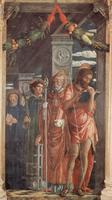
Altarpiece of San Zeno in Verona, right panel of St. Benedict, St. Lawrence, St. Gregory and St. John the Baptist
Andrea Mantegna
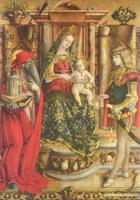
Enthroned Madonna, Saint Jerome, and St. Sebastian
Carlo Crivelli
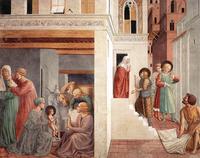
Birth of St. Francis, Prophecy of the Birth by a Pilgrim, Homage of the Simple Man
Benozzo Gozzoli
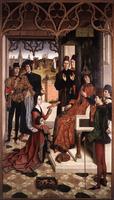
Justice of the Emperor Otto: The Ordeal by Fire
Dirk Bouts
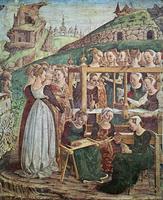
Allegory of March – Triumph of Minerva and Sign of Aries. Frescos in Palazzo Schifanoia (detail)
Francesco del Cossa
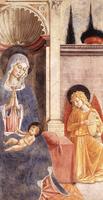
Madonna and Child (detail)
Benozzo Gozzoli
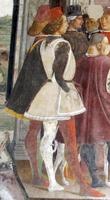
April. Frescos in Palazzo Schifanoia (detail)
Francesco del Cossa
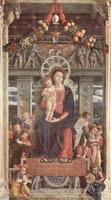
Altarpiece of San Zeno in Verona, central panel Madonna and Angels
Andrea Mantegna