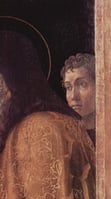
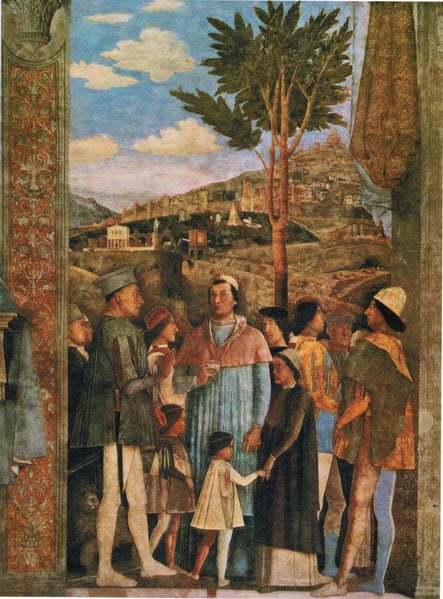
Meeting of Duke Ludovico II Gonzaga with Cardinal Francesco Gonz (fragment)
Details
Expert analysis of Andrea Mantegna’s Meeting of Duke Ludovico II Gonzaga with Cardinal Francesco Gonz (fragment)
Style: High Renaissance · Genre: history painting
Expert Analysis of Meeting of Duke Ludovico II Gonzaga with Cardinal Francesco Gonzaga (fragment) by Andrea Mantegna
This fragmentary history painting by Andrea Mantegna exemplifies the intellectual and formal ambitions of the High Renaissance style, while also demonstrating the period’s deep engagement with classical antiquity, perspectival rigor, and the political function of art. Although the work survives only as a fragment, its significance within Mantegna’s oeuvre and the broader Renaissance canon is profound.
1. Revolutionary Use of Perspective and Foreshortening
Mantegna was a master of sotto in sù (extreme foreshortening from below), and even this surviving portion showcases his pioneering approach to spatial illusion. In the complete original setting—likely part of the famed Camera degli Sposi in the Ducal Palace of Mantua—the artist treated the wall not as a flat surface but as a seamless extension of the viewer’s space. The figures of Duke Ludovico II and Cardinal Francesco Gonzaga are arranged with a rigorous one-point perspective that draws the eye into a convincing, deep architectural setting. This technique, central to High Renaissance painting, elevated the status of history painting by making historical events appear palpably present.
2. Humanist Celebration of Dynastic Power
The subject—a meeting between a ruling duke and a cardinal of the same family—is a classic history painting in the Renaissance sense: it documents a moment of political and ecclesiastical alliance while glorifying the Gonzaga dynasty. Mantegna, court painter to the Gonzagas, infused the scene with a solemn, almost antique gravity. The figures are rendered with sculptural solidity and individualized features, reflecting the High Renaissance belief that history painting should combine accurate portraiture with moral and civic exemplarity. The fragment’s very survival underscores its importance as a record of Renaissance courtly ritual.
3. Classical Allusions and the “Mantegna Style”
Even in fragment, the crisp drapery, precise contours, and marble-like flesh tones betray Mantegna’s archaeological interest. He treats the figures almost like Roman reliefs brought to life, a hallmark of his style that influenced later High Renaissance artists such as Leonardo and Raphael. The severe, linear clarity emphasizes the nobility of the encounter, aligning the Gonzaga family with Roman imperial virtue. This fusion of history painting with classical revival is what makes Mantegna a transitional figure between the Early and High Renaissance, and this work is a key example of that synthesis.
4. Significance as a Fragment
The damaged state of the painting paradoxically adds to its scholarly importance. It invites speculation about the original composition’s scale, iconography, and narrative sequence. Art historians study such fragments to reconstruct the lost unity of Mantegna’s illusionistic schemes, and to understand how High Renaissance artists integrated architecture, portrait, and narrative into a single, convincing whole.
In summary, this fragment is significant because it encapsulates the High Renaissance’s core values: rational perspective, humanist propaganda, classical revival, and the elevation of history painting from mere documentation to a supreme artistic and intellectual achievement. Mantegna’s work here set a standard that defined the era’s visual culture.
Museum / Gallery
Visually similar
20 works with related composition and palette
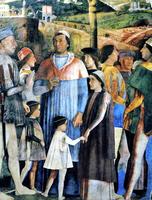
The House of Ludovico Gonzaga Bridegroom decorated wall and his son
Andrea Mantegna
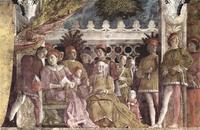
The court of the Gonzaga
Andrea Mantegna
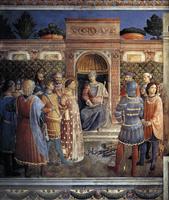
Condemnation of St. Lawrence by the Emperor Valerian
Fra Angelico
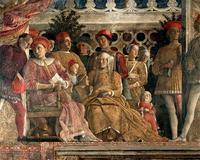
The court of the Gonzaga (detail)
Andrea Mantegna
April. Fresco in Palazzo Schifanoia (detail)
Francesco del Cossa
Allegory of March – Triumph of Minerva and Sign of Aries. Frescos in Palazzo Schifanoia (detail)
Francesco del Cossa
Heraclius Restores the Cross to Jerusalem
Piero della Francesca
Disembarkation at Ostia
Benozzo Gozzoli
Disputation in the Synagogue (detail)
Filippo Lippi
Procession of the Queen of Sheba
Piero della Francesca
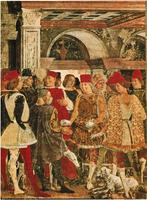
April. Fresco in Palazzo Schifanoia (detail)
Francesco del Cossa
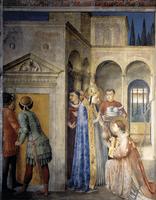
Saint Lawrence Receiving the Treasures of the Church from Pope Sixtus II
Fra Angelico
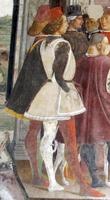
April. Frescos in Palazzo Schifanoia (detail)
Francesco del Cossa
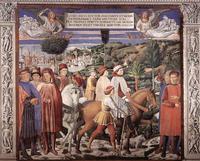
St. Augustine Departing for Milan
Benozzo Gozzoli
Disputation in the Synagogue
Filippo Lippi
The School of Tagaste
Benozzo Gozzoli
St. Lawrence on Trial
Fra Angelico
Procession of the Queen of Sheba (detail)
Piero della Francesca
Procession of the Queen of Sheba and Meeting between the Queen of Sheba and King Solomon
Piero della Francesca
St. Augustine Leaving His Mother
Benozzo Gozzoli