Analisi esperta di Women of Life di Jose Gutierrez Solana
Stile: Expressionism · Genere: genre painting
Expert Analysis: "Women of Life" by José Gutiérrez Solana
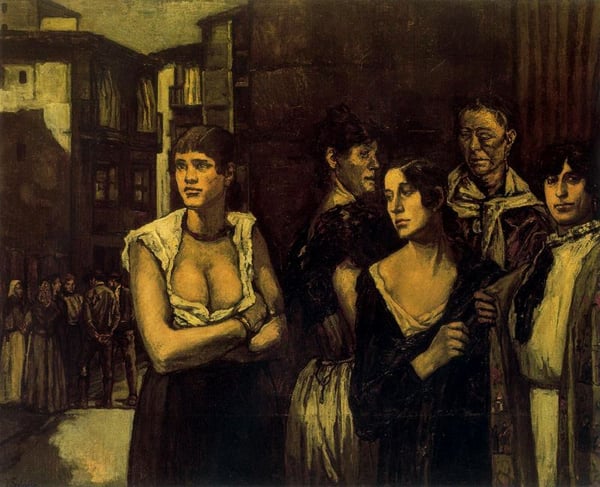
As an expressionist genre painting, "Women of Life" stands as a quintessential example of how early 20th-century Spanish Expressionism used everyday scenes to confront social realities with raw, unflinching intensity. Solana’s work belongs to the darker, more grotesque vein of the movement, where the mundane—here, the lives of women on the margins of society—becomes a vehicle for psychological and emotional truth.
Significance within Expressionism and Genre Painting:
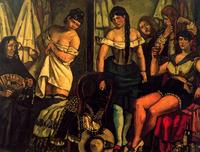
- Genre painting traditionally depicts scenes of daily life, often with warmth or moralizing overtones. Solana subverts this convention by stripping away sentimentality. In "Women of Life," the title itself suggests a focus on women whose existence is defined by struggle, survival, or social stigma—likely referencing sex workers or those living on society’s fringes. This aligns with Expressionism’s goal to portray inner experience and societal dysfunction, using distorted forms, jarring color, and harsh brushwork (as is characteristic of Solana’s style) to evoke discomfort and empathy.
- Significance: The painting is remarkable for its fusion of social realism and expressionist exaggeration. Solana does not simply document; he exaggerates features—elongated faces, heavy shadows, awkward poses—to convey the psychological weight of these women’s lives. This approach makes the work a powerful critique of early 20th-century Spanish society, where poverty and marginalization were often hidden behind pastoral or folkloric clichés.
- Within Solana’s oeuvre and Expressionism, the piece reflects the movement’s debt to El Greco’s spiritual intensity and Goya’s dark, satirical visions. By focusing on "women of life"—a term loaded with both vitality and condemnation—Solana forces viewers to confront the humanity behind societal labels, using the genre painting format as a mirror for uncomfortable truths.
Conclusion: "Women of Life" is significant because it transforms a conventional genre scene into a vehicle for expressionist protest. It exemplifies how Spanish Expressionism, through artists like Solana, leveraged the familiar to reveal the grotesque, the painful, and the overlooked—making it a key work in understanding the movement’s social conscience and aesthetic brutality.
Museum / Gallery
Visivamente simili
20 opere con composizione e palette affini
Women of Life
Jose Gutierrez Solana
Waiting for Bridal Couple's Return from a Church in Novgorod Province
Andrei Ryabushkin
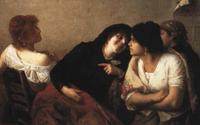
Mottos and laughter
Noè Bordignon
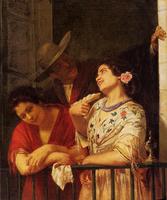
The Flirtation A Balcony in Seville
Mary Cassatt
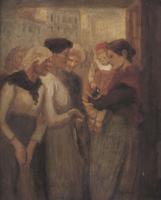
Women Conversing
Theophile Steinlen
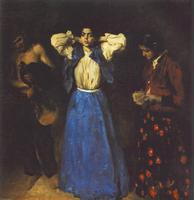
Gipsies
Karoly Ferenczy
Claudia Girls
Jose Gutierrez Solana
The Baptism
Ludwig Knaus
Café d'Italia
Christian Schad
Indoor dance
Joaquín Domínguez Bécquer
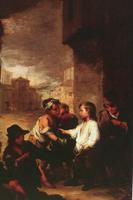
Saint Thomas of Villanueva dividing his clothes among beggar boys
Bartolome Esteban Murillo
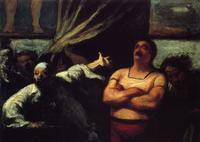
Barker at a fair booth
Honore Daumier
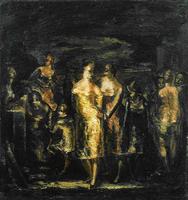
Figures
Alexander Bazhbeuk-Melikyan
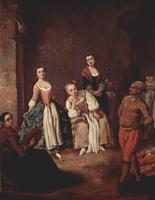
The furlana (Venetian dance)
Pietro Longhi
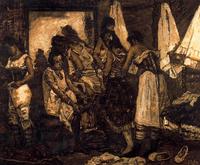
The Chorus Girls
Jose Gutierrez Solana
Women in Montemurlo
Vincenzo Cabianca
Dressing the Dead Girl (Dressing the Bride)
Gustave Courbet
Distinguished visit to a working-class family with a young child
Angelo Inganni
Raising of the Son of Theophilus and St Peter Enthroned
Nils Forsberg
A Visit from the Old Mistress
Winslow Homer