Analisi esperta di The Chorus Girls di Jose Gutierrez Solana
Stile: Expressionism · Genere: genre painting
Expert Analysis: "The Chorus Girls" by José Gutiérrez Solana
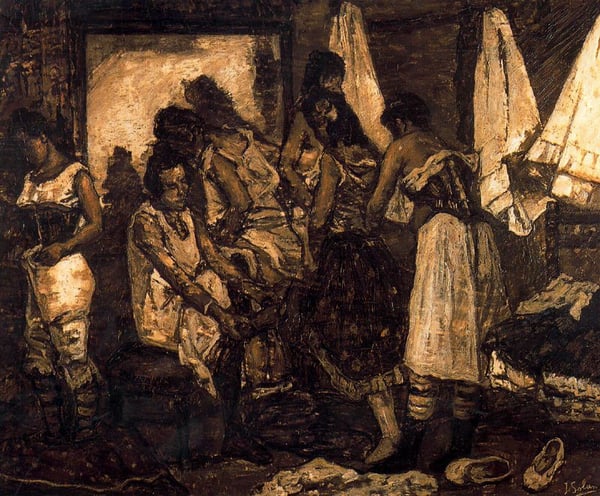
Within the canon of Spanish Expressionism, José Gutiérrez Solana’s The Chorus Girls stands as a profound and unsettling example of genre painting used for social critique. While many artists of the period celebrated the vibrancy of popular entertainment, Solana subverts the typical depiction of chorus girls by focusing on the grotesque, the melancholy, and the dehumanizing aspects of their trade.
Significance within Expressionism: Solana’s work is quintessential Expressionism in its deliberate distortion of form and color to convey psychological and emotional truth. The figures, likely rendered with heavy, dark outlines and a muted, earthy palette, appear almost mask-like or puppet-like—emphasizing the performers' mechanical existence. There is a palpable tension between the supposed cheerfulness of a chorus line and the grim, almost funereal atmosphere Solana injects. This aligns with Expressionism's mission to reveal the anguish beneath the surface of modern life, rejecting idealized beauty in favor of raw, often uncomfortable authenticity.
Significance within Genre Painting: As a genre painting, The Chorus Girls documents a specific slice of early 20th-century Spanish urban life. However, Solana elevates the scene beyond mere documentation. Where other genre painters might seek charm or narrative, Solana’s eye is clinical and empathetic. He captures the stiffness of the poses, the uniformity of the costumes, and the exhausted, vacant stares of the women. This turns the painting into a silent commentary on exploitation, economic hardship, and the loss of individuality in the spectacle of entertainment. The chorus girls become symbols of a broader societal malaise—a recurring theme in Solana’s oeuvre, which often fixated on the margins of society, from prostitutes to beggars.
Overall Significance: The Chorus Girls is significant because it embodies the dark, introspective, and critical spirit of Spanish Expressionism. It refuses to glamorize its subjects, instead forcing the viewer to confront the human cost of performance. Solana’s ability to blend the mundane with the macabre, and to find the tragic within the theatrical, makes this work a powerful artifact of a period grappling with modernity, poverty, and alienation.
Visivamente simili
20 opere con composizione e palette affini
Dressing the Dead Girl (Dressing the Bride)
Gustave Courbet
Claudia Girls
Jose Gutierrez Solana
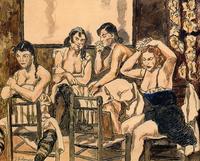
Village Cupletista
Jose Gutierrez Solana
Venus and Cupid
Felicien Rops
The brood
Alessandro Milesi
Bathers
Alexey Venetsianov
Breakfast after Bath
Edgar Degas
In tailoring (Embroiderers)
Giacomo Favretto
Дівчата ворожать
Микола Пимоненко
Young Woman in the Atelier
Janos Tornyai
A Visit from the Old Mistress
Winslow Homer
Waiting for Bridal Couple's Return from a Church in Novgorod Province
Andrei Ryabushkin
The young teacher
Giacomo Favretto
Women of Life
Jose Gutierrez Solana
Woman in Black Stockings
Pierre Bonnard
The betrothal of the children
Nikolaos Gyzis
In a Laundry
Edgar Degas
Study for 'A summer morning'
Rupert Bunny
Barracks
Taras Shevchenko
Salome brings head of Saint John the Baptist to her mother Herodias
Vasily Surikov