
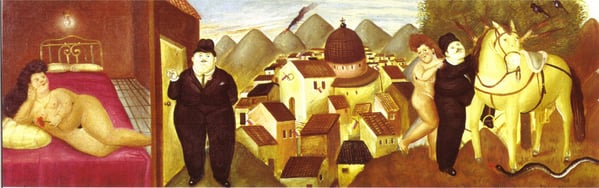
Expert analysis of Fernando Botero’s The Murder of Anna Rosa Caderonne (1)
Style: Naïve Art (Primitivism) · Genre: genre painting
Expert Analysis of "The Murder of Anna Rosa Caderonne (1)" by Fernando Botero
This work occupies a striking position within Fernando Botero’s oeuvre, leveraging the stylistic hallmarks of Naïve Art (Primitivism) to deliver a powerful commentary on violence and human vulnerability. While Botero is globally celebrated for his signature "Boterismo" style—characterized by voluminous, inflated figures—this painting explicitly channels the directness, flatness, and emotional rawness associated with naïve and primitive traditions. The genre is genre painting, yet the subject matter subverts the typically domestic or folkloric scenes of that category.
The significance of this piece lies in its jarring juxtaposition of form and content. Botero employs the childlike simplicity of naïve art—its bold outlines, simplified anatomy, and candid perspective—to depict a brutal act: the murder of a woman named Anna Rosa Caderonne. The rounded, almost plump figures (a Botero trademark) here become deeply unsettling. Their exaggerated physicality does not soften the violence; instead, it amplifies the grotesqueness, as the sweet, cartoonish aesthetic clashes with the grim reality of the subject. This contrast forces viewers to confront the horror without the buffer of traditional realism or heroic drama.
In the context of Primitivism, Botero draws on the movement’s interest in "unlearned" or "raw" visual languages. However, he does not use this style to evoke purity or nostalgia, but rather to expose the absurdity of violence. The painting can be read as a social critique—common in Botero’s work—particularly regarding Colombia’s history of political and criminal violence. By presenting murder through the lens of naïve art, Botero suggests that such atrocities exist as a matter-of-fact, almost routine occurrence in certain spheres, yet their emotional weight is no less devastating.
This work is also significant for its challenge to the expectations of naïve painting. Normally associated with idyllic, celebratory, or religious themes, naïve art here becomes a vehicle for trauma. Botero thus expands the expressive range of the style, demonstrating that its apparent simplicity can accommodate the most complex and disturbing human experiences. In doing so, he affirms that even the most innocent-seeming visual language can be used to demand a response to injustice.
Visually similar
20 works with related composition and palette
The Murder of Anna Rosa Caderonne (2)
Fernando Botero

The Dream
Franz Marc
Lovers
Fernando Botero
L'attesa
Carlo Carra
The Family of the President
Fernando Botero
Room with Children's Games
Fernando Botero
Heat
Florine Stettheimer
By the Outdoor Photographer
Yiannis Moralis
In the Village
Grégoire Michonze
The First Day of Spring
Salvador Dali
Man and Woman (Adam and Eve)
Pavel Filonov
Red Roofs
Marc Chagall

Paul Ranson
Paul Ranson
Immortality
Max Ernst
In the Village
Grégoire Michonze
White birds
Ivan Generalic
Family Excursions
Max Ernst
Portrait of a Family
Fernando Botero
Scene de village
Grégoire Michonze

Veranda
Albert Bloch