Analisi esperta di Man in a Tuxedo di Fernando Botero
Stile: Naïve Art (Primitivism) · Genere: portrait
Expert Art Historical Analysis: "Man in a Tuxedo" by Fernando Botero
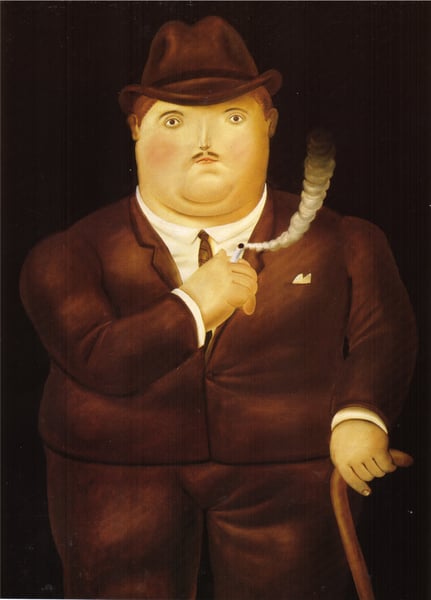
Fernando Botero’s Man in a Tuxedo is a quintessential example of his signature style—often classified within Naïve Art and Primitivism for its deliberate rejection of academic naturalism in favor of exaggerated, rounded forms. Though Botero’s work is sometimes described as "Boterismo," the provided framework of Naïve Art (Primitivism) highlights the work’s kinship with folk-art directness, flatness, and a childlike sense of volume. This portrait, however, is far from simplistic; it is a sophisticated commentary on power, formality, and the human condition.
Significance within Botero’s Oeuvre and the Naïve/Primitivist Tradition
- Volumetric Distortion as Identity: The most arresting feature is the subject’s swollen, balloon-like proportions—a hallmark of Botero’s mature style. This is not mere caricature but a philosophical statement. By inflating the figure, Botero challenges the Western ideal of the lean, classical body. The tuxedo, a symbol of formal, bourgeois respectability, becomes paradoxically absurd and monumental. The man’s round face, tiny hands, and compressed features within a plump head create a tension between dignity and the grotesque, a central concern of Primitivist artists who sought to disrupt European conventions of beauty.
- Naïve Aesthetics and Deliberate Simplicity: The painting’s flat, unmodulated color planes and minimal background recall the work of Henri Rousseau (a key Primitivist), yet Botero adds his own twist: a razor-sharp elegance. The black of the tuxedo and the crisp white of the shirt are rendered with a decorative, almost graphic clarity. This apparent naivety is highly controlled—every curve and shadow is calculated to emphasize volume without illusionistic depth. The subject stares directly at the viewer with a placid, inscrutable expression, borrowing from both folk portraiture and the stoic tradition.
- Genre and Social Commentary: As a portrait, Man in a Tuxedo subverts the genre’s historical function. Botero does not flatter the sitter nor provide psychological insight; instead, he uses the portrait to explore formal properties of shape and scale. The tuxedo—an attire of ceremony and status—is rendered so inflated that it seems to strangle the wearer, suggesting the weight of social roles. This aligns with Primitivism’s critique of modern, “civilized” life by presenting a vision of humanity that is both comical and deeply human.
- Legacy: The painting is significant as a bridge between Naïve Art and contemporary Latin American avant-garde. Botero’s figures are instantly recognizable, and Man in a Tuxedo demonstrates how a seemingly simple style can carry complex ideas about identity, culture, and the visual language of power. It remains a powerful example of how Primitivist strategies can be deployed not to fetishize the “other” but to critique the familiar.
Visivamente simili
20 opere con composizione e palette affini
Man Smoking
Fernando Botero
The Street
Fernando Botero
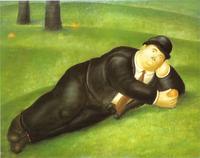
Man Reclining
Fernando Botero
Scheiber Hugó Cigarettás Önarckép
Scheiber Hugó
Of Things To Come
Georg Scholz
Self Portrait
Maurice de Vlaminck
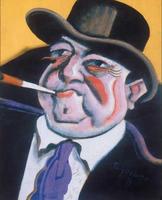
Scheiber Hugó, Önarckép Lila Nyakkendővel
Scheiber Hugó
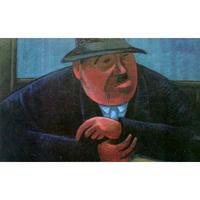
Trader
Werner Berg
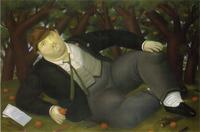
The Poet
Fernando Botero
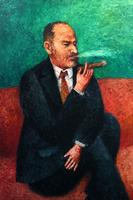
Self Portrait
Alexander Roitburd
The Siesta
Fernando Botero
Scheiber Hugó, Önarckép Cigarettával,.
Scheiber Hugó
Oscar Miestchaninoff
Amedeo Modigliani
The Musicians
Fernando Botero
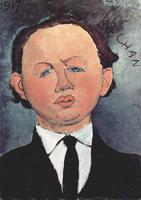
Portrait of the Mechanical
Amedeo Modigliani
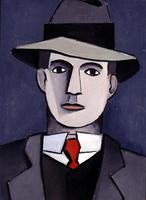
Untitled
Jean Helion
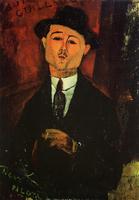
Paul Guillaume
Amedeo Modigliani
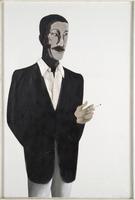
Norman Lewis
Benny Andrews
Scheiber Hugó, Kapaos Férfi,.
Scheiber Hugó
Fisherman Smoking A Cigarette
Louay Kayyali