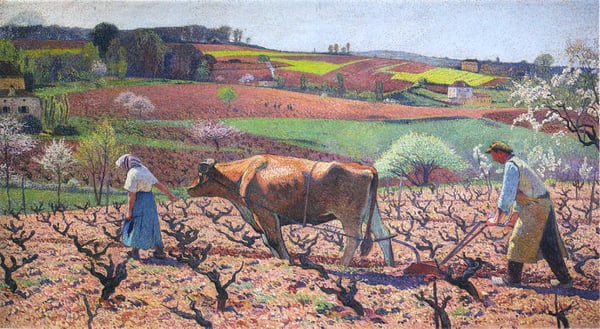
Laborers Prepare the Vines in Quercy
Expert analysis of Henri Martin’s Laborers Prepare the Vines in Quercy
Style: Divisionism · Genre: genre painting
Expert Analysis: "Laborers Prepare the Vines in Quercy" by Henri Martin
Henri Martin’s Laborers Prepare the Vines in Quercy exemplifies the synthesis of Divisionist technique with the genre painting tradition, creating a work that is both a scientific study of light and a lyrical celebration of rural life. Executed in the Divisionist style—a method derived from Neo-Impressionism in which small, distinct dots of pure color are applied to the canvas so that they optically blend at a distance—Martin transforms a mundane agricultural scene into a shimmering, atmospheric tableau.
What makes this painting significant within its period is Martin’s ability to infuse the rigorous, almost scientific color theory of Divisionism with a warm, humanistic narrative. While Divisionism was often associated with urban or coastal landscapes (as in the works of Seurat or Signac), Martin adapts it to a specifically regional, agrarian subject: laborers tending vines in the Quercy region of southwestern France. The careful placement of complementary hues—for instance, juxtaposing green vine leaves with touches of violet shadow or orange highlights in the soil—generates a vibrant, luminous surface that suggests the heat and dappled light of a working day, while the dot technique itself echoes the patient, repetitive toil of the figures.
As a genre painting, the work elevates everyday rural labor to a subject worthy of modernist exploration. Martin does not romanticize his laborers as heroic archetypes; rather, he positions them as integral, rhythmic elements of the landscape. The figural groups are composed with a frieze-like stability, their movements harmonizing with the organic patterns of the vines. This fusion of Divisionist optical vibrancy with genre-painting intimacy marks Martin as a distinctive voice in Post-Impressionism—one who used the method not for detached formal exercises but to capture the enduring, sunlit dignity of place and work. The painting thus stands as a key example of how Divisionism could be domesticated and regionalized, bridging avant-garde color theory with the timeless subject of human connection to the land.
Visually similar
20 works with related composition and palette
Rest in the fields
Niccolo Cannicci
Labour Dans Le Jorat
Eugène Burnand
Descanso
Arthur Nísio
Late summer
Hugo Mühlig
Plowing in the Nivernais
Rosa Bonheur
Feldarbeit
Herman Johannes van der Weele
Ploughman with Woman Planting Potatoes
Vincent van Gogh
Oxen Plowing
Rosa Bonheur
Ploughing
Stefan Dimitrescu
Nice landscape with Ox and farmer
Nikolay Bogdanov-Belsky
12. Plowing the Clearing
Francis Davis Millet
Oxen Ploughing
Clarence Gagnon
Der Landmann
Eugène Burnand
Oxcart
Nicolae Grigorescu
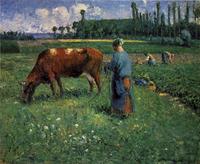
Girl Tending a Cow in Pasture
Camille Pissarro
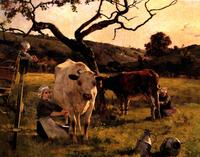
The Milking
Arturo Michelena
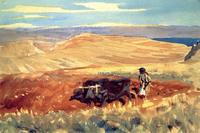
Hills of Galilee
John Singer Sargent
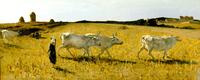
Pastures in Castiglioncello
Telemaco Signorini
Plowing in Ukraine
Leon Wyczółkowski
Bullocks
Valentin Serov