Expert Analysis: “The Vert and the first houses of Labastide” by Henri Martin
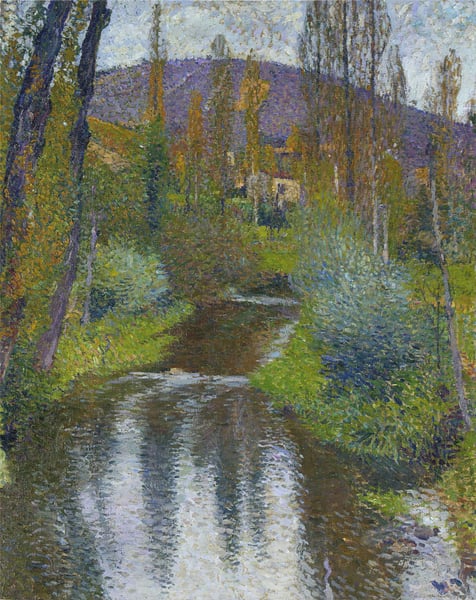
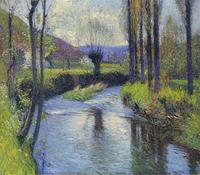
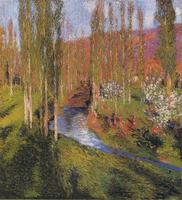
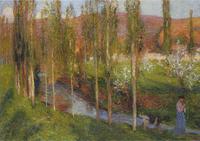
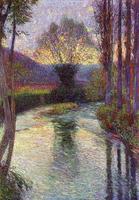
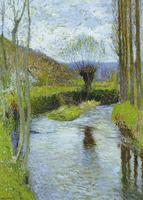
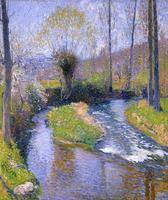
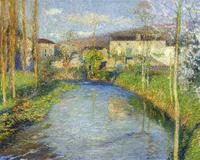
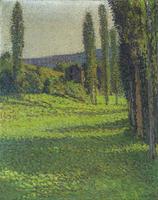
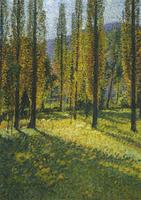
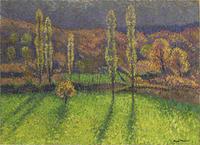
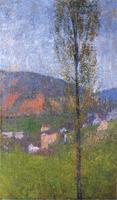
Henri Martin’s “The Vert and the first houses of Labastide” exemplifies the Divisionist commitment to optical color mixing, applied here to a serene landscape. As a work in the Divisionist style—a technique derived from Neo-Impressionism in which small, distinct dots or strokes of pure color are placed side by side to be blended by the viewer’s eye—this painting transforms a simple rural view into a vibrant, luminous scene.
What makes this artwork significant is Martin’s ability to marry the scientific rigor of Divisionism with a poetic, almost dreamlike treatment of the ordinary. The subject—the “Vert” (likely a green area or stream) and the first houses of the village of Labastide—is rendered not through descriptive outlines but through a mosaic of separate touches. The landscape becomes a field of optical energy: greens, blues, ochres, and whites vibrate against one another, capturing the flicker of sunlight across leaves, grass, and stone.
Within the Divisionist movement, Martin stands out for his lyrical interpretation. Unlike Seurat’s more geometric, still compositions, Martin’s Divisionism retains a soft, atmospheric quality. Here, the boundary between the natural “Vert” and the man-made houses dissolves into a unified tapestry of color and light, suggesting harmony between human settlement and the land. This work is significant as a testament to how Divisionism could be adapted to depict not just grand urban scenes but also intimate, quiet landscapes—infusing them with a timeless, shimmering vitality.