The Vert
Expert analysis of Henri Martin’s The Vert
Style: Divisionism · Genre: landscape
Expert Art Historical Analysis: "The Vert" by Henri Martin
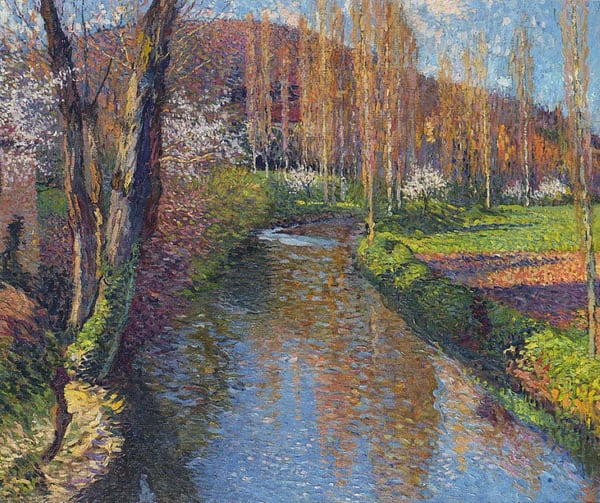
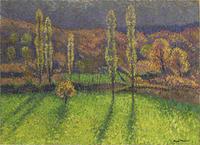
Henri Martin’s “The Vert” stands as a compelling example of late 19th‑century Divisionism applied to landscape, revealing how the technique could transcend scientific precision to achieve a lyrical, atmospheric vision. Martin was a key figure in the second generation of Neo‑Impressionists, and this work demonstrates his distinctive synthesis of Georges Seurat’s pointillist method with a more fluid, personal handling of color and light.
Divisionist Technique and Landscape Significance
True to Divisionist principles, Martin builds the scene from small, separate strokes of pure pigment—dots and short dashes of complementary colors that optically blend when viewed from a distance. Yet unlike the more rigid, systematic approach of Seurat, Martin’s touch is softer and more varied. In “The Vert,” the greens, blues, and yellows are not merely scientific separations; they pulse with life, suggesting the shimmer of foliage, the play of sun on grass, and the moist air of a lush landscape. The title itself (“The Vert,” French for green) emphasizes the centrality of verdant tones, but Martin avoids monotony by weaving in tiny accents of violet and orange, creating a vibration that evokes the sensory experience of being in nature.
What Makes This Work Historically Significant
-
Martin’s Personal Evolution within Divisionism – While many Neo‑Impressionists remained faithful to Seurat’s dogma, Martin began to loosen the dot into more expressive, rhythmic strokes. “The Vert” captures this transitional moment, where the optical theories of Divisionism are still fully employed, but the artist’s emotive response to the landscape overrides pure theory. This work thus anticipates the move toward Post‑Impressionist freedom.
-
Atmospheric Luminosity over Form – Instead of focusing on clear, structured forms, Martin prioritizes the overall atmosphere. The trees, sky, and ground dissolve into a mosaic of color patches. This approach highlights Divisionism’s power to render light effects not as static shadows but as dynamic, interdependent fields of color. “The Vert” becomes a study of how green itself can be infinitely varied—cool, warm, saturated, muted—depending on near and neighboring hues.
-
Integration of Nature and Technique – Martin’s landscapes are often described as “poetic” because they fuse the rigorous optical science of Divisionism with a Romantic sensitivity to nature’s moods. In “The Vert,” the method never overshadows the subject; rather, the technique becomes the very medium through which the viewer feels the quiet vibrancy of a secluded green space. This balance marks Martin’s significant contribution to the movement: he demonstrated that Divisionism could be both structurally sound and profoundly evocative.
Conclusion
“The Vert” is not merely a landscape painted with dots—it is a record of how Henri Martin pushed Divisionism beyond its origins as a laboratory of color theory, transforming it into a vehicle for intimate, atmospheric expression. The work’s significance lies in its seamless fusion of method and emotion, its masterful modulation of a single color (green) across countless hues, and its place in the evolution from Neo‑Impressionist system to a more personal, modern sensibility.
Visually similar
20 works with related composition and palette
The Vert and the first houses of Labastide
Henri Martin
Valle du Vert with Shepherdess
Henri Martin
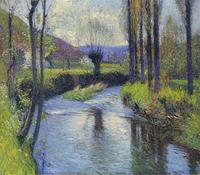
The Willow
Henri Martin
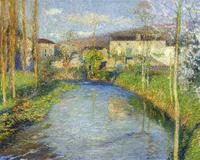
The Green Lot
Henri Martin
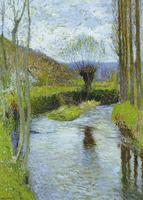
River Vert in Spring
Henri Martin
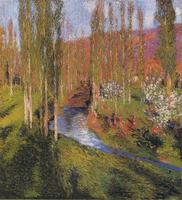
Poplars on the Edge of Vert
Henri Martin
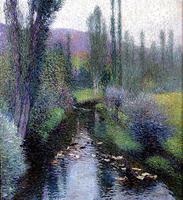
Ducks on the Vert
Henri Martin
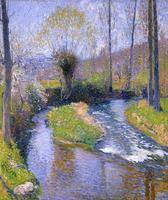
River Vert
Henri Martin
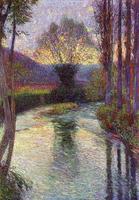
Reflected Willow on the Green
Henri Martin
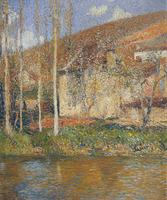
The House on Water
Henri Martin
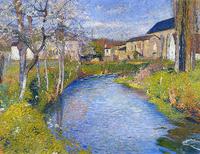
The Labastide du Vert in Spring
Henri Martin
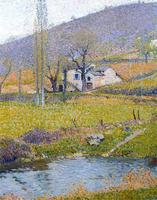
Labastide du Vert
Henri Martin
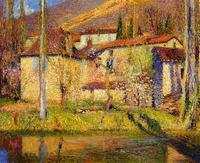
Landscape near Toulouse
Henri Martin
Near the Seine at By
Alfred Sisley
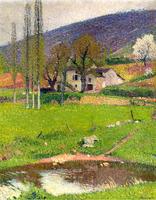
Landscape near Toulouse
Henri Martin
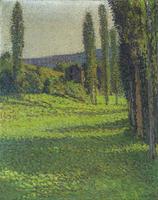
By the Fields
Henri Martin
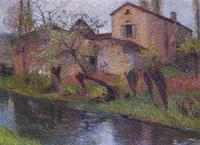
Marie Louise House
Henri Martin
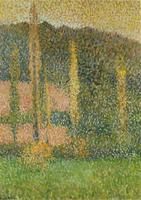
On The Prairie
Henri Martin
The Prairie
Henri Martin
Lakeside trees
Istvan Nagy