Muse in the Fields
Análisis experto de Muse in the Fields de Henri Martin
Estilo: Divisionism, Symbolism · Género: allegorical painting
Expert Analysis: "Muse in the Fields" by Henri Martin
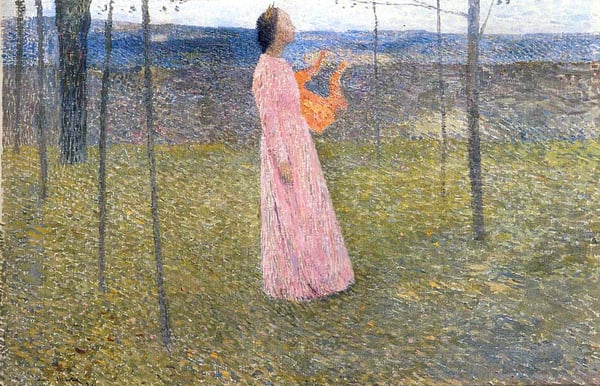
Henri Martin’s “Muse in the Fields” stands as a compelling synthesis of two late‑19th‑century movements: Divisionism and Symbolism. Its significance lies in how Martin employs the rigorous, scientific color theory of Divisionism not merely for optical effect, but as a vehicle for Symbolist meaning—transforming a pastoral landscape into a meditation on the union of nature, creativity, and the divine.
Divisionist Technique as Emotional Language
True to the Divisionist method, Martin builds the canvas with individual strokes of pure, unmixed pigment applied in systematic dabs. Seen from a distance, these dots fuse optically to create luminous, vibrating surfaces. In “Muse in the Fields,” this technique is particularly effective in rendering dappled light filtering through leaves, the shimmer of distant fields, and the hazy atmosphere of an idealised countryside. The repetitive, mosaic‑like application evokes a sense of timeless reverie, slowing the viewer’s gaze and encouraging contemplation—a deliberate departure from the hurried impressionist sketch.
Symbolist Allegory
The title explicitly identifies the female figure as a Muse—a classical personification of artistic inspiration. She is placed not in a studio or on Mount Helicon, but in an ordinary field, suggesting that creative energy is immanent in the natural world. Her pose is meditative, perhaps with a musical instrument or a book, but details are softened into atmospheric suggestion. The Symbolist dimension emerges through this indistinctness: the Muse is both present and ethereal, a being of spirit and light rather than flesh. The fields themselves become a liminal space between the real and the ideal.
Significance Within the Period
Martin’s work is notable for bridging Post‑Impressionist technique with Symbolist philosophy. While Georges Seurat and Paul Signac applied Divisionism to modern urban or leisure scenes, Martin turns the method toward allegorical and poetic themes. This aligns him with the Symbolist generation of artists and writers who sought to evoke inner states and universal truths through stylized, dreamlike imagery. The painting also reflects the period’s nostalgia for a pre‑industrial, harmonious world—a recurring motif in late‑19th‑century French art.
In summary, “Muse in the Fields” is significant because it demonstrates that Divisionism could serve more than a decorative or naturalistic purpose; here it becomes a spiritual instrument, making the invisible presence of inspiration visible through the very fabric of paint and light.
Visualmente similares
20 obras con composición y paleta relacionadas
Poetesses on a Lake Shore
Henri Martin
Orpheus in a Wood
Henri Martin
A woman walking in garden
Vincent van Gogh
Woman in Grey in a Lane
Edouard Vuillard
Landscape with Figure in Pink
Robert Henri
The Rose Robe
Henri Martin
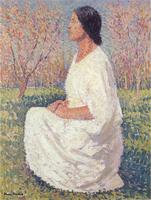
The Muse
Henri Martin
The Couple
Georges Seurat
Ladies In A Wood
Arthur Hacker
Woman with a Monkey
Georges Seurat
The Voice
Edvard Munch
Sheperd and sheperdess in a meadow
Paul Gauguin
Young Girl Reading
Henri Martin
Daughters of the Sun
Janis Rozentāls
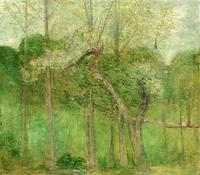
Landscape with Steeple, Wyndham
Julian Alden Weir
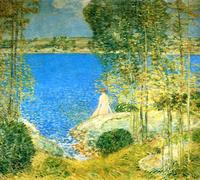
The Bather
Childe Hassam
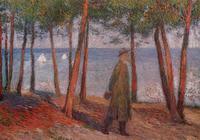
Philosopher
Henri Martin
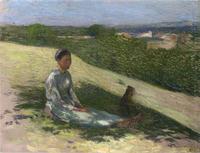
Young Peasant Girl and Her Dog
Henri Martin
Conversation
Paul Gauguin
Vestale
Kimon Loghi