
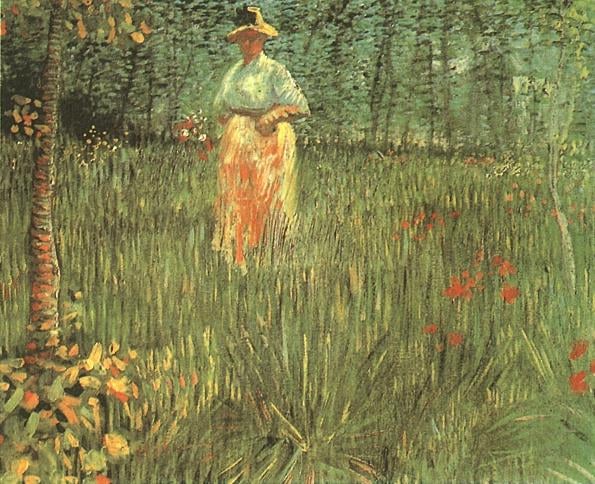
Expert analysis of Vincent van Gogh’s A woman walking in garden
Style: Neo-Impressionism · Genre: genre painting
Expert Analysis: "A Woman Walking in Garden" by Vincent van Gogh
This work occupies a fascinating crossroads in van Gogh’s career, where the disciplined technique of Neo-Impressionism meets the genre-painting tradition of capturing everyday life. Painted during his Paris period (circa 1886–1888), the piece reflects van Gogh’s brief but intense embrace of pointillist color theory and divided brushwork—hallmarks of the Neo-Impressionist style pioneered by Seurat and Signac.
Significance within Neo-Impressionism:
Van Gogh was never a doctrinaire follower of Neo-Impressionism; instead, he adapted its scientific approach to color to serve his own expressive aims. In A Woman Walking in Garden, the typically systematic dots and dashes of pure color are loosened and energized, creating a surface that vibrates with emotional intensity rather than static optical mixing. The garden setting becomes a laboratory for juxtaposing complementary hues—blues against oranges, greens against reds—to heighten the sensation of light and atmosphere. This personalization of Neo-Impressionist technique foreshadows van Gogh’s later, more turbulent style while proving that the movement could be a vehicle for psychological expression, not merely optical realism.
Significance within Genre Painting:
As a genre scene, the painting elevates a commonplace motif—a solitary woman strolling through a garden—into a moment of heightened perception. The figure is integrated into the landscape through rhythmic strokes that unify her dress with the foliage, suggesting a harmony between human and nature that van Gogh would continue to explore in Arles. Unlike the detached, observational quality of many earlier genre works, this painting invites the viewer into a subjective, almost meditative experience of the ordinary.
Overall Contribution:
A Woman Walking in Garden exemplifies how van Gogh used Neo-Impressionist color theory not as an end in itself, but as a springboard for a more personal, emotional mode of painting. It stands as a key transitional work that bridges the analytical color experiments of Paris with the raw, symbolic landscapes that would define his legacy.
Visually similar
20 works with related composition and palette
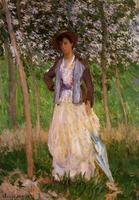
The Stroller (Suzanne Hoschede)
Claude Monet
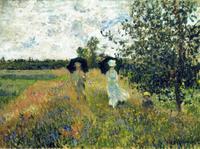
The Promenade near Argenteuil
Claude Monet
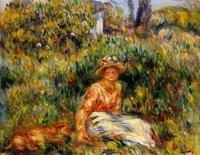
Young Woman in a Garden
Pierre-Auguste Renoir
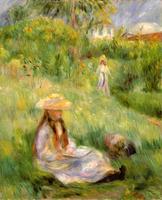
Young Girl in the Garden at Mezy
Pierre-Auguste Renoir
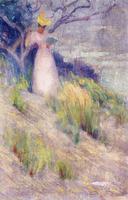
Landscape with Figure in Pink
Robert Henri
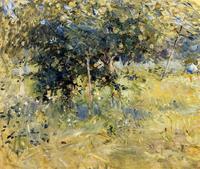
Willows in the Garden at Bougival
Berthe Morisot
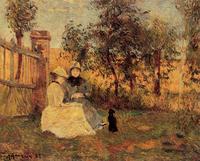
Conversation
Paul Gauguin
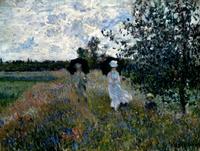
Promenade near Argenteuil
Claude Monet
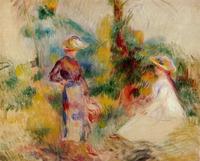
Two Women in a Garden
Pierre-Auguste Renoir
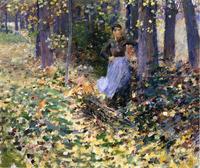
Autumn Sunlight
Theodore Robinson
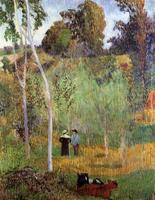
Sheperd and sheperdess in a meadow
Paul Gauguin
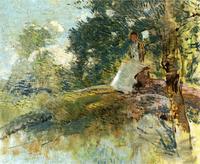
Landscape with Seated Figure
Julian Alden Weir
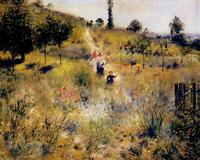
Path Leading through Tall Grass
Pierre-Auguste Renoir
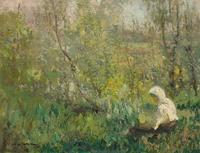
Peasant Woman Resting
Arthur Verona
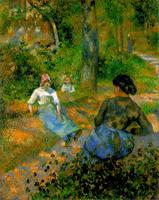
Peasants Resting
Camille Pissarro
Spring at Catou
Pierre-Auguste Renoir
Alice Hoschede in the Garden
Claude Monet
A Summer Morning Tiff
Tom Roberts
Campaign with a female figure
Silvestro Lega
In The Woods At Giverny Blanche Hoschede
Claude Monet