Expert analysis of Henri Martin’s Pergola at the South Door of Marquayrol
Style: Divisionism · Genre: cityscape
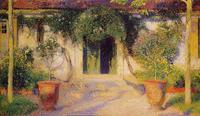
Expert Analysis: "Pergola at the South Door of Marquayrol" by Henri Martin
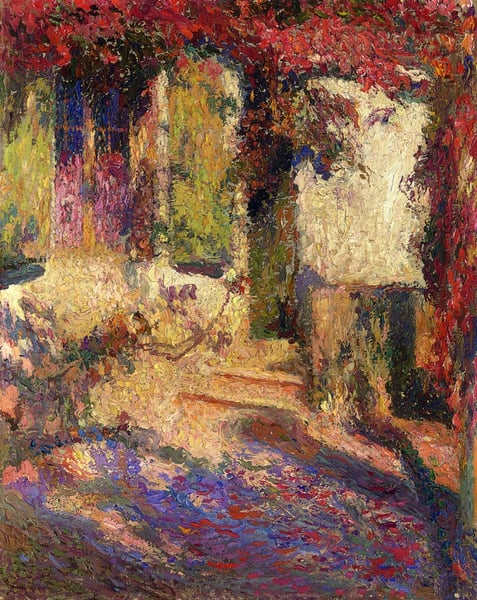
This work is a quintessential example of Henri Martin’s mature Divisionist style, showcasing how he transformed the rigorous, scientific color theory of Georges Seurat and Paul Signac into a more lyrical, atmospheric vision. Painted in the early 20th century, likely at the artist’s beloved home in Marquayrol (in the Lot region of France), the piece captures a quiet corner of his garden with a pergola and a doorway—a subject that Martin returned to repeatedly, making it a personal and artistic signature.
Significance within Divisionism: While Divisionism is often associated with precise, dot-by-dot color separation, Martin’s approach is notably softer and more rhythmic. Here, he uses short, broken touches of pure color—not tiny dots but small comma-like strokes—to build form and light. This technique allows the warm sun-dappled foliage and the cool shadow of the pergola to vibrate with optical mixing, creating a shimmering, almost dreamlike atmosphere. The cityscape genre is subtly redefined: the "city" is instead a domestic garden architecture, where human-made structure (the pergola, the door) harmonizes with nature. The south door, bathed in light, becomes a threshold between interior and exterior, solid and ephemeral.
Art-Historical Context: Martin was one of the leading French Divisionists after Seurat’s death, but he departed from pure Pointillism by allowing individual brushstrokes to express texture and emotion. In Pergola at the South Door of Marquayrol, the division of color is employed not as a mechanical system but as a poetic device to capture the fleeting quality of Mediterranean light. The palette—predominantly greens, ochres, and soft blues—is both naturalistic and intensely decorative, reflecting Martin’s interest in Symbolist mood. The work’s significance lies in its bridging of Impressionist immediacy with Post-Impressionist structure: the pergola’s trellis provides a geometric frame, while the dappled paint surface dissolves the scene into a mosaic of light and color.
Why It Matters: This painting exemplifies how Divisionism, often seen as rigid, could become a vehicle for personal expression. Martin’s use of the pergola motif—a recurring feature in his Marquayrol garden—anchors the work in a specific place while elevating it into a meditation on luminosity and tranquility. It stands as a testament to the enduring appeal of Divisionism beyond the 1880s, proving that the style could evolve into a sensitive, intimate idiom for depicting the quiet poetry of everyday life.
Museum / Gallery
Visually similar
20 works with related composition and palette
At the Pergola
Henri Martin
Mother and Child in the Garden
Henri Martin
The open door
Henri Martin
Facade of the House
Henri Martin
Sunny Doorway
Henri Martin
Garden Court
Henri Martin
Terrace in Sun
Henri Martin
Doorway into the House
Henri Martin
The Pergola
Henri Martin
The Garden in Marquayrol
Henri Martin
The House in Giverny
Frederick Carl Frieseke
The Facade of Marquayrol
Henri Martin
House and Garden at Saint-Cirq-Lapopie
Henri Martin
The Artist's House at Argenteuil
Claude Monet
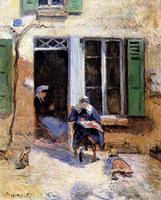
Woman and Child Doing Needlework
Camille Pissarro
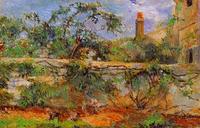
Party wall
Paul Gauguin
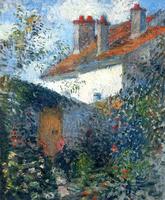
Study at Pontoise
Camille Pissarro
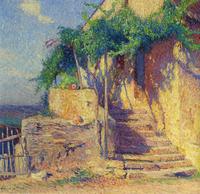
House with Vine and Staircase
Henri Martin
The Green Door
Henri Martin
The Terrace, St. Tropez
Henri Matisse