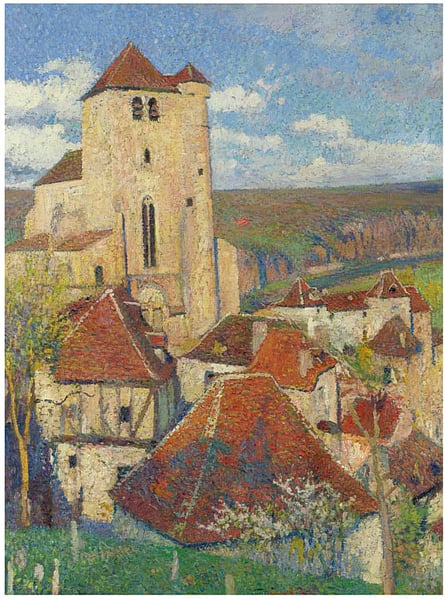
The Village Saint Cirq Lapopie
Expert analysis of Henri Martin’s The Village Saint Cirq Lapopie
Style: Post-Impressionism · Genre: cityscape
Expert Analysis: "The Village Saint Cirq Lapopie" by Henri Martin
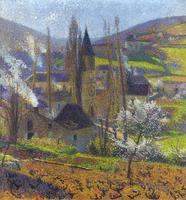
Henri Martin’s The Village Saint Cirq Lapopie exemplifies the mature phase of Post-Impressionism, where the artist synthesized Neo-Impressionist technique with a deeply personal, lyrical vision. Painted in the late 19th or early 20th century, this cityscape captures the iconic, cliff-perched medieval village in the Lot region of southern France—a site that became a recurring motif for Martin.
Stylistic Significance: Martin was a leading exponent of Divisionism (or Pointillism), a method derived from Georges Seurat and Paul Signac, in which small, distinct dots of pure color are applied in patterns to form an image. However, Martin’s touch is looser and more atmospheric than strict Pointillism. In this work, he uses shimmering, hatched strokes of complementary colors—blue-violet and yellow-orange, green and rose—to construct the sunlit facades and rocky precipice. The result is a vibrancy that respects natural light while asserting the painter’s emotional response. His handling of the village’s verticality—tiered houses climbing toward the church tower—demonstrates a Post-Impressionist concern with structure and rhythm, akin to Cézanne’s geometric order but softened by a more delicate palette.
Genre and Subject: As a cityscape, the painting transcends mere topographical record. Martin elevates Saint Cirq Lapopie into a symbol of timeless rural harmony. The interplay of architecture and nature is central: the village appears almost organically grown from the limestone cliff, its roofs and walls catching the Mediterranean clarity of the light. Martin’s brushwork imbues the stone with warmth, while the deep blue sky and verdant hillsides frame the composition with a serene, almost mystical balance.
Significance within Post-Impressionism: What makes this work significant is Martin’s ability to fuse the scientific color theory of Neo-Impressionism with a poetic, nostalgic sensibility. He avoids the detachment of early Pointillism; instead, every dappled stroke seems charged with affection for the place. The Village Saint Cirq Lapopie stands as a bridge between the analytical rigor of Seurat and the expressive freedom of later Fauvism—a testament to how Post-Impressionism could render a humble village as a vision of luminous, enduring beauty.
Visually similar
20 works with related composition and palette
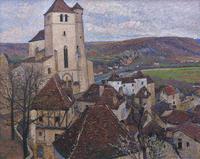
Saint Cirq Lapopie
Henri Martin
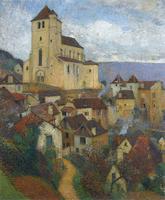
Saint Cirq Lapopie
Henri Martin
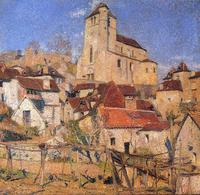
Saint Cirq Lapopie over the Roofs
Henri Martin
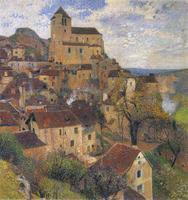
Saint Cirq Lapopie
Henri Martin
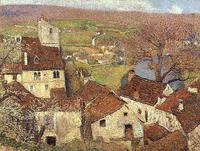
The Cirque
Henri Martin
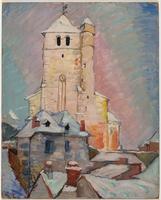
Untitled (Church in snow with rose sky)
Pierre Daura
The Center of La Bastide du Vert
Henri Martin
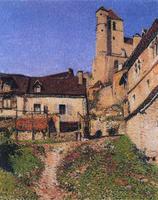
Village Corner
Henri Martin
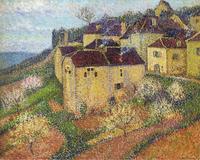
Houses at Saint Cirq Lapopie
Henri Martin
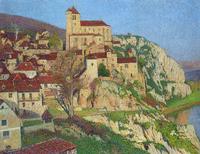
Cliff with Houses
Henri Martin
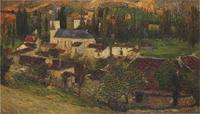
The Village among the trees
Henri Martin
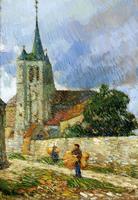
Village Scene, Breton
Childe Hassam
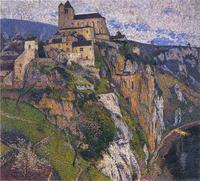
Saint Cirq Lapopie in the Rain
Henri Martin
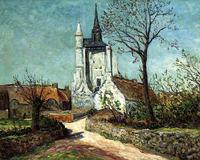
The Village and Chapel of Sainte-Avoye (Morbihan)
Maxime Maufra
The old house
Henri Martin
Saint Cirq Lapopie
Henri Martin
Landscape with House
Henri Martin
View of Labastide du Vert
Henri Martin
Labastide in Spring behind the Presbytere
Henri Martin
View of Osny near Pontoise
Camille Pissarro