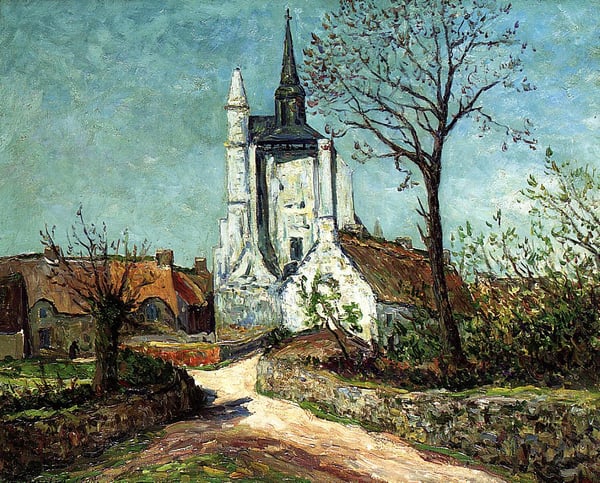
The Village and Chapel of Sainte-Avoye (Morbihan)
Dettagli
Analisi esperta di The Village and Chapel of Sainte-Avoye (Morbihan) di Maxime Maufra
Stile: Post-Impressionism · Genere: landscape
Expert Art Historical Analysis: "The Village and Chapel of Sainte-Avoye (Morbihan)" by Maxime Maufra
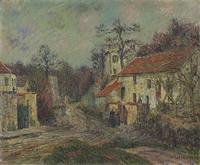
Maxime Maufra’s The Village and Chapel of Sainte-Avoye (Morbihan) stands as a compelling example of Post-Impressionist landscape painting, distinguished by its deliberate synthesis of observed nature and subjective expression. As a work firmly rooted in the Post-Impressionist ethos, it moves beyond the fleeting optical effects of Impressionism toward a more structured, emotive, and symbolically resonant treatment of the Breton countryside.
Significance within Post-Impressionism:
-
Emphasis on Structure and Design: While Maufra retains the vibrant palette and outdoor light sensibility inherited from Impressionism, his composition here demonstrates a Post-Impressionist concern for geometric order and pattern. The village and chapel are not merely atmospheric impressions; they are rendered with firm contours and a clear sense of architectural mass, anchoring the scene against the natural surroundings. This reflects the broader Post-Impressionist shift—seen also in Cézanne and Gauguin—toward using form to convey depth and permanence rather than transient sensation.
-
Subjective, Expressive Color: The painting’s significance lies in its use of color as an emotional and symbolic vehicle. Maufra likely modulates hues—rich greens, deep blues, warm earth tones—not for strict naturalism, but to evoke the character of the Morbihan region and its spiritual quietude. The chapel, often a focal point in his Brittany works, becomes a motif of human presence within a timeless landscape, aligning with Post-Impressionism’s interest in the personal, the primitive, and the sincere.
-
Regional Identity and Modernity: Maufra was part of the Pont-Aven circle and a key figure in the revitalization of French landscape painting. This artwork is significant for its celebration of rural Brittany—its architecture, light, and terrain—at a moment when industrialization was transforming France. By choosing to depict the humble chapel and village, Maufra asserts the enduring value of local, vernacular beauty, a theme that resonates with Post-Impressionism’s broader search for authenticity and meaning beyond the urban center.
Conclusion: The Village and Chapel of Sainte-Avoye (Morbihan) is not merely a pleasing landscape; it is a testament to Maufra’s ability to fuse direct observation with a structured, emotive vision. Its significance lies in its demonstration of Post-Impressionism’s core tenets: a move from optical realism to a more deliberate, personal, and symbolic representation of the world, all while preserving the genre’s deep connection to the natural environment.
Museum / Gallery
Visivamente simili
20 opere con composizione e palette affini
Village Scene, Breton
Childe Hassam
Church at Notre Dame by the Eure
Gustave Loiseau
Crossroads at l'Hermitage, Pontoise
Camille Pissarro
Red Roofs, Corner of a Village, Winter
Camille Pissarro
The Church at Essoyes
Pierre-Auguste Renoir
The Tumbledown Cottage near Osny
Camille Pissarro
Landscape at Valhermeil
Camille Pissarro
Cottages of Auvers
Paul Cezanne
Breton Landscape
Maxime Maufra
House of Monsieur de Irvy near Vaudreuil
Gustave Loiseau
The Turn in the Road at Auvers
Paul Cezanne
The House of Dr. Gachet in Auvers
Paul Cezanne
Thaw, Pontoise
Camille Pissarro
House of the Sisters in Pontoise
Gustave Loiseau
Street in Veneux
Alfred Sisley
Peasant Pushing a Wheelbarrow, Maison Rondest, Pontoise
Camille Pissarro
Church at Notre Dame at Vaudreuil
Gustave Loiseau
Saint Cirq Lapopie over the Roofs
Henri Martin
Winter in Chaponival
Gustave Loiseau
Farmyard in Pontoise
Camille Pissarro