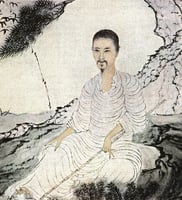
Expertenanalyse zu Shitaos Prunus in flower and bamboo
Stil: Ink and wash painting · Genre: flower painting
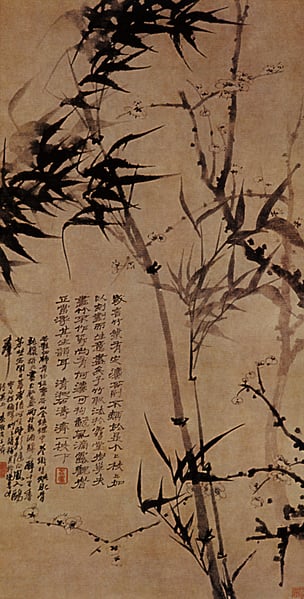
This artwork, Prunus in Flower and Bamboo, by the Qing dynasty master Shitao, is a remarkable example of ink and wash painting that elevates the traditional flower-painting genre through its radical individualism and philosophical depth.
Significance within Ink and Wash Painting and the Literati Tradition:
Shitao is renowned for his theoretical treatise Huayu Lu (Remarks on Painting), in which he championed the concept of the "Single Brushstroke" (yihua). This philosophy posits that all painting originates from one fundamental, spontaneous act of the brush, reflecting the unity of the artist with the Dao (the cosmic way). In Prunus in Flower and Bamboo, this principle manifests in the dynamic, seemingly effortless yet intensely controlled brushwork. The plum blossoms (prunus) and bamboo are not rendered with meticulous academic precision; instead, the brushstrokes carry an expressive, calligraphic energy. The branches zigzag with confident, angular strokes, while the bamboo leaves are dashed in with swift, rhythmic pressure, embodying the artist's belief that painting should be an immediate, living "trace" of the inner spirit.
The Significance of the Subject Matter:
Plum blossom and bamboo are classic subjects in Chinese literati painting, symbolizing resilience and integrity (the plum blooms in late winter) and flexibility and uprightness (the bamboo bends but does not break). By pairing them, Shitao follows a long tradition of pairing "the Four Gentlemen" (plum, orchid, bamboo, chrysanthemum), but his treatment is distinctly personal. Unlike the more formal, orthodox styles of his contemporaries (such as the Four Wangs), Shitao’s composition is intentionally asymmetrical and "unbalanced," with branches bursting from the edges or diagonally cutting across the empty space. This deliberate rupture of conventional harmony reflects his rebellious artistic stance—he famously declared, "I use my own method," rejecting the slavish imitation of ancient masters.
Stylistic Innovation:
In terms of ink technique, Shitao exploits the full range of tonality—from dense, deep black for knots and stems to pale, watery washes for blossoms and bamboo nodes. The wet and dry contrasts create a vivid sense of textural variety and atmosphere, making the flowers appear to emerge from a misty, living landscape rather than a static decorative arrangement. The empty background (typical of ink wash) is not mere void but an active space that suggests the infinity of nature, inviting the viewer’s imagination.
In summary, Prunus in Flower and Bamboo is significant because it embodies Shitao’s revolutionary synthesis of Zen-like spontaneity with profound technical mastery. It transforms a standard flower painting into a manifesto of individuality, where the brushstrokes themselves become the subject—a direct expression of the artist’s mind and the rhythmic pulse of nature. This work stands as a key example of early Qing individualist painting, challenging the orthodoxy of its time and paving the way for later expressive movements in East Asian art.
Visuell ähnlich
20 Werke mit ähnlicher Komposition und Farbpalette
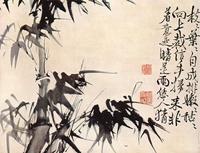
Bamboos
Xu Wei
Twelve Plants and Calligraphy
Xu Wei
Bamboo in the Wind
Fujishima Takeji
Bamboo
Xu Beihong
Bamboo and Stone
Guan Daosheng
Ink Bamboo
Xu Beihong
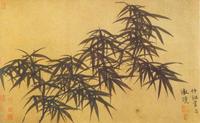
Ink Bamboo
Guan Daosheng
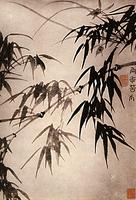
Bamboo
Shitao
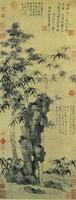
Bamboo, and Elegant Stone
Ni Zan
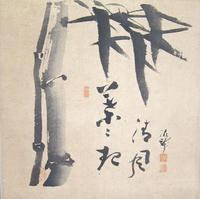
Bamboo
Deiryu
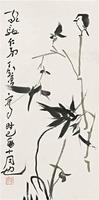
Bird on Bamboo Tree
Ding Yanyong
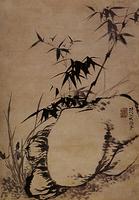
Orchids, bamboo, rock
Shitao
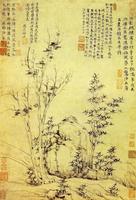
Autumn Wind in Gemstones Trees
Ni Zan
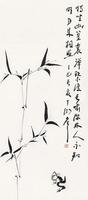
Bamboo and Frog
Ding Yanyong
Snail on the bamboo leaf
Ohara Koson
Frogs
Ding Yanyong
Three Friends of Winter
Bada Shanren
Bamboo and Bird
Ding Yanyong
Bamboo Enso
Deiryu
Bamboo and Rock
Shitao