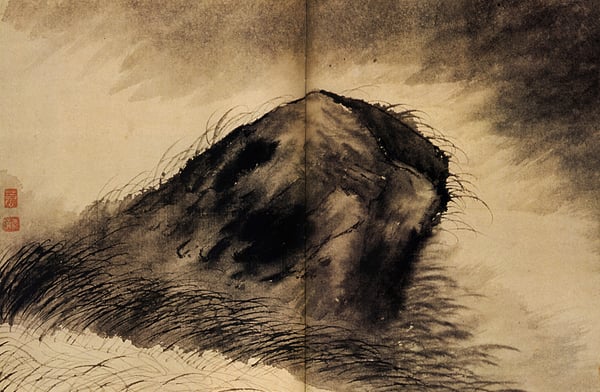
Shitao の The Solitary Rock の専門的な分析
スタイル:Ink and wash painting · ジャンル:landscape
Expert Analysis: "The Solitary Rock" by Shitao
Shitao (1642–1707) was a pioneering individualist of the early Qing dynasty, whose radical theories and expressive ink-wash techniques broke decisively from orthodox literati conventions. The Solitary Rock exemplifies his revolutionary approach within the landscape genre, a subject he transformed into a vehicle for personal philosophy.
Formal Significance:
Executed in monochrome ink on paper, the work epitomizes the xieyi (sketching the idea) style, where brushwork conveys emotion over verisimilitude. The rock—a classic scholarly symbol of enduring resilience—is rendered not as a mere topographic feature but as a living, dynamic form. Shitao’s hallmark “one-stroke” (yihua) method imbues the composition with rhythmic spontaneity: wet, sweeping washes suggest shifting light and atmosphere, while dry, jagged strokes create texture and tension. The rock’s isolation against a nearly blank background emphasizes its singularity, mirroring the artist’s own defiant individuality after the fall of the Ming dynasty.
Philosophical & Stylistic Innovation:
In his treatise Huayu Lu (Remarks on Painting), Shitao argued that the “one stroke” is the origin of all phenomena—a Daoist-inspired concept that liberated painters from imitating past masters. The Solitary Rock is a direct manifestation of this belief: every ink mark is both a representation of nature and an expression of the artist’s inner state. Unlike the serene, idealized landscapes of the Four Wangs (orthodox contemporaries), Shitao’s rock bristles with irregular contours and expressive energy, evoking the raw power of a single, unyielding presence.
Context & Legacy:
Within the ink-wash tradition, The Solitary Rock stands as a defiant rebuttal to academicism. Shitao’s emphasis on individual vision over tradition anticipated later modernist sensibilities, influencing not only Chinese literati painting but also 20th-century Western artists drawn to its gestural abstraction. The painting’s significance lies in its ability to compress cosmic scale into a single, intimate form—a microcosm of Shitao’s belief that “the landscape is the painting of the self.”
視覚的に類似
構図やパレットが近い作品 20 件
Between mountain and river, not far from Mount Huang
Shitao
On the other side of the water
Shitao
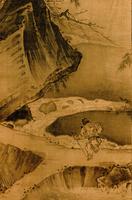
Dancing and Singing (Peasants Returning from Work) (detail 2)
Ma Yuan
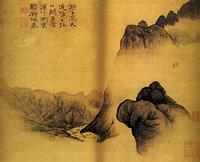
Two friends in the moonlight
Shitao
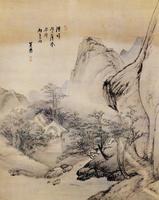
Keimyung Gok Amdo
Shin Yoon-bok
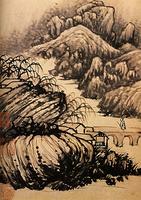
Hiking in the area of the Temple of the Dragon
Shitao
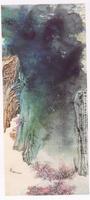
Peach Blossom Spring
Chang Dai-chien
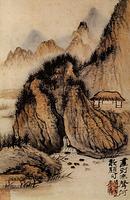
The Source in the hollow of the Rock
Shitao
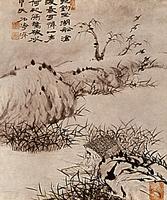
The Solitaire has fishing
Shitao
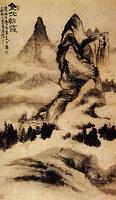
Light of dawn on the monastery
Shitao
The crosses Torrent
Shitao
Go by the cold paths
Shitao
Conversation with the mountain
Shitao
Watching Waterfall
Lan Ying
Bathing Horses
Shitao
Nostalgic walk
Shitao
Mountains in the Mist
Shitao
Autumn the mountain
Shitao
Summer Landscape
Tomioka Tessai
Mountain
Utagawa Kuniyoshi