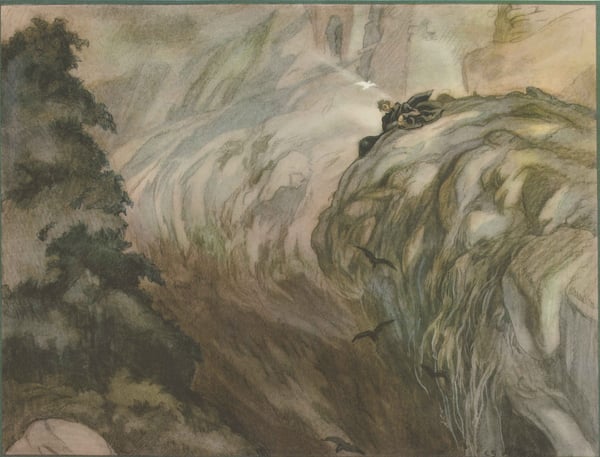
The Life of St. Ignatius Loyola. Plate 3. The vision at the River Cardoner (Manresa).
Dettagli
Analisi esperta di The Life of St. Ignatius Loyola. Plate 3. The vision at the River Cardoner (Manresa). di Carlos Saenz de Tejada
Stile: Art Nouveau (Modern) · Genere: history painting
Carlos Saenz de Tejada’s The Life of St. Ignatius Loyola. Plate 3. The vision at the River Cardoner (Manresa) occupies a fascinating intersection between traditional religious history painting and the decorative, modernist aesthetic of Art Nouveau. As a plate in a series, it functions both as narrative illustration and as a sophisticated example of early 20th‑century graphic art, but its significance lies in how it reinterprets a canonical spiritual subject through the formal language of the new style.
Stylistic Significance within Art Nouveau
Art Nouveau (c. 1890–1910) is characterized by flowing, organic lines, flattened planes of color, and a fusion of fine art with applied design. Tejada’s treatment of this visionary scene embodies several hallmarks of the movement:
- Sinuous, rhythmic lines – The composition likely uses serpentine contours (e.g., the river’s course, St. Ignatius’s drapery, or the swirling atmosphere of the vision) to create a sense of spiritual energy and continuous motion, typical of Art Nouveau’s “whiplash” curves.
- Flat decorative patterning – Instead of deep illusionistic space, Tejada may employ flattened, tapestry‑like areas of color and ornamental motifs (leaves, light rays, water patterns), reducing the scene to a harmonious surface design. This aligns with Art Nouveau’s celebration of pattern and decoration over strict naturalism.
- Symbolism through line and color – The vision itself (the moment St. Ignatius perceived divine illumination while sitting by the Cardoner River) becomes a formal event: light radiates in stylized, linear bursts; the landscape folds into abstract, organic shapes. The modern, almost poster‑like quality makes the mystical accessible without losing its emotional weight.
Historical and Genre Significance
As a history painting, the work participates in a long tradition of Catholic sacred art, but Tejada deliberately modernizes it. Rather than following 19th‑century academic realism or Baroque theatricality, he applies Art Nouveau’s decorative economy:
- The plate format suggests the work was conceived as an illustrated book or print series, a medium Art Nouveau artists often used to reach a broader public. This bridges high‑art religious narrative with the applied arts (book illustration, lithography), a key ambition of the modernist movement.
- By depicting St. Ignatius—founder of the Jesuits and a figure of Counter‑Reformation spirituality—through a lens of delicate, modernist ornamentation, Tejada implies that spiritual experience can be rendered in a contemporary visual language without losing its power.
Why It Matters
This plate is significant because it demonstrates how Art Nouveau was not limited to decorative objects, posters, or architecture—it could renew the most traditional of genres, the religious history painting. Tejada’s work is a bridge: it respects the narrative of St. Ignatius’s transformative vision yet translates it into the sinuous, symbolic, and flattened aesthetic of early modernism. In doing so, it invites viewers to perceive the sacred not through monumental realism but through the elegant, rhythmic abstraction of a movement that was itself spiritual in its pursuit of total harmony.
Visivamente simili
20 opere con composizione e palette affini
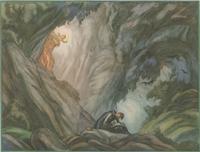
The Life of St. Ignatius Loyola. Plate 2. Ignatius writes the Spiritual Exercises in the cave at Manresa.
Carlos Saenz de Tejada
Wave rolling after wave, where way they found If steep, with torrent rapture
Gustave Dore
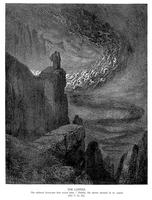
The Lustful
Gustave Dore
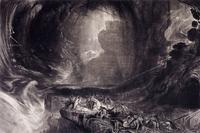
The Evening of the Deluge
John Martin
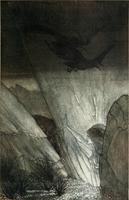
Erda bids thee beware
Arthur Rackham
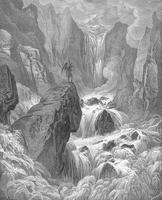
In with the river sunk, and with it rose Satan
Gustave Dore
The Lonely Tower
Samuel Palmer
Keeps watch over Alberich's ring
Arthur Rackham
Mime writhes under the lashes he receives
Arthur Rackham
Ancient land
Konstantin Bogaevsky
Star light
Konstantin Bogaevsky
Paradise Lost
Gustave Dore
Witches' Dance
Hermann Hendrich
The road in the Sinai after the storm
Karl Bryullov
The Seventh Circle
Gustave Dore
Journey to the Center of the Earth
Edouard Riou
Snow Storm, Hannibal and His Army Crossing the Alps
J.M.W. Turner
Don Quixote
Gustave Dore
The Inferno, Canto 34
Gustave Dore
The Ascent
Gustave Dore