Carlos Saenz de Tejada sanatçısının The portalón. Vitoria, fifties. eseri hakkında uzman analizi
Tarz: Art Nouveau (Modern) · Tür: genre painting
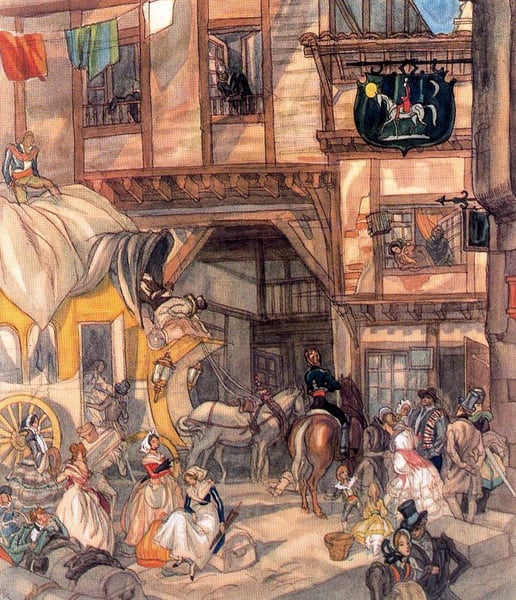
This analysis focuses solely on the provided structured facts: the artwork is "The portalón. Vitoria, fifties." by Carlos Saenz de Tejada, classified as Art Nouveau (Modern) in style and genre painting in genre. While the title suggests a mid-20th-century setting, the significance lies in how Saenz de Tejada applies the fluid, decorative vocabulary of Art Nouveau—a movement that peaked around 1900—to a realist scene of everyday life in 1950s Vitoria.
What makes the work significant within its style/period:
-
Anachronistic Stylistic Synthesis: Saenz de Tejada’s persistent use of Art Nouveau into the 1950s marks him as a late, deliberate practitioner of a style that had long fallen out of mainstream avant-garde fashion. This gives the painting a nostalgic, timeless quality—an idealized vision of a modern Spanish city filtered through the sinuous lines, flattened forms, and organic ornamentation of turn-of-the-century Art Nouveau. The “portalón” (a large doorway) likely becomes a framing device for elegant, curving silhouettes.
-
Reimagining Genre Painting with Decorative Modernity: Traditionally, genre painting depicts the ordinary activities of common people. Here, the ordinary is elevated by the Art Nouveau aesthetic—whiplash curves in architectural details, flowing lines of clothing, and a decorative rhythm in the composition. The mundane scene of a Vitoria street or courtyard in the 1950s is transformed into an almost ornamental tableau, bridging the gap between everyday observation and stylized, modern beauty.
-
Testament to the Endurance of Art Nouveau in Popular Illustration: Saenz de Tejada was a prolific illustrator and poster artist. This painting reflects the movement’s diffusion beyond its original era into commercial and genre art. Its significance lies in showing that Art Nouveau principles—emphasis on line, harmony, and integrated design—could be adapted to portray contemporary mid-century life, not just the mythical or aristocratic subjects of the fin-de-siècle.
-
Regional Identity Through a Universal Lens: By depicting Vitoria in the 1950s within an Art Nouveau framework, the artist melds a distinctly Spanish, provincial setting with an international, modern style. The “portalón” becomes a symbol of local character, while the flowing, stylized treatment connects the work to a broader European trend of decorative modernism. This dual identity—rooted in place yet stylistically transcendent—gives the painting its unique historical resonance.
Görsel olarak benzer
İlişkili kompozisyon ve renk paletine sahip 20 eser
Toll to Pay
Arthur David McCormick
Butcher's Row, Hereford
David Cox
The Tailor Returning Home
Beatrix Potter
Street, Monlight, Mont-Saint-Michel
Clarence Gagnon
Wolverhampton, Staffordshire
J.M.W. Turner
Heriot's Hospital, Edinburgh
J.M.W. Turner
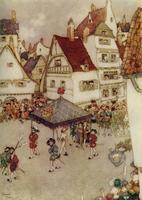
The Emperor's New Clothes
Edmund Dulac
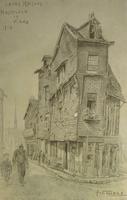
Honfleur Le Vieux, "Leurs Maisons"
Fernand Combes
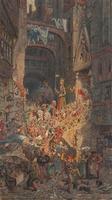
Der Karneval
Georg von Rosen
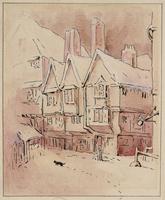
Simpkin Hears the Mice
Beatrix Potter
Fine knacks for ladies, cheap, choice, brave and new
Eleanor Fortescue-Brickdale
Birth of Christ
Albrecht Durer
The Loose Shoe
Heywood Hardy
Moonlight Street, Pont-de-l'Arche
Clarence Gagnon
The Arrival of the Stagecoach
Carl Spitzweg
Simpkin Goes Out
Beatrix Potter
The Farmyard
John Frederick Herring Sr.
EUROPEAN STREET SCENE
Daniel MacDonald
Moonlight Street, Pont-de-l'Arche
Clarence Gagnon
Simpkin in the Snowy Street
Beatrix Potter