Expert analysis of David Cox’s Butcher's Row, Hereford
Style: Romanticism · Genre: cityscape
Expert Analysis of "Butcher's Row, Hereford" by David Cox
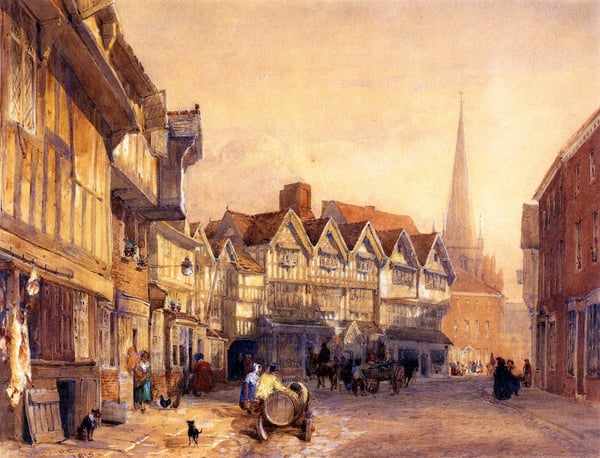
David Cox’s Butcher’s Row, Hereford is a compelling cityscape executed within the Romantic tradition, yet it stands apart from the era’s more typical grand landscapes or sublime nature scenes. Instead, Cox applies Romanticism’s core principles—emotional resonance, atmospheric dynamism, and a reverence for the transient—to an everyday urban subject, elevating a mundane marketplace to a study of light, texture, and mood.
Significance Within Romanticism: The Sublime in the Everyday
Most Romantic painters sought the sublime in mountains, storms, or ruins. Cox, a master of watercolor and a precursor to later plein-air movements, found that same emotional power in the weathered architecture and bustling life of Hereford’s Butcher’s Row. The significance of this work lies in its democratic Romanticism: it treats a humble street scene with the same sensitivity to atmosphere and fleeting light that contemporaries like J.M.W. Turner reserved for grand maritime or alpine vistas.
- Atmospheric Transience: Cox captures a specific moment—likely a damp, overcast day. The loose, almost sketchy handling of the buildings and sky suggests rain-soaked stone and the soft diffusion of light. This emphasis on changing weather and its effect on perception is a hallmark of Romantic nature-worship, here applied to a human-made environment.
- Picturesque Realism: Unlike the idealized classical cityscapes of the 18th century, Cox presents the row with unvarnished character—timber-framed buildings, uneven rooflines, and the clutter of shop awnings. This aligns with the Romantic interest in the picturesque: the beauty found in irregularity, age, and local color. The scene feels authentic, not staged.
- Emotional Tone through Technique: Cox’s use of rapid, broken brushwork (common in his watercolors) creates a sense of movement and life—the bustle of the market is implied, not described in detail. The muted palette of browns, grays, and olive tones evokes a quiet, almost melancholic dignity, inviting the viewer to feel the weight of history and the rhythm of daily labor.
Contribution to the Cityscape Genre
As a cityscape, Butcher’s Row, Hereford demonstrates that Romanticism could thrive in urban settings. Cox refuses to romanticize the scene into a sanitized view; instead, he celebrates the raw, lived-in quality of the place. This approach influenced later British watercolorists and contributed to the development of the “topographical” Romantic style, where precise location is fused with subjective emotion. The artwork’s significance lies in its quiet rebellion: it proves that the Romantic vision—of transience, emotion, and the sublime—can be found not only in untamed nature, but also in the tolerant, aging architecture of a provincial street.
Visually similar
20 works with related composition and palette
Simpkin Hears the Mice
Beatrix Potter
EUROPEAN STREET SCENE
Daniel MacDonald
The Tailor Returning Home
Beatrix Potter
Street, Monlight, Mont-Saint-Michel
Clarence Gagnon
The Tailor and Simpkin Set Out for the Shop
Beatrix Potter
Honfleur, La Rue Gambetta
Fernand Combes
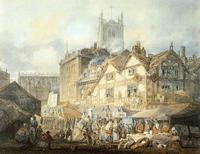
Wolverhampton, Staffordshire
J.M.W. Turner
Honfleur Le Vieux, "Leurs Maisons"
Fernand Combes
Toll to Pay
Arthur David McCormick
Cherry Ripe
Walter Osborne
The La Rue Bavolle at Honfleur
Claude Monet
Cathedral Church at Lincoln
J.M.W. Turner
Street of the Bavolle Honfleur
Claude Monet
The portalón. Vitoria, fifties.
Carlos Saenz de Tejada
Old farm buildings
William Henry Hunt
Moonlight Street, Pont-de-l'Arche
Clarence Gagnon
The Loose Shoe
Heywood Hardy
Moonlight Street, Pont-de-l'Arche
Clarence Gagnon
The La Rue Bavolle at Honfleur 2
Claude Monet
Front view of the Cathedral
Richard Parkes Bonington