Analisi esperta di The Hunt Supper di Julius LeBlanc Stewart
Stile: Realism · Genere: genre painting
Expert Analysis: "The Hunt Supper" by Julius LeBlanc Stewart
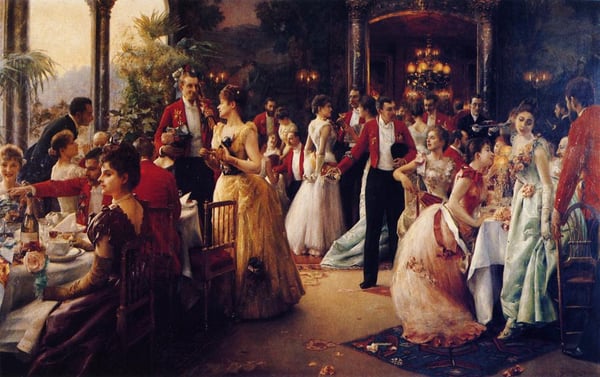
Based on the provided facts, Julius LeBlanc Stewart’s The Hunt Supper operates squarely within the Realist tradition and the genre painting category, yet its significance lies in how it reinterprets these conventions for its specific late-19th-century moment.
Realism and the American Expatriate Gaze
Stewart was an American expatriate in Paris, and his adoption of Realism—a style that sought to depict contemporary life with truthfulness and without idealization—places him in dialogue with French masters like Courbet and the Barbizon school. However, unlike the rural, often grim scenes favored by earlier Realists, Stewart’s work typically focused on the leisure and social rituals of the affluent. In The Hunt Supper, the subject of a post-hunt meal among hunters is a classic genre scene, but rendered with a polished, almost photographic fidelity that elevates a mundane social gathering into a document of a specific class and moment. This fusion of Realist technique with an insider’s view of elite recreation is what marks Stewart’s contribution: he democratizes high society by painting it with the same unflinching clarity Realists applied to peasants.
Genre Painting as Social Record
As a genre painting—a scene of everyday life—The Hunt Supper becomes significant for its anthropological precision. The hunt supper was a ritual of male camaraderie and status display in 19th-century European and American sporting culture. Stewart captures this with careful attention to costume, setting, and gesture: the table laden with game, the relaxed yet posed postures, the interplay of light and shadow on fabrics and faces. By avoiding overt narrative or moralizing, he treats the scene as a slice of life, aligning with Realism’s goal of objective observation. The work thus functions as a visual record of a disappearing aristocratic tradition, while also reflecting the growing urbanization and nostalgia for rural masculinity in the Gilded Age.
Significance Within Its Style
What makes The Hunt Supper significant within Realism is its demonstration that the style could be applied not only to the working class or the poor but also to the pleasures of the well-to-do—without satire or sentimentality. Stewart’s meticulous rendering of textures (fur, leather, glass, wood) and his careful compositional balance show Realism’s capacity for elegance, challenging the assumption that the style must be raw or didactic. In this sense, the work bridges Realist integrity with the polish expected by Stewart’s wealthy patrons, making it a key example of how American artists adapted European Realism for their own social commentary and market demands.
Museum / Gallery
Visivamente simili
20 opere con composizione e palette affini
The End of Dinner
Jules-Alexandre Grun
A Hunt Ball
Julius LeBlanc Stewart
Redemption
Julius LeBlanc Stewart
Personnages
Jean Béraud
The Ball
Julius LeBlanc Stewart
The Ball
James Tissot
Himno Nacional Argentino
Pedro Subercaseaux
The Dinner at the Ball
Adolph Menzel
Fiesta elegante
Francisco Miralles
The living room of Princess Mathilde
Giuseppe De Nittis
The Political Lady
James Tissot
Chopin Playing the Piano in Prince Radziwill's Salon
Henryk Siemiradzki
Presentation of a Prospective Suitor
Angelo Zoffoli
An evening at the Paiva
Adolphe Joseph Thomas Monticelli
Victory Ball, 1781
Jean Leon Gerome Ferris
The Young Ladies of the Province
James Tissot
The Baptism
Julius LeBlanc Stewart
The game of chess
Francesco Beda
The First Visit
Arturo Ricci
Presentation of the princess
Salvador Sánchez Barbudo