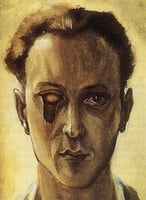
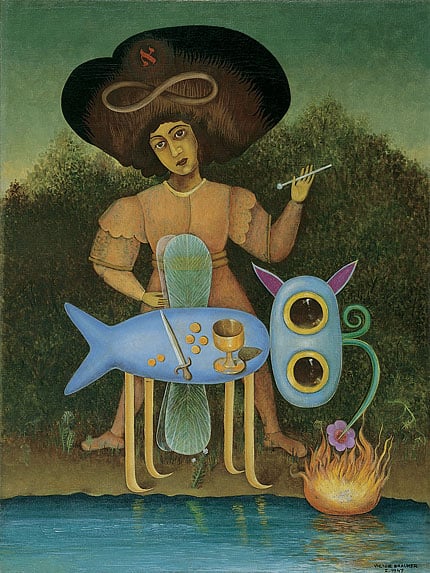
Expert analysis of Victor Brauner’s The Surrealist
Style: Surrealism · Genre: portrait
Expert Analysis: "The Surrealist" by Victor Brauner
Although the supplied facts are minimal, the artwork’s title, artist, style, and genre immediately position it within Surrealism’s most self-reflective and provocative practices. Victor Brauner (1903–1966) was a Romanian-born Surrealist whose work often fused occult symbolism, personal mythology, and a distinctive, sometimes disturbing, figuration. A portrait titled The Surrealist is inherently significant because it functions as both a self-definition and a meta-commentary on the movement itself.
Why this artwork is significant:
-
Identity and the Surrealist Self: By labeling the sitter (likely a self-portrait or an archetype) as “The Surrealist,” Brauner confronts the viewer with the question of what it means to be a Surrealist. In the 1930s and 1940s, Surrealists were deeply engaged in exploring the unconscious, dreams, and the fragmented self. This portrait therefore becomes a manifesto in paint—asserting that the Surrealist identity is not merely an artistic style but a state of being, often marked by metamorphosis, hybridity, or psychological tension.
-
Brauner’s Esoteric Language: Unlike the more biomorphic Surrealism of Miró or the dreamscapes of Dalí, Brauner’s portraiture frequently incorporated enigmatic objects, half-human/half-animal forms, and alchemical references. The Surrealist likely distills his interest in the intersection of the visible and the invisible—the face might be split, doubled, or adorned with symbolic talismans. This aligns with Brauner’s broader project of creating a “painted philosophy” that challenges conventional perception.
-
Genre Transformed: As a portrait, the work subverts traditional portraiture’s goals of likeness and status. Instead, Brauner uses the genre to explore the psyche. The sitter is not a passive subject but an active embodiment of surrealist principles: irrationality, transformation, and the liberation of the mind. This makes The Surrealist a key example of how Surrealist painters repurposed established genres to serve revolutionary, introspective ends.
In sum, even without visual details, The Surrealist stands as a significant document of Surrealist self-understanding—a snapshot of an artist and a movement turning the gaze inward to question what it means to see, to be, and to create.
Museum / Gallery
Genre
Style
Visually similar
20 works with related composition and palette
Alice Au Pays De L'homme 1978
Denyse Willem
Blessed Fisherman Family and Golden Fish
Twins Seven Seven
Thoth Tarot
Lady Frieda Harris
Paul Ranson
Paul Ranson
The Rotting Bird
Salvador Dali
Dos Anjos
Xul Solar
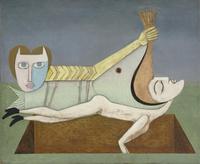
L'animal Manuel
Victor Brauner
Icon
Małgorzata Serwatka
A young fisherman
Niko Pirosmani
The Juggler
Marc Chagall
Untitled
August Natterer
Kingdom of the Absurd by Jonathan Swift
Oleksandr Aksinin
Drapeau rigide aux couleurs inconnues
Jules Perahim
The Dance
Marc Chagall
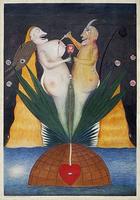
The Moralistic Moon Dualism
Friedrich Schroder-Sonnenstern
Untitled
Ligia Macovei
Atu III - The Empress - Thoth Tarot - Aleister Crowley
Lady Frieda Harris
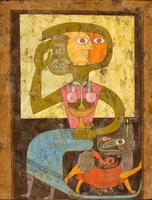
Coup of Doubt
Victor Brauner
The Demoness of Urgency
Friedrich Schroder-Sonnenstern
Untitled
Oleksandr Aksinin