Alfred Stevens の Pleasant Letter の専門的な分析
スタイル:Realism · ジャンル:genre painting
Expert Analysis: "Pleasant Letter" by Alfred Stevens
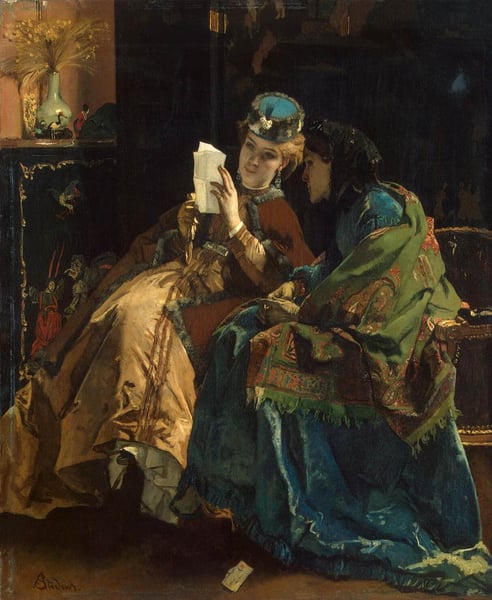
Alfred Stevens’ "Pleasant Letter" is a masterful example of Realist genre painting, a work that derives its significance from its quiet, intimate focus on a single, fleeting moment of daily life. Executed within the strictures of the Realist style—which sought to depict contemporary existence without idealization or historical pretense—the painting elevates the ordinary into something profoundly evocative.
What makes the work significant within its style and period:
-
A study of private emotion in a public-facing world: Realism prized the truthful depiction of modern life, and Stevens captures here a uniquely private psychological moment. The "pleasant letter" is not just a prop but a catalyst for a narrative that remains open-ended. The viewer is invited to speculate on the sender, the content, and the subtle shift in the subject’s mood. This focus on inner experience—rendered through outward, observable details (the tilt of the head, the slight curve of a smile, the relaxed hand holding the paper)—is a hallmark of advanced Realist portraiture, moving beyond mere surface likeness to explore human interiority.
-
Attention to the textures of the modern bourgeoisie: As a genre painting, "Pleasant Letter" documents the material culture of the 19th-century middle class. The polished wooden table, the sheen of silk or satin in the woman’s dress, the intricate lace, and the subtle light filterings are rendered with painstaking precision. This commitment to tangible reality—the sheen of fabric, the grain of wood, the soft glow of daylight—aligns Stevens with the core Realist principle of recording the sensory world as it truly appears. The significance lies in the way these objects are not merely decorative but function as indicators of the subject’s social station and the era’s domestic ideals.
-
Narrative restraint as a Realist strategy: Unlike earlier Romantic or Neoclassical works that often spelled out explicit moral or historical messages, "Pleasant Letter" offers no grand drama. The title itself guides the interpretation—a pleasant letter—but the painting resists melodrama. This restraint is a defining, significant feature of Realist genre painting: it trusts the viewer to find meaning in the mundane. The work’s power comes from this very refusal to explain, allowing the simplicity of the scene (a woman, a letter, a moment) to resonate as a universal experience of private joy or anticipation.
-
The inversion of the “female subject” trope: In much 19th-century academic painting, women were depicted as allegorical figures or passive objects of beauty. In Stevens’ Realist hands, the woman reading the letter is an active participant in her own narrative. Her focus is directed away from the viewer, fully absorbed in the text. This psychological autonomy—her inner life is the true subject—makes the painting significant. It aligns with Realism’s broader interest in contemporaneous social roles, portraying a modern woman of leisure engaged in a personal, intellectual act (reading a letter), rather than a mythical or idealized being.
In summary, "Pleasant Letter" is significant because it perfectly embodies Realism’s ambition to find profound meaning in the everyday. By concentrating on an intimate, ephemeral moment of private correspondence, Stevens transforms a domestic vignette into a timeless study of human emotion, material truth, and the quiet poetry of modern life. It stands as a refined example of how genre painting, when executed with the observational rigor of Realism, can achieve both documentary accuracy and emotional resonance.
Museum / Gallery
視覚的に類似
構図やパレットが近い作品 20 件
Visiting the New Mother
Domenico Induno
The first earring
David Wilkie
The Love Letter
Alfred Stevens
An antiquarian
Gerolamo Induno
The Modiste
Francois Boucher
An Afternoon Idyll
Auguste Toulmouche
Interior with Figures
Hendrik Jacobus Scholten
Lovelorn
Alfred Stevens
The Letter
Camille Corot
Sertine School
Domenico Induno
The Misses Vickers
John Singer Sargent
The Dolour Certainty
Alfred Stevens
Helene Fourment with her Children
Peter Paul Rubens
At Home
Julius LeBlanc Stewart
Model in costume
Federico Faruffini
The letter
Silvestro Lega
La carta
Luis Paret y Alcazar
The work
Jules Trayer
A Visit to the Boarding School
George Morland
Sketch for 'The Family Compact'
James Ward