
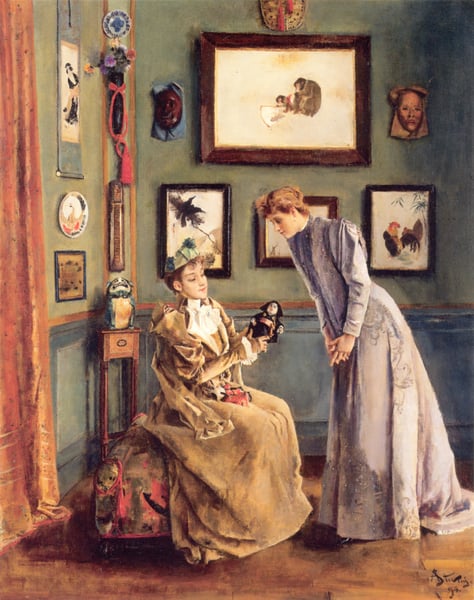
Alfred Stevens sanatçısının Woman with a Japanese Doll eseri hakkında uzman analizi
Tarz: Realism · Tür: genre painting
Expert Analysis of Woman with a Japanese Doll by Alfred Stevens
Alfred Stevens’ Woman with a Japanese Doll (c. 1870s–1880s) stands as a compelling example of Realism’s ability to capture both the material world and the subtle psychological currents of its time. Painted within the genre of domestic or genre painting, the work reflects the artist’s profound engagement with the Realist movement’s core tenets: precise observation, truthful representation of contemporary life, and a focus on the everyday experiences of the bourgeoisie.
Significance within Realism
Stevens was a Belgian painter who became a leading figure in the Parisian art world, and his work exemplifies the Realist commitment to depicting modern life without idealization. In Woman with a Japanese Doll, the meticulous rendering of textures—the sheen of silk, the softness of skin, the delicate glaze of the doll—demonstrates the Realist emphasis on empirical observation. The scene is not allegorical or mythological; it is a quiet, private moment, a slice of 19th-century domesticity. By choosing a woman absorbed in contemplation of an exotic object, Stevens aligns Realism with a growing fascination for material culture and interiority.
Genre Painting and the Role of Women
As a genre painting, the work belongs to a tradition that flourished in the 19th century, particularly in the hands of artists like Stevens, who specialized in elegant interior scenes. The woman’s poised, reflective gaze and the intimate setting underscore the era’s interest in the private lives of women—their leisure, their taste, and their roles as custodians of domestic refinement. Stevens often painted women in stylish interiors, and here the Japanese doll introduces an element of cross-cultural curiosity, reflecting the vogue for Japonism that swept Europe after Japan opened to trade in the 1850s. The doll is not merely a prop but a marker of cosmopolitan taste, connecting the sitter’s world to a global exchange of aesthetics.
Artistic and Cultural Resonance
What makes Woman with a Japanese Doll significant is its fusion of Realist precision with a subtle narrative of contemplation and cultural encounter. Stevens’ brushwork is controlled, his palette harmonious—rich browns, muted golds, and touches of rosy flesh tones—evoking the quiet opulence of the Second Empire and early Third Republic. The painting quietly challenges the viewer to consider the relationship between the sitter’s refined European domesticity and the imported exoticism of the doll, a tension that prefigures later Symbolist and Orientalist interests. In its unassuming way, the work encapsulates how Realism could serve as a vehicle for exploring modernity’s intersections: gender, class, and global influence.
Museum / Gallery
Görsel olarak benzer
İlişkili kompozisyon ve renk paletine sahip 20 eser

A Friendly Call
William Merritt Chase

Woman in an Interior
Julius LeBlanc Stewart

The Evening Prayer
Peter Fendi

Two young women in a cabinet
Charles Victor Thirion

Interior, Young Woman at a Table
William Merritt Chase

Portrait of a Woman in Blue
Alfred Stevens

At Home
Julius LeBlanc Stewart

The letter
Silvestro Lega

In front of the mirror. Reading the letter
Ivan Shishkin

The comforting words
Gustave Léonard De Jonghe The Japanese Fan

The Mirror
William Orpen

The Tailor
Pietro Longhi

Blue Belle
John Atkinson Grimshaw

The work
Jules Trayer

Two wool winding girls
Jules Trayer

My Studio
Sir Lawrence Alma-Tadema

The lace makers
Jules Trayer

Summer
John Atkinson Grimshaw

Harmony in Green and Rose: The Music Room
James McNeill Whistler

Portrait of Fru Lisen Samson, nee Hirsch, Arranging Flowers at a Window
Anders Zorn