
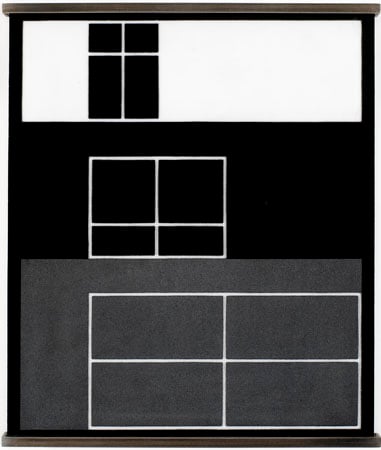
Analyse experte de Interior B de Josef Albers
Style : Constructivism · Genre : abstract
Expert Analysis of "Interior B" by Josef Albers
Within the framework of Constructivism, Josef Albers's "Interior B" stands as a pivotal early exploration of pure geometric abstraction—a work that both embodies the movement’s core tenets and foreshadows Albers’s lifelong investigation into color and spatial perception.
Significance within Constructivism
Constructivism, which emerged in the early 20th century, rejected narrative and representational art in favor of abstract, geometric forms that reflected the industrial age. Albers, while at the Bauhaus, applied these principles by stripping his compositions to elemental shapes—rectangles, lines, and planes. In "Interior B", the title itself is deliberately non-descriptive; it does not depict a literal interior but rather constructs an interior of the mind, a space defined by relationships of form and color. This aligns with the Constructivist goal of art as a "construction" rather than an imitation.
Albers’s Contribution to Abstract Art
What makes "Interior B" significant is how Albers uses Constructivist geometry to create optical tension and illusory depth. By manipulating flat, unmodulated colors and precise edges, he generates a sense of spatial ambiguity—the "interior" seems to recede or advance depending on the viewer’s focus. This work is a clear precursor to his later, more famous Homage to the Square series, where color interaction becomes the primary subject. Here, in "Interior B", we see Albers already treating color as an autonomous force, capable of altering perception without reference to the external world.
Bridging Movements
While firmly rooted in Constructivism’s rational, non-representational language, "Interior B" also looks ahead to Op Art and Color Field painting. Albers’s insistence on the relational nature of color and form—each element gaining meaning only through its neighbors—marks a departure from the more rigid, machine-like aesthetic of earlier Constructivist works. Instead, he introduces a human, perceptual element: the work is not merely a design but an experience.
In summary, "Interior B" is significant as a quintessential Constructivist abstract that demonstrates how geometrically precise, non-objective art can generate dynamic spatial effects. It stands as an early testament to Josef Albers’s unique ability to blend Constructivist discipline with a sensitivity to color’s emotional and perceptual power—a synthesis that would define his entire career.
Visuellement similaire
20 œuvres à la composition et à la palette proches
Dreiformvariation
Carl Buchheister
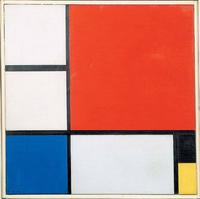
Composition 2
Piet Mondrian
Composition No. III Blanc-Jaune
Piet Mondrian
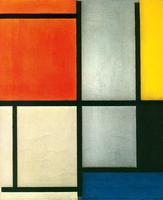
Tableau 3 with Orange -Red, Yellow, Black, Blue and Gray
Piet Mondrian
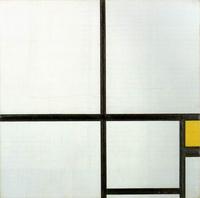
Composition with yellow patch
Piet Mondrian
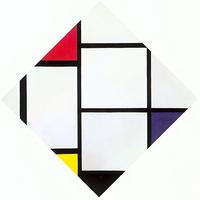
Lozenge Composition with Red, Gray, Blue, Yellow, and Black
Piet Mondrian
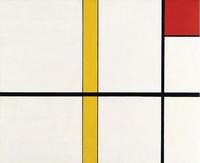
Early Geometric #492
Burgoyne Diller
Untitled
Myron Stout
Toile découpée
Louis Cane
Simultaneous Composition XXIV
Theo van Doesburg
Composition C (No.III) with Red, Yellow and Blue
Piet Mondrian
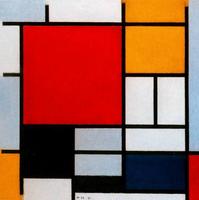
Composition with Large Red Plane, Yellow, Black, Gray and Blue
Piet Mondrian
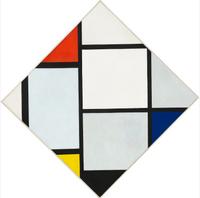
Tableau No. IV - Lozenge Composition
Piet Mondrian

Composition III with Blue, Yellow and White
Piet Mondrian
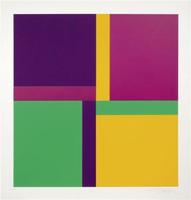
4 x 4 Bewegungen um eine Achse
Richard Paul Lohse
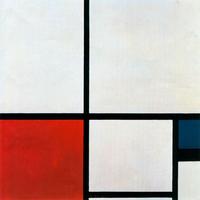
Composition N. 1 with Red and Blue
Piet Mondrian

Lozenge Composition 3 Lines Blue Gray Yellow
Piet Mondrian

Doppelfarben (in the cross 1-2-3-4)
Max Bill
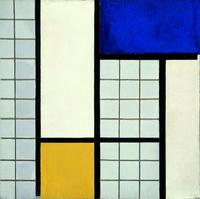
Composition with half values
Theo van Doesburg
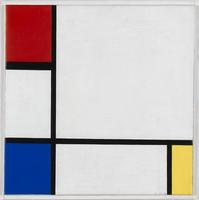
Composition No. IV, with Red, Blue and Yellow
Piet Mondrian