Analisi esperta di Peinture 12 November 2008 (diptyque) di Pierre Soulages
Stile: Minimalism · Genere: abstract
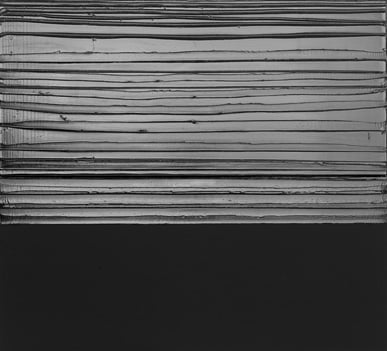
Expert Analysis: "Peinture 12 November 2008 (diptyque)" by Pierre Soulages
Despite being most famously associated with his "outrenoir" (beyond black) approach, this work is classified within Minimalism—a style defined by extreme reduction, geometric clarity, and a focus on the materiality of paint and surface. In this context, Soulages’ diptych becomes a significant meditation on light, texture, and the tension between the singular and the relational.
Significance within Minimalism
-
Reduction to Essence
The title itself—Peinture 12 November 2008—is deliberately non-referential, stripping away narrative or symbolic content. This aligns with Minimalism’s rejection of illusionism and its insistence on the artwork as an object in its own right. The diptych format further emphasizes the work’s physical presence: two equal panels that exist in a subtle dialogue, their edges and join creating a minimal yet decisive division of the visual field. -
Materiality and Light
Soulages’ signature use of black is not mere negation but a vehicle for light. He applies paint in thick, textured layers—often with tools like spatulas—creating ridges and grooves that catch ambient light. In a Minimalist reading, this transforms the canvas into a phenomenological event: the viewer’s movement alters the play of light across the surface, making perception a dynamic experience. The diptych format doubles this effect, inviting comparison between how light behaves on each panel. -
Rhythm and Symmetry
Minimalism often employs seriality or modular repetition. Here, the two panels can be seen as rhythmic complements—they may share similar textures but differ slightly in gesture or density. This creates a subtle asymmetry that prevents the work from becoming static. The composition’s balance is active, not passive, forcing the eye to oscillate between unity and difference. -
Beyond Black
Soulages’ black is not emptiness; it is a field of infinite possibility. In the context of 2008, this work continues his lifelong inquiry into how a single, extreme color can generate luminosity. Minimalist artists like Ad Reinhardt also explored black-on-black, but Soulages’ textured surface and diptych structure introduce a sculptural dimension that challenges the flatness typically associated with the style.
Conclusion
Peinture 12 November 2008 (diptyque) is significant because it synthesizes Minimalism’s core tenets—reduction, material presence, and phenomenological engagement—with Soulages’ unique vocabulary of light and texture. By using the diptych, he elevates the minimalist grid into a dynamic relational field, proving that extreme simplicity can yield inexhaustible perceptual complexity. This work is a testament to how Minimalism, in the hands of a master, remains a living, luminous practice rather than a sterile doctrine.
Visivamente simili
20 opere con composizione e palette affini
Peinture 130 x 81 cm, 20-03-2004
Pierre Soulages
Peinture 103 x 81 cm, 18 Mars 2004
Pierre Soulages
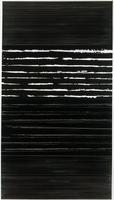
Peinture 324 x 181 cm, 14 mars 1999 (Polyptyque)
Pierre Soulages

Peinture 324 x 181 cm, 17 novembre 2008
Pierre Soulages
Rumor Has It
Roger Weik

Hairstring Skirts
Makinti Napanangka
White with Red
Roger Weik
Composition
Kazimir Malevich
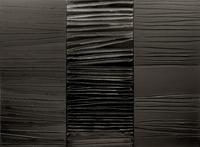
Peinture 227 x 306 cm, 2 Mars 2009
Pierre Soulages
409
Roger Weik
Glorias Level
Daniel Sambo-Richter
Horizontal Stripe Painting: November 1957 - January 1958
Patrick Heron
Blue Baleen
Dan Christensen
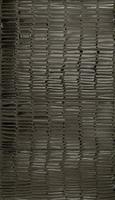
Peinture 324 x 181 cm, 19 février 2009 (Polyptyque)
Pierre Soulages
Achrome
Piero Manzoni
My Mother;s Country
Emily Kame Kngwarreye
Untitled 79
Roger Weik
Lupulnga
Makinti Napanangka
Babylon
Roger Weik
Untitled
Wade Guyton