Cafe Arab
Analyse experte de Cafe Arab de Marcel Janco
Style : Naïve Art (Primitivism) · Genre : figurative
Expert Analysis of "Cafe Arab" by Marcel Janco
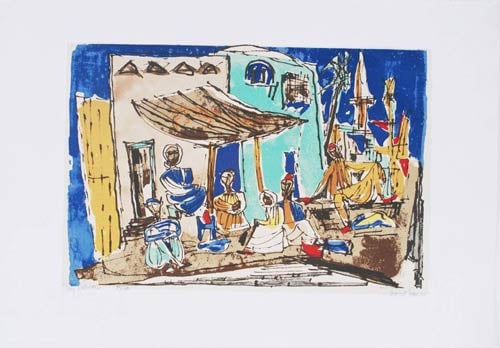
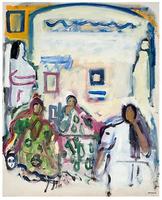
Marcel Janco’s Cafe Arab (ca. 1920s–1930s) is a striking example of his shift from pioneering Dadaist abstraction to a figurative, Primitivist idiom. Executed in the Naïve Art style, the work depicts a communal gathering in a Middle Eastern café—a subject drawn from Janco’s life after emigrating to Palestine in 1941, though his interest in “Oriental” themes began earlier.
Stylistic Significance:
Janco deliberately adopts a childlike, flattened perspective and bold, unmodulated colors, characteristic of Naïve Art. This Primitivist approach rejects academic naturalism in favor of a direct, intuitive representation. The figures are simplified into almost geometric, totemic shapes, their faces reduced to mask-like ovals with large eyes. This recalls Janco’s earlier involvement with African and Oceanic art (key to Dada and Primitivism), but here applied to a local, everyday scene.
Thematic Depth:
Cafe Arab is not merely a genre scene—it is an anthropological meditation on social ritual. The café functions as a microcosm of Arab urban life, with patrons seated in contemplative repose, smoking hookahs, and engaging in quiet exchange. Janco’s composition emphasizes the horizontal arrangement of bodies, creating a frieze-like rhythm that suggests timelessness and communal harmony. The warm, earthy palette (ochres, browns, muted greens) evokes the dusty light of the Levant.
Historical Context:
As a Romanian-born Jewish artist who co-founded the Dada movement in Zurich, Janco later turned to figurative art as a means of engaging with his new cultural environment. Cafe Arab exemplifies his hybrid identity: a modernist steeped in European avant-garde techniques, yet eager to capture the authenticity of Arab daily life without exoticizing it. The work’s Naïve quality is deliberate—it channels a pre-industrial, “primitive” simplicity that Janco saw as an antidote to the mechanization of Western modernity.
Legacy:
This painting is significant for bridging two poles of Janco’s career: the radical abstraction of Dada and the later humanism of his Israeli period. Cafe Arab stands as a testament to how Primitivism could be used not to appropriate the “other,” but to find a new visual language for cross-cultural encounter. It remains a key work in understanding Janco’s contribution to 20th-century Primitivist art.
Genre
Visuellement similaire
20 œuvres à la composition et à la palette proches
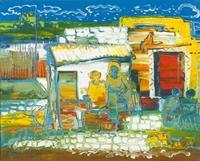
Figures in a Township
Walter Battiss
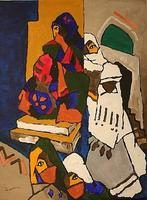
Women from Yemen
M.F. Husain
Illumination for the tale by Hovhannes Tumanyan 'Nazar the Brave'
Martiros Sarian
Cape Winter
Walter Battiss
Old Lamu, Bajun Isles
Walter Battiss
Middle-Eastern Figures
Marcel Janco
Baianas
Emiliano Di Cavalcanti
Arab Café in Ramallah
Marcel Janco
Page from the Moroccan Notebook
Eugene Delacroix
A Gathering
Walter Battiss
Die Königin von Saba
Arthur Segal
The Market
Walter Battiss
Market in Algiers
August Macke
Composition With Figures
Mario Zanini
BLUE FIGURE
Walter Battiss
Arab camel saddled
Jean Dubuffet
Untitled
Marcel Janco
In the bazaar
August Macke
Moroccan Women
Robert De Niro, Sr.
Market. Marrakesh
Zinaida Serebriakova