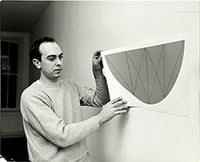

Analisi esperta di 104″ Perimeter Series di Robert Mangold
Stile: Minimalism · Genere: abstract
Expert Analysis of Robert Mangold’s 104″ Perimeter Series (Minimalism, Abstract)
Robert Mangold’s 104″ Perimeter Series is a quintessential example of Minimalist painting, a movement that sought to strip art of illusionistic depth, narrative content, and expressive gesture. The work belongs to Mangold’s broader exploration of the “shaped canvas,” a format he pioneered alongside other Minimalists to challenge the traditional rectangular support. By titling the piece with a precise measurement (104 inches), Mangold foregrounds the physical reality of the object—its scale, its edge, and its relationship to the surrounding space—rather than any symbolic or representational meaning.
Significance within Minimalism
- Materiality and Facture: Mangold’s painting is not a window onto a fictive world but a literal object. The perimeter becomes the subject: the taut, uniform application of paint (often acrylic or oil in muted, near-monochromatic tones) emphasizes the flatness and the literal edge of the canvas. The “104 inches” likely refers to the length of the perimeter or a key dimension, turning a numerical measurement into a conceptual parameter.
- The Edge as Content: In Minimalism, the edge of the canvas is no longer a mere boundary but an active participant in the composition. Mangold’s perimeter series often uses two-panel or irregularly shaped supports; the line separating panels or the seam between the stretcher and the wall becomes a focal point. This work likely employs a subtle, hand-drawn line—created with pencil, crayon, or thin paint—that traces the inner perimeter, echoing the shape of the canvas itself. This line is neither fully centered nor decorative; it establishes a taut, non-hierarchical tension between the interior field and the outer limit.
- Seriality and Repetition: The “Series” in the title links it to Mangold’s broader practice of repeating a single formal problem across multiple works (e.g., The X Series, The Column Series). This serial approach, common to Minimalists like Sol LeWitt and Donald Judd, reinforces the idea that the work is not a unique “expression” but a systematic investigation of a predetermined set of variables—here, the relationship between shape, measurement, and surface.
How It Transcends Simple Abstraction
- Unlike Abstract Expressionism’s impulsive brushwork, Mangold’s abstraction is cool, deliberate, and architectural. 104″ Perimeter Series invites contemplation of the physical act of perception: the viewer must walk around the canvas to understand its three-dimensional form, and the eye is drawn repeatedly to the edge. The subtle color—often a warm off-white, pale gray, or earth tone—creates a phenomenological experience of light and shadow rather than a symbolic palette.
- The work also blurs the boundary between painting and drawing. Mangold’s central line (often described as “internal measurement”) is both a drawn element and a painted one, asserting the artist’s hand while remaining rigorously controlled. This tension between precision and handmade nuance is a hallmark of Mangold’s contribution to Minimalism: he rejected the industrial anonymity of Judd’s boxes or LeWitt’s wall drawings while still embracing a near-scientific formalism.
Legacy
104″ Perimeter Series exemplifies how Minimalist abstraction could be both radical and intimate. By reducing the painting to its most essential components—shape, line, scale, and edge—Mangold creates an object that demands active, embodied viewing. It stands as a crucial bridge between the reductive logic of 1960s Minimalism and the more perceptual, phenomenological concerns of later post-minimalist art. The work’s quiet authority lies in its refusal to be anything other than what it is: a measured, precisely executed statement about the nature of pictorial space itself.
Museum / Gallery
Visivamente simili
20 opere con composizione e palette affini
Petal
Agnes Martin
Painting #93065
Rudolf de Crignis
Spazio Luce
Antonio Calderara
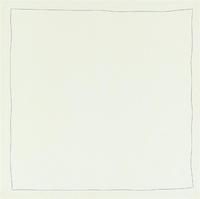
Bent Line Drawing
Robert Ryman
Untitled (e) From Five Plates
Brice Marden
Untitled (White Out)
Rirkrit Tiravanija
Painting #92138
Rudolf de Crignis
30 July 1973
Anne Truitt
Print 3
Bernard Cohen
Untitled
Brice Marden
Untitled
Gene Davis
Untitled, from BAM III
Robert Ryman
Untitled
Jo Baer
An Accordment #80
Perle Fine
Untitled
Agnes Martin
Painting #92137
Rudolf de Crignis
Number 27
John McLaughlin

The Peach
Agnes Martin
Blue Line
Robert Ryman
Spazio Luce
Antonio Calderara