
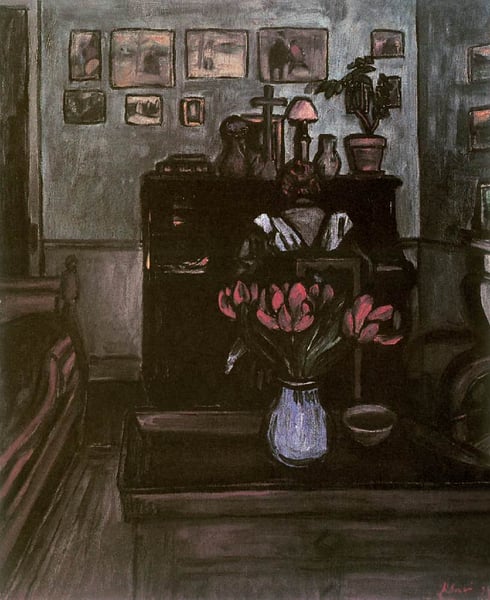
Jozsef Rippl-Ronai の Twilight in an Intimate Room の専門的な分析
スタイル:Post-Impressionism · ジャンル:interior
Expert Analysis: "Twilight in an Intimate Room" by József Rippl-Rónai
József Rippl-Rónai’s "Twilight in an Intimate Room" is a masterful Post-Impressionist interior that exemplifies the artist’s pivotal role in bridging the decorative and psychological currents of fin-de-siècle European painting. Created during his mature period, this work stands out for its synthesis of intimate domesticity and the expressive color harmonies championed by the Nabis—a group Rippl-Rónai associated with during his Paris years.
The painting’s significance lies in three key achievements:
-
Mood through Subtle Illumination
As the title suggests, twilight transforms the room into a hushed, contemplative space. Rippl-Rónai eschews naturalistic light effects in favor of a muted, tonal palette—soft blues, subdued lavender, and warm earthy browns—that evoke the psychological weight of the hour. This is not merely a record of a scene but a study of atmosphere, where the fading daylight seems to absorb the solidity of objects, blurring edges and infusing the room with a sense of quiet privacy. The artist’s Post-Impressionist departure from optical realism allows color and light to become carriers of emotion. -
Interior as Psychological Stage
True to his Nabi influences (particularly Vuillard and Bonnard), Rippl-Rónai treats the interior as an extension of human presence. Though no figures are explicitly depicted, the arrangement of furniture, the folded textile, the tilted vase, and the play of shadows suggest a lived-in, recently vacated space. The viewer becomes a silent observer, invited into an intimate moment of afterthought or withdrawal. This focus on the unpopulated domestic interior as a vehicle for mood was a distinctive trait of Rippl-Rónai’s work, setting him apart from many of his contemporaries who populated their interiors with figures. -
Hungarian Modernism in a European Context
Rippl-Rónai’s career is crucial to understanding how Post-Impressionism evolved outside France. "Twilight in an Intimate Room" demonstrates his ability to absorb the flatness, decorative patterning, and symbolic color of Gauguin and the Nabis while infusing them with a distinctly Central European sensibility—a quieter, more melancholic introspection. This painting, with its restrained palette and intimate scale, represents the artist’s mature style after he returned to Hungary, where he became a leading figure in the Nagybánya artist colony and a bridge between Western avant-gardes and Hungarian cultural identity.
In summary, the artwork’s significance rests on its successful fusion of Nabi decorative aesthetics with a deeply personal interior vision, its innovative use of twilight to craft an almost tangible emotional ambience, and its role in establishing a distinctly Hungarian modernism within the broader Post-Impressionist movement.
視覚的に類似
構図やパレットが近い作品 20 件
Lady at the Piano
Felix Vallotton
The Duet
Luke Fildes
Woman at writing desk
Lesser Ury
Zongoránál
Bela Czobel
Piano Player and Still Life
Henri Matisse
Girl at the Piano (Overture to Tannhauser)
Paul Cezanne
Mademoiselle Dihau at the Piano
Henri de Toulouse-Lautrec
The piano
Henri Matisse
Big Brother Playing
Harriet Backer
The Piano Lesson
Henri Matisse
The Singing Lesson. (The Teacher, Mlle.Dihau, with Mme.Faveraud)
Henri de Toulouse-Lautrec
The Granddaughter Playing Piano
Tetyana Yablonska
By the Piano
Harriet Backer
Lady by Piano
Igor Grabar
Woman at a Piano
Giovanni Boldini

A Romance
Santiago Rusinol
Les Grands Douleurs
Theophile Steinlen
Mademoiselle Gachet at the Piano
Vincent van Gogh
The Piano
Berthe Morisot
Chez Moi
Harriet Backer