Analisi esperta di Physichromie No. 326 di Carlos Cruz-Diez
Stile: Op Art · Genere: abstract
Expert Art Historical Analysis: "Physichromie No. 326" by Carlos Cruz-Diez
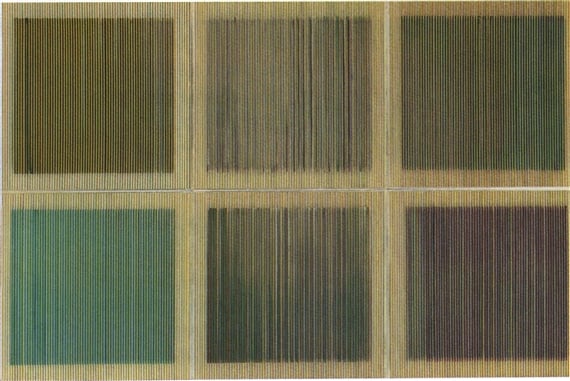
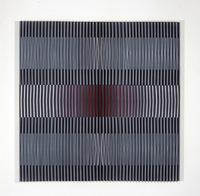
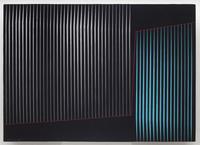
Carlos Cruz-Diez’s Physichromie No. 326 stands as a masterful exemplar of Op Art’s central ambition: to transform the viewer’s passive observation into an active, perceptual experience. Within the abstract, non-representational framework of the movement, this work is significant for how it systematically dismantles the traditional boundary between color and form, turning the artwork into a dynamic, ever-changing event.
The piece belongs to Cruz-Diez’s seminal Physichromie series—a term he coined to describe the "physics of color." Unlike static painting, Physichromie No. 326 relies on a structural interplay of vertical or horizontal colored strips (often in contrasting hues) separated by thin white or black ribs. This meticulous arrangement forces the eye to engage in optical mixing: as the viewer moves, the colors seem to shimmer, shift, and create afterimages. The work thus becomes an exploration of chromatic induction and simultaneous contrast, principles that Op Art refined from earlier color theory.
What makes this artwork significant within Op Art is its reliance on real time and space. Unlike a conventional painting that holds fixed meaning, Physichromie No. 326 changes its appearance depending on the viewer’s angle, distance, and lighting conditions. This places Cruz-Diez at the forefront of the kinetic and perceptual art movement, where the artwork’s "life" is generated solely by the spectator’s physical presence. It is a pure, abstract system designed to reveal color as a phenomenon—fluid, unstable, and relational.
In the context of the 1960s and 1970s Op Art boom, Cruz-Diez’s work stands apart for its rigorous, quasi-scientific methodology and its refusal to rely on illusionistic depth. Physichromie No. 326 does not depict anything; instead, it enacts color’s behavior. Its significance lies in turning abstraction into a laboratory for human perception, challenging the viewer to recognize that they are not just looking at a picture, but participating in the very creation of what they see.
Museum / Gallery
Visivamente simili
20 opere con composizione e palette affini
30.11.15
Andrzej Nowacki
20.09.16
Andrzej Nowacki
Untitled
Gene Davis
June 21
Jack Tworkov
Fisicromía 1
Carlos Cruz-Diez
Green Giant
Gene Davis
04.12.15, The composition with B
Andrzej Nowacki
17.06.16, Symmetrical new composition
Andrzej Nowacki
Sunset Veils
Richard Anuszkiewicz
21.09.07
Andrzej Nowacki
Red Picnic
Gene Davis
18.04.15
Andrzej Nowacki
Burning Through #III
Julian Stanczak
22.05.16, Lyric Composition
Andrzej Nowacki
Yukon Sonata
Gene Davis
10.05.16., The new composition II
Andrzej Nowacki
Half Lemon
Gene Davis
Chromographie V-Violet
Gregorio Vardanega
Composição
Lothar Charoux
Red Witch
Gene Davis