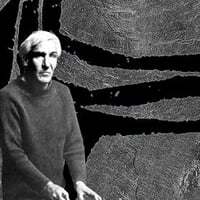
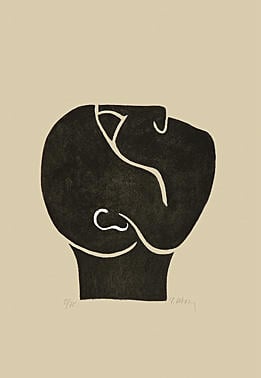
Expert analysis of Raoul Ubac’s Tête levée
Style: Abstract Expressionism · Genre: figurative
Analysis of "Tête levée" by Raoul Ubac
Raoul Ubac’s "Tête levée" occupies a fascinating threshold between two dominant mid-20th‑century currents: the lingering surrealist interest in the human form and the emerging, predominantly American, idiom of Abstract Expressionism. While the work is classified as figurative, its treatment of the head (the "raised head" of the title) is anything but literal. Ubac dissolves the traditional portrait into a field of gestural marks, dense textures, and biomorphic shapes that recall shattered bone, weathered stone, or organic growth.
Within the context of Abstract Expressionism, Ubac’s contribution is significant precisely because he does not abandon the figure entirely. Instead, he subjects it to a radical transformation that parallels the movement’s core concerns—spontaneity, materiality, and the expression of inner psychic states—while maintaining a tenuous link to recognizable anatomy. This creates a charged tension: the viewer’s eye searches for the face that is “raised,” only to find it emerging from and receding into a field of painterly energy.
Ubac’s European background adds a layer of philosophical weight. For much of his career, he worked with the human silhouette (in photography and painting), often referencing the trauma of war and existential vulnerability. "Tête levée" can be read as a solitary, defiant gesture—a head held high—but its fragmented, almost petrified surface suggests a state of becoming or dissolution. In this, Ubac bridges the emotive, gesture‑driven vocabulary of Abstract Expressionism with the existential questions posed by post‑war European art.
The work’s significance lies in its refusal to choose: it is figuration pushed to abstraction, a proof that Abstract Expressionist principles could be applied to the human image without losing expressive power. Ubac demonstrates that the “raised head” is not merely a body part but a symbol of consciousness, resistance, and transformation—rendered through the very materials of paint and surface that define the movement.
Visually similar
20 works with related composition and palette
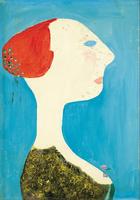
Anna Margit Női Profil
Anna Margit
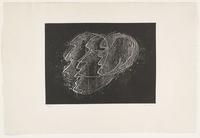
Hostages Black Ground
Jean Fautrier
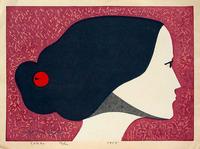
Coral
Kiyoshi Saito
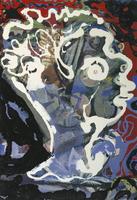
Head of Dylan Thomas
Eileen Agar
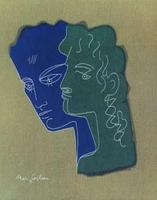
Untitled
Jean Cocteau
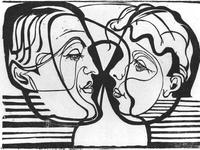
Two Heads Looking at Each Other
Ernst Ludwig Kirchner
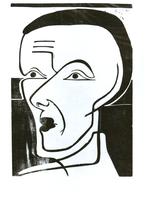
Self-portrait
Ernst Ludwig Kirchner
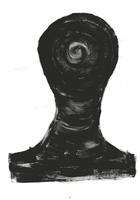
Drow-ink 8
Ikhwan Sugianto
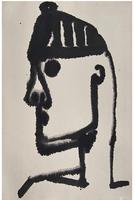
Profile
Vilen Barsky
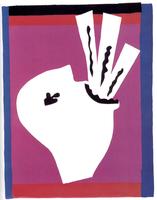
The Circus
Henri Matisse
The end of contemplation
Rene Magritte
Hlava chlapce
Josef Capek
My Eye is a Mouth
Dieter Roth
Barcelona IV
Jorge Castillo
Kiss
Darwin Stead
Illustration
Peter Max
Three Profiles between the Vertical and the Diagonal (Drei Profile zwischen der Senkrechten und der Diagonalen)
Oskar Schlemmer
Portrait of Vsevolod Meyerhold
Nikolai Kulbin
Untitled
Wilhelm Sasnal
Untitled
Christo Coetzee