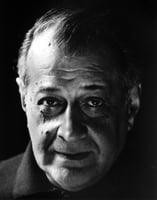
Analisi esperta di Composition abstraite di Serge Poliakoff
Stile: Tachisme · Genere: abstract
Expert Analysis of Serge Poliakoff’s Composition abstraite (c. 1950s)
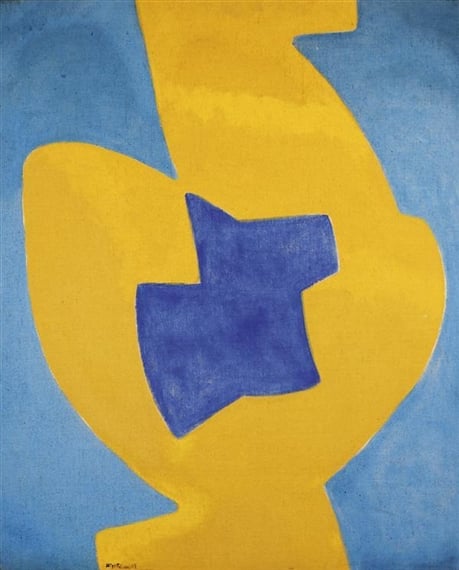
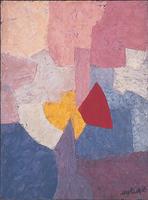
Serge Poliakoff’s Composition abstraite exemplifies the core principles of Tachisme—the French abstract movement that emerged in the 1940s and ’50s as a counterpoint to geometric abstraction. In this untitled work (the title itself underscores its non-representational intent), Poliakoff masterfully balances spontaneity with structural rigor, creating a visual field that is both intuitive and meticulously controlled.
Visual and Stylistic Features
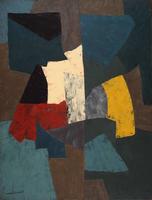
The painting is built from irregular, interlocking patches of muted color—deep ochres, slate blues, warm greys, and earthy reds—arranged in a loose grid that seems to breathe. Unlike the hard edges of geometric abstraction, Poliakoff’s forms are soft, almost organic, as if the pigment has been applied in layers, thinned and scraped to reveal subtle shifts in hue and density. The brushwork is restrained yet tactile; each shape feels like a residue of a decision, not a premeditated plan. This is Tachisme’s hallmark: the “blot” or tache (French for stain) that records the artist’s gesture without rigid outline, allowing color to assert its own emotional weight.
Significance Within Tachisme
Poliakoff’s contribution to Tachisme lies in his unique synthesis of lyrical abstraction and compositional discipline. Where many Tachiste painters (like Georges Mathieu or Jean Fautrier) emphasized explosive, gestural chaos, Poliakoff favored a quieter, more meditative approach. His “compositions” are not random but carefully calibrated—each color block exists in tension and harmony with its neighbors, creating a unified surface that pulsates with inner light. This work is significant because it demonstrates how Tachisme could be introspective rather than merely dramatic, retaining the movement’s commitment to spontaneous expression while achieving a serene, almost architectural balance.
Place in Poliakoff’s Oeuvre
Composition abstraite belongs to Poliakoff’s mature period, when he fully embraced the Russian icon tradition of flat, luminous color planes and the School of Paris’s love for nuanced tonal shifts. The painting’s resonance comes from its ability to feel both ancient and modern—echoing Byzantine mosaics yet utterly contemporary in its refusal to depict anything but itself. It stands as a testament to Poliakoff’s belief that abstraction could convey spiritual depth through pure color and form, a key legacy within Tachisme and post-war European painting.
Visivamente simili
20 opere con composizione e palette affini
Pedestal
Pablo Picasso
Composition
Serge Poliakoff
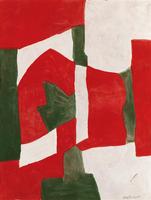
Untitled
Serge Poliakoff
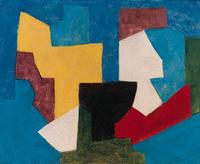
Composition multicolore à dominante bleue
Serge Poliakoff
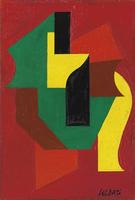
Composizione
Atanasio Soldati
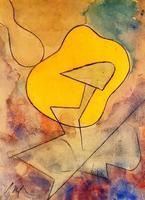
Moondancer
Jean Arp
Still Life (pochoir Design)
Dorrit Black
Mystere vert
Alberto Magnelli
Composition
Serge Poliakoff
Composition carmin, brune, jaune et grise
Serge Poliakoff
Calligraphy
Mark Tobey
Sborul păsărilor
Ion Pacea
Studio per composizione
Enrico Prampolini
Abstract Composition
Serge Poliakoff
Composition Tight Curves. 25
Carl Buchheister
Interior
Robert Blackburn
Bortnyik Sándor, MA Almbum 1921
Sandor Bortnyik
Etude de tissu
Serge Poliakoff
Untitled
Harriet Korman
With Premeditation
Alberto Magnelli