
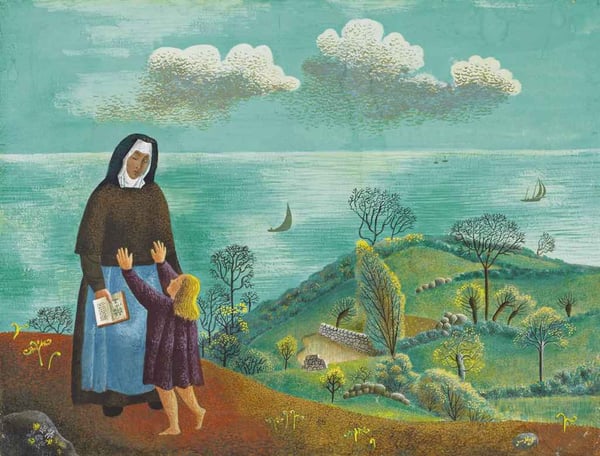
Expert analysis of Jean Hugo’s Sainte-Anne
Style: Naïve Art (Primitivism) · Genre: genre painting
Expert Analysis of "Sainte-Anne" by Jean Hugo
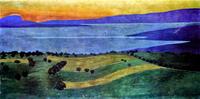
Jean Hugo’s Sainte-Anne is a compelling example of Naïve Art (Primitivism), a style that deliberately eschews academic conventions in favor of directness, flatness, and a childlike or folk-like simplicity. As a genre painting, the work likely depicts a scene from everyday life or a familiar religious subject (Saint Anne being the mother of the Virgin Mary), yet rendered through the distinctive lens of Naïve Art.
Significance within Naïve Art (Primitivism):
- Rejection of virtuosity: Unlike trained painters, Naïve artists such as Hugo often employ simplified forms, unmodulated color, and a disregard for linear perspective. In Sainte-Anne, this would manifest as a flattened spatial arrangement, where figures and objects are arranged with a charming, literal clarity that prioritizes symbolic meaning over naturalistic depth.
- Folk or religious authenticity: The choice of Saint Anne—a beloved, maternal figure—aligns with Naïve Art’s frequent focus on traditional, devotional, or rustic subjects. Hugo’s treatment likely emphasizes warmth, accessibility, and a direct emotional connection, bypassing the grandeur of academic religious painting.
- Personal vision: Jean Hugo (a French painter and stage designer, 1894–1984) was associated with the “Naïve” movement that included artists like Henri Rousseau. His work often blends a refined decorative sense with an intentionally untutored look. Sainte-Anne would be significant for how it marries a classic religious theme with a modern primitivist aesthetic, making the sacred feel intimate and unhieratic.
Significance as a Genre Painting:
- Elevation of the ordinary: Even when depicting a saint, Naïve genre painting treats the subject as part of a recognizable, human-scaled world. The painting likely shows Saint Anne in a domestic or pastoral setting—sewing, reading, or with the young Virgin—rather than in a grandiose celestial scene. This aligns with the genre tradition of finding the divine in the quotidian.
- Narrative simplicity: The composition would be straightforward, perhaps frontal and symmetrical, with each element clearly readable. This clarity invites viewers to engage with the story without needing art-historical knowledge, reinforcing the democratic spirit of Naïve Art.
Conclusion: Sainte-Anne is significant as a work that channels the core values of Primitivism—innocence, directness, and a heartfelt devotion to subject—through the framework of genre painting. Jean Hugo transforms a traditional Christian figure into an emblem of humble, everyday grace, demonstrating how Naïve Art can make the sacred feel both timeless and refreshingly human.
Genre
Visually similar
20 works with related composition and palette
A Widow
Paul Serusier
Madeline with the Offering
Paul Serusier
Promenade au bord de la mer (Rencontre des fiancés)
Andre Bauchant
Excursion to the Ecumenical Cioncile
Fernando Botero
Dymaxion Principle (#110)
Mark Ryden
Jeanne d'Arc, or Breton girl spinning
Paul Gauguin
Bretons on a Path
Paul Serusier
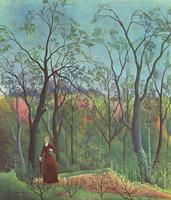
The Walk in the Forest
Henri Rousseau
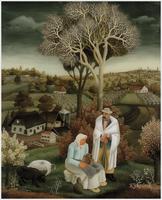
Resting under the tree
Ivan Generalic
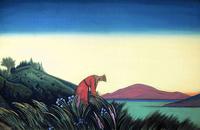
Beneficial herbs (Vasilisa the Wise)
Nicholas Roerich
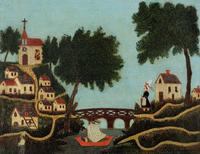
Landscape with Bridge
Henri Rousseau
The adoration of the Magi (detail)
Hieronymus Bosch
L'attesa
Carlo Carra
View of the Fortifications
Henri Rousseau
A Beautiful World
Grandma Moses
Winter in the Village
Ivan Generalic
Les Ursulines
Jean Paul Lemieux
Tuonelan Portilla
Hugo Simberg
Landscape on the Teggernsee with a reading man
August Macke
The Lake Leman, effect of the evening
Felix Vallotton