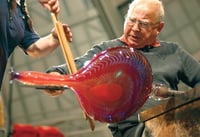
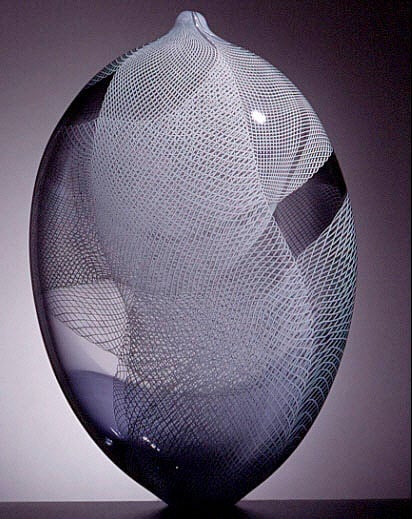
Ostuni
Expertenanalyse zu Lino Tagliapietras Ostuni
Stil: Op Art · Genre: sculpture
Expert Analysis of "Ostuni" by Lino Tagliapietra
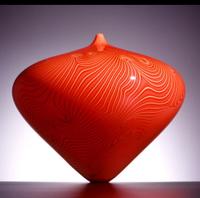
Lino Tagliapietra’s Ostuni is a landmark sculpture that exemplifies the convergence of Op Art principles with the centuries-old Venetian glassblowing tradition. By marrying the rigorous geometry and perceptual play of Op Art with the fluid, luminous medium of Murano glass, Tagliapietra elevates glass sculpture from decorative craft to a sophisticated dialogue with modernist visual theory.
Op Art Characteristics in Glass
The work’s significance lies in its translation of Op Art’s core concerns—illusion, vibration, and the instability of visual perception—into a three-dimensional, translucent form. Tagliapietra employs stark contrasts of color and precise linear patterning (likely in rhythmic bands or concentric motifs) that seem to shift, ripple, or float as the viewer moves around the piece. This creates a kinetic effect without actual movement, a hallmark of Op Art. The transparency and internal reflections of glass amplify these optical effects, adding layers of depth that a flat canvas cannot achieve. Light passing through the sculpture generates ever-changing highlights and shadows, making the work feel alive and responsive to its environment.
Significance within Glass Art
Before Tagliapietra, glassblowing was primarily associated with functional objects or figurative decoration. Ostuni stands as a pivotal work because it repurposes glass as an “advanced” medium for pure perceptual research. Tagliapietra’s technical mastery—his ability to control viscosity, color layering, and internal air traps—allows him to realize the crisp geometry and illusionistic depth demanded by Op Art. This fusion challenges traditional hierarchies in art: the sculpture is both a feat of craftsmanship and a rigorous conceptual statement about vision itself.
The Title’s Implication
The title Ostuni references the whitewashed, geometrically layered town in Puglia, Italy. This connection grounds the abstract Op Art forms in a tangible architectural landscape, suggesting that perception is not purely theoretical but shaped by real environments. The interplay of light and white surfaces in Ostuni’s historic center parallels the sculpture’s own optical radiance.
Legacy
Ostuni is significant as a milestone in Tagliapietra’s career and in the broader field of studio glass. It demonstrates that Op Art’s visual puzzles can be realized in a medium that is inherently refractive, transparent, and colored, adding a dimension of material alchemy to perceptual experience. The work solidified Tagliapietra’s reputation as an artist who expanded the boundaries of blown glass, inspiring a generation to treat glass as a fine-art medium capable of engaging with contemporary movements like Op, Minimalism, and Light and Space art. In Ostuni, the viewer is not merely observing a sculpture but participating in an optical event—a quiet, shimmering provocation that redefines what glass can say about the nature of seeing.
Visuell ähnlich
20 Werke mit ähnlicher Komposition und Farbpalette
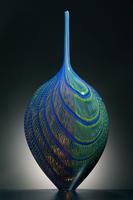
Tatoosh
Lino Tagliapietra
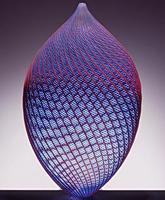
Borneo
Lino Tagliapietra
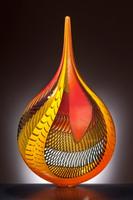
Saba
Lino Tagliapietra
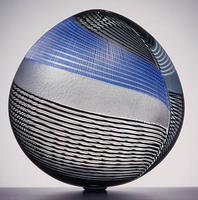
Altare
Lino Tagliapietra
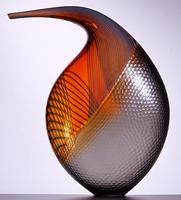
Cornacchia
Lino Tagliapietra
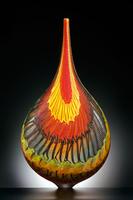
Maui
Lino Tagliapietra
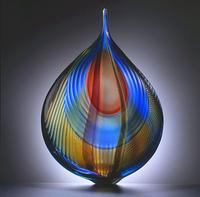
Makah
Lino Tagliapietra
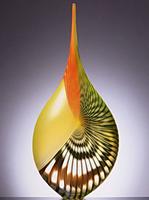
Coronado
Lino Tagliapietra
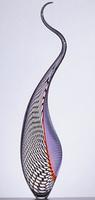
Dinosaur
Lino Tagliapietra
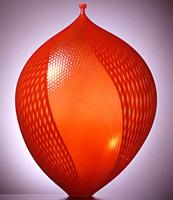
Foemina
Lino Tagliapietra
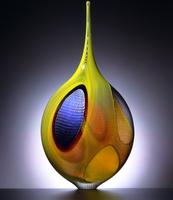
Bilbao
Lino Tagliapietra
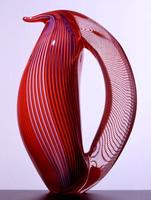
Penguino Ballerino
Lino Tagliapietra
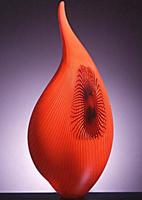
Hama Hama
Lino Tagliapietra
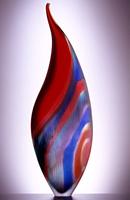
Coinbra
Lino Tagliapietra
Madras
Lino Tagliapietra
Silea
Lino Tagliapietra
Giudecca
Lino Tagliapietra
Piccadilly
Lino Tagliapietra
Hopi
Lino Tagliapietra
Angel Tear
Lino Tagliapietra