
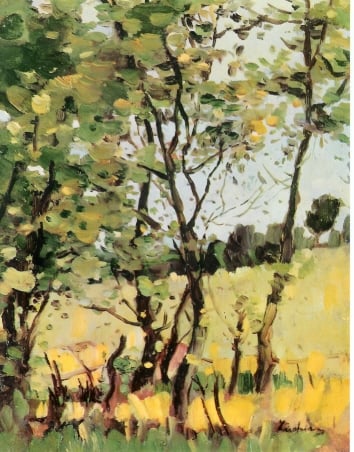
Expert analysis of Stefan Luchian’s The River Meadow at Poduri
Style: Impressionism · Genre: landscape
Expert Analysis – "The River Meadow at Poduri" by Ștefan Luchian
Style & Period Significance:
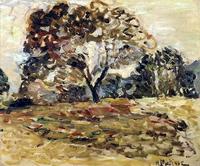
As a work of Romanian Impressionism, The River Meadow at Poduri exemplifies how Luchian—often called the father of modern Romanian painting—adapted the French Impressionist idiom to the rural landscapes of his homeland. While acknowledging the movement’s core principles—plein air execution, broken brushwork, and vivid light effects—Luchian infuses the scene with a distinctly local sensibility: the quiet, unpretentious beauty of the Romanian countryside.
Composition & Technique:
Though specific visual details are not provided, the title suggests a lush, open meadow beside a river, typical of the Bărăgan or Oltenia plains Luchian favored. His characteristic approach would involve:
- Dynamic, short strokes that capture the shimmer of water and the rustle of grass, prioritizing optical sensation over meticulous detail.
- A high-key palette dominated by greens, yellows, and blues, with touches of complementary color (e.g., vermilion accents) to enhance luminosity—a hallmark of Impressionist color theory.
- A focus on atmospheric conditions (likely a summer afternoon) where sunlight filters through clouds, dappling the meadow in shifting patches of warmth and shadow.
Artistic Legacy:
The River Meadow at Poduri is significant as a key example of Luchian’s mature period (c. 1900–1910), when he synthesized Impressionist spontaneity with a personal, lyrical attachment to Romania’s natural environment. Unlike many Western Impressionists who painted urban leisure scenes, Luchian turned to the humility of rural life—farmlands, riverbanks, and forests—thus democratizing the movement’s subject matter. His work bridged the gap between traditional Romanian painting (marked by Neo-Classical and Romantic conventions) and the modern emphasis on light and subjective perception.
In the broader context of European Impressionism, this painting stands out for its regional authenticity: it is not a generic landscape but a specific, felt place. Luchian’s ability to capture the transient beauty of this meadow, while working under the physical limitations of multiple sclerosis (which eventually confined him), adds a layer of poignant dedication to the artist’s craft. The painting remains a testament to Impressimism’s adaptability—proving that its central concerns (light, color, immediacy) could flourish far beyond Paris.
Visually similar
20 works with related composition and palette
Young oaks
Pyotr Konchalovsky
Landscape at Ladyzhino
Natalia Goncharova
Summer Landscape (Summertime)
Joseph DeCamp
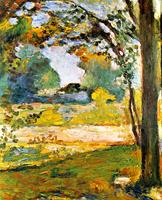
Toulouse Landscape
Henri Matisse
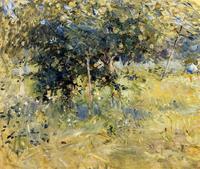
Willows in the Garden at Bougival
Berthe Morisot
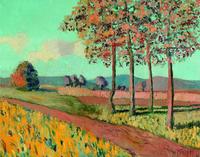
Country Landspace
Kmetty János
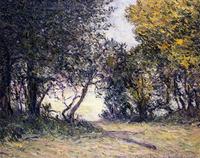
Beg-Miel, Bay of Cocarneau
Maxime Maufra
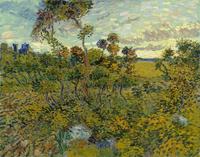
Sunset at Montmajour
Vincent van Gogh
Wheatfield by the Sea
Nathaniel Hone the Younger
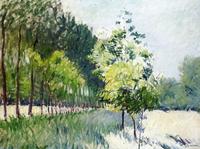
Orchard and avenue of trees
Gustave Caillebotte
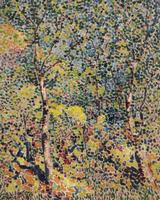
Impressionist Landscape
Harry Phelan Gibb
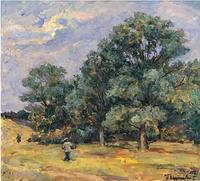
Twilight
Pyotr Konchalovsky
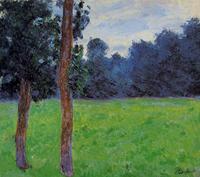
Two Trees in a Meadow
Claude Monet
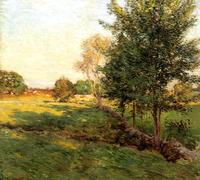
Lenghtening Shadows
Willard Metcalf
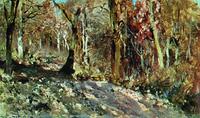
Autumn forest
Isaac Levitan
Summer
Cuno Amiet
Undergrowth
Vincent van Gogh
In the Woods (study)
Pierre Bonnard
Path Towards the Cemetery
Stefan Luchian
Landscape of Corsica
Henri Matisse