Expertenanalyse zu Natalia Goncharovas Landscape at Ladyzhino
Stil: Cubism, Expressionism · Genre: landscape
Expert Analysis of “Landscape at Ladyzhino” by Natalia Goncharova
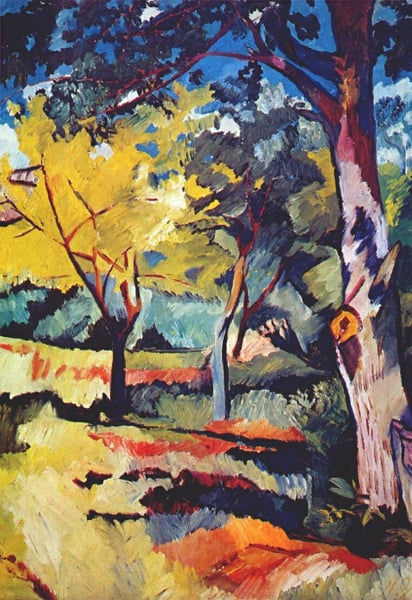
Natalia Goncharova’s Landscape at Ladyzhino stands as a pivotal work within the intersection of Cubism and Expressionism, illustrating the artist’s bold synthesis of Russian folk traditions with the radical formal experiments of the European avant-garde. Painted during a period of intense creative ferment (c. 1912–1913), the work exemplifies Goncharova’s unique contribution to Cubo-Futurism—a movement that merged Cubist spatial fragmentation with Futurist dynamism and an unmistakable Russian sensibility.
Stylistic Significance within Cubism and Expressionism
Goncharova pushes Cubism beyond its Parisian origins by infusing it with expressive, almost primal energy. Rather than the cool, analytical dissection of form found in Braque or Picasso, she employs fractured planes and angular facets to capture the visceral pulse of the Russian countryside. The landscape’s forms—trees, fields, and sky—are shattered into sharp, overlapping geometric shards, yet they retain a rhythmic, organic flow that suggests growth and movement. This hybridity is central to Goncharova’s achievement: she uses Cubist structure not for intellectual abstraction, but to heighten emotional resonance, a hallmark of Expressionism.
The palette is equally telling: earthy browns, ochres, and greens are punctuated by vivid blues and whites, creating a tension between natural observation and subjective emotion. Goncharova’s brushwork is energetic, even rough, rejecting refined finish in favor of raw immediacy—a move that aligns her with the Expressionist rejection of academic polish.
Placement within Goncharova’s Career and Russian Avant-Garde
Landscape at Ladyzhino reflects a transitional moment when Goncharova was moving away from Impressionist and Symbolist influences toward a more radical, synthetic language. The title references Ladyzhino, an estate near Kiev where she lived and worked, grounding the painting in a specific place while abstracting it into a universal vision. This duality—provincial subject matter treated with avant-garde technique—was central to her project of forging a modern Russian art that was neither derivative of the West nor trapped in folklore.
The work is significant for how it incorporates lubok (popular folk print) conventions—flattened space, bold outlines, and decorative patterns—within a Cubist framework. Goncharova’s use of non-naturalistic color and skewed perspective recalls the expressive distortions of Fauvism and German Expressionism, yet the underlying grid-like structure remains recognizably Cubist.
Legacy and Influence
Landscape at Ladyzhino exemplifies Goncharova’s role as a bridge between Eastern and Western modernism. It anticipates her later, more abstract works and her influential involvement with the Russian avant-garde groups such as the Jack of Diamonds and Donkey’s Tail. By demonstrating that Cubism could be warm, visceral, and tied to national identity rather than coolly intellectual, Goncharova expanded the movement’s possibilities. This painting remains a vibrant testament to her fearless experimentation and her conviction that modernity and tradition could coexist in a single, explosive landscape.
Visuell ähnlich
20 Werke mit ähnlicher Komposition und Farbpalette
Paysage, sketch to the "Strange garden"
Józef Mehoffer
Study for 'In the Woods with Female Nude
Henri-Edmond Cross
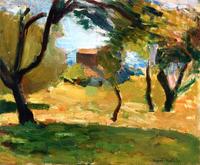
Corsican Landscape
Henri Matisse
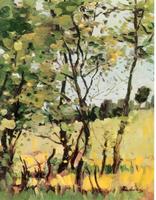
The River Meadow at Poduri
Stefan Luchian
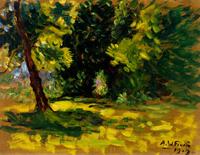
Bushes
Alfred William Finch
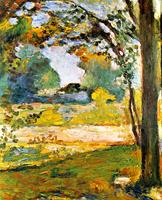
Toulouse Landscape
Henri Matisse
A Close
Paul Cezanne
The large tree
Paul Gauguin
In the Woods (study)
Pierre Bonnard
Summer
Cuno Amiet
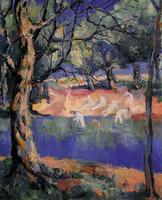
River in Forest
Kazimir Malevich
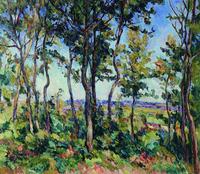
Young oaks
Pyotr Konchalovsky
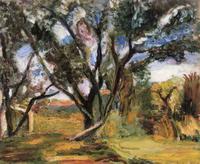
The Olive Tree
Henri Matisse
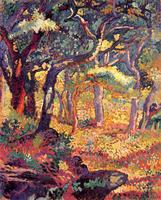
Study for The Clearing
Henri-Edmond Cross
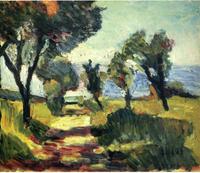
Olive Trees
Henri Matisse
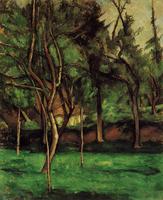
Orchard
Paul Cezanne
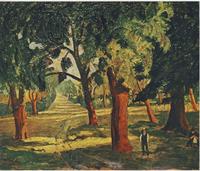
Cork Trees Near Mimizan
Winston Churchill
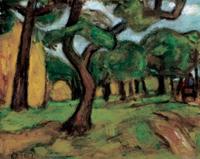
In the Garden
Bela Czobel
Landscape with Olive Trees
Henri Matisse
Landscape with a Tree
Michel Kikoine