Expertenanalyse zu John Marins From Seeing Cape Split
Stil: Expressionism · Genre: landscape
Expert Analysis
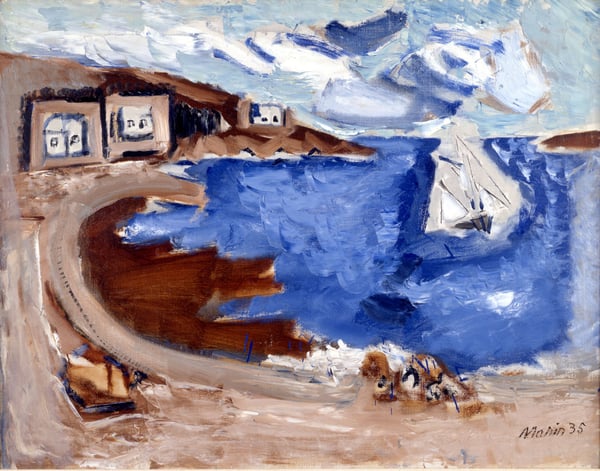
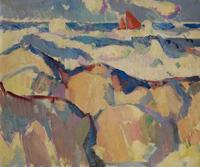
John Marin’s From Seeing Cape Split is a landmark of American Expressionist landscape painting. Executed in the artist’s signature watercolor style, the work transforms a specific coastal vista (Cape Split, Maine) into a visceral, almost abstracted field of energy. Instead of depicting the scene with topographical accuracy, Marin breaks the landscape into vibrant, fractured planes of color and rapid, calligraphic line—a technique he called “pushing the landscape into the picture.”
What makes this work significant within Expressionism is how it balances pure subjective feeling with the structural logic of nature. The “seeing” in the title signals that this is not a passive view but an active, perceptual event; Marin’s jagged strokes and saturated washes convey the restless rhythm of wind, water, and rock. His approach—influenced by both European Fauvism and the dynamism of American urban painting—helped define a uniquely American Expressionist vocabulary. Here, the landscape becomes an immediate record of the artist’s sensory encounter, where every brushstroke suggests motion, light, and the emotional force of the natural world.
Genre
Stil
Visuell ähnlich
20 Werke mit ähnlicher Komposition und Farbpalette
Sailboats
Pierre-Auguste Renoir
Seascape
Nikolaos Lytras
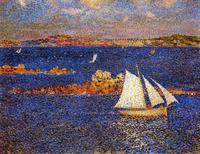
Near the Rocks of Per Kiridec
Theo van Rysselberghe
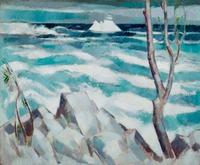
The Breeze, Antibes
John Duncan Fergusson
The Sea at Kavarna
Gheorghe Petrascu
Sailboats near the coast
Henri Martin
O Barco
Anita Malfatti
Sea by the coasts of Finland
Isaac Levitan
Pier in Gurzuf
Konstantin Korovin
Sea
Vasily Vereshchagin
Le Rivage, Etretat
Henri Matisse
Rough Day
Fujishima Takeji
Fishing Boats. St. Ives.
Stanley Spencer
Coup De Vent (Marine)
Alexis Gritchenko
The Point, Gloucester
Maurice Prendergast
Birds of the Bagaduce
Marsden Hartley
The Coast of Brittany, Fishing Boats
Pierre-Auguste Renoir
La tarmul marii
Ion Pacea
The Red Sail
John Duncan Fergusson
Landscape
Gustave de Smet