Expertenanalyse zu Amadeo de Souza-Cardosos Corpus Christi procession
Stil: Cubism · Genre: genre painting
Expert Analysis: Corpus Christi Procession by Amadeo de Souza-Cardoso
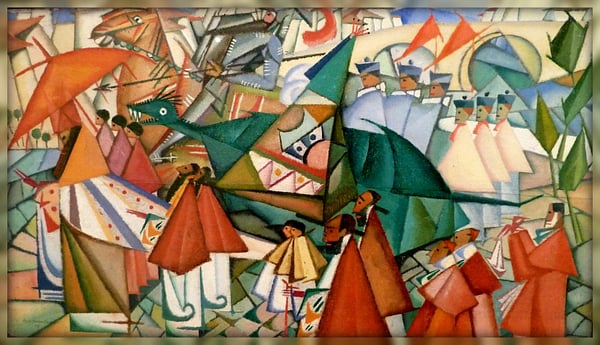
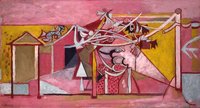
Amadeo de Souza-Cardoso’s Corpus Christi Procession is a remarkable example of how Cubist principles were adapted to a traditional genre painting, imbuing a familiar religious and social scene with radical formal energy. Executed during his brief but intensely innovative career (he died tragically young in 1918), this work stands at the crossroads of European avant-garde aesthetics and Portuguese cultural identity.
Significance within Cubism and Genre Painting
Most Cubist works from the Parisian school (Picasso, Braque, Gris) focused on still lifes, portraits, or abstracted nudes. Souza-Cardoso, however, took the Cubist vocabulary—faceted planes, shifting perspectives, fragmented forms, and a subdued yet vibrant palette—and applied it to a genre painting: a public procession. This choice is significant because it demonstrates that Cubism could serve narrative and social commentary, not just formal experimentation. The subject—a Corpus Christi procession—is inherently dynamic, with its moving crowd, banners, clergy, and faithful. By breaking the scene into intersecting geometric shards, Souza-Cardoso captures the sensory overload of the event: the jostling bodies, the flickering candlelight, the rhythmic sway of religious icons. The canvas becomes a visual translation of movement and collective piety, rather than a static documentary.
Cultural and Stylistic Hybridity
Souza-Cardoso was a Portuguese artist who lived in Paris and absorbed Cubism, Futurism, and Expressionism. Corpus Christi Procession synthesizes these influences while remaining rooted in Portuguese tradition. The procession is a deeply Catholic, community-centered ritual, yet Souza-Cardoso renders it with the fractured, multi-viewpoint language of Cubism. This hybridity is key to his significance: he provincializes Cubism, proving it was not merely a French school but a flexible tool for representing local life. The painting’s bold color contrasts—ochre, deep blue, and touches of red—and its dynamic angularity also echo the explosive energy of Futurism, giving the ancient procession a modern, almost syncopated rhythm.
Technical and Formal Innovation
As a Cubist genre painting, the work challenges the viewer to read the scene not as a unified window onto reality, but as a constructed, multiple-viewpoint experience. Elements such as the cross, the canopy, and the figures are simultaneously recognizable and abstracted. The composition’s diagonal thrust and overlapping planes create a sense of urgency, as if the procession is charging toward the spectator. This formal innovation—merging the everyday with the avant-garde—shows that Souza-Cardoso was not a mere imitator of Picasso or Braque, but an original voice who used Cubism to explore his own cultural heritage.
Legacy
Corpus Christi Procession is significant because it exemplifies the global reach of Cubism and the ability of a non-French artist to infuse the style with personal and national meaning. It bridges the gap between high modernism and folkloric tradition, and stands as a testament to Souza-Cardoso’s role as a pioneer of Portuguese modernism. The work reminds us that Cubism was not a monolith but a living language, adaptable to genre painting and capable of capturing the soul of a community in motion.
Genre
Stil
Visuell ähnlich
20 Werke mit ähnlicher Komposition und Farbpalette
The Tournament. The War Series.
Joan Tuset
Painter and the Wheel
William Balthazar Rose
Lancers
Gino Severini
Untitled
Alaa Awad
Bortnyik Sándor Múvészek Bevonulása Az Alapba
Sandor Bortnyik
Scheiber Hugó , Sturm Bál 1925, Olaj, Papírlemez, 71x102cm
Scheiber Hugó
Bucolic Landscape
Heinrich Campendonk
Fishing Schooner
Pavel Filonov
East and West
Pavel Filonov
My Absolute
Max Ernst
A revolta - A revolta das bonecas
Eduardo Viana
Femmes cousant
Albert Gleizes
Angel of the Last Judgment
Wassily Kandinsky
The Wedding
Fernand Leger
Kondor Béla, Dózsa Legényei
Kondor Béla
Stables
Franz Marc
Drei Reiter mit Lasso
Heinrich Campendonk

Plastic Dynamism: Horse+House
Umberto Boccioni
Girl of carnations
Amadeo de Souza-Cardoso
Large Vine Pergola No. 2
Graham Sutherland