Analisi esperta di East and West di Pavel Filonov
Stile: Analytical Realism · Genere: allegorical painting
Expert Analysis of East and West by Pavel Filonov
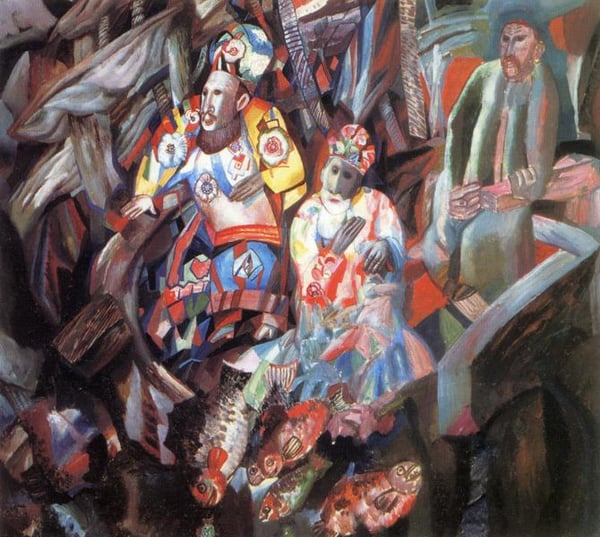
Pavel Filonov’s East and West (c. 1912–1915) stands as a pivotal work within his idiosyncratic system of Analytical Realism, a style that sought to dismantle and rebuild visual perception through meticulous, crystalline brushstrokes and densely layered compositions. Executed as an allegorical painting, the work eschews simple narrative in favor of a profound meditation on cultural and spiritual synthesis.
Significance within Analytical Realism
Filonov’s method—often called “made painting”—involves building every centimeter of the canvas with tiny, faceted strokes that create a vibrating, almost biological surface. In East and West, this technique transforms the allegory into a dynamic field of energy. Rather than presenting two static, opposing figures (e.g., a robed Eastern sage and a Western industrialist), Filonov dissolves their boundaries. The “East” and “West” are not separate entities but interpenetrating forms, their features constructed from the same cellular units of paint. This visual ambiguity is central to Filonov’s anti-cubist stance: where Cubism fractures objects to analyze them, Analytical Realism fuses them into a unified, pulsating whole.
Allegorical Innovation
The painting’s significance also lies in its radical reinterpretation of allegory. Traditional allegorical painting relies on recognizable symbols (scales, globes, classical figures). Filonov replaces these with an abstracted, almost organic morphology. The “East” might be suggested by a crescent-shaped structure or veiled eye; the “West” by a machine-like cluster or a grid of lines. Yet these elements are woven so tightly that the viewer cannot isolate them. The allegory thus becomes a process of becoming—the constant metamorphosis of cultures, not their opposition. This reflects Filonov’s utopian belief in a universal, “biological” art that could transcend historical divides.
Legacy
Within the Russian avant-garde, East and West is a rare example of metaphysical content rendered through purely optical means. It anticipates later non-objective abstraction, but retains a deeply humanist, symbolic resonance. Filonov’s uncompromising technique—labor-intensive and radically anti-commercial—makes the work a manifesto for art as a form of cosmic cognition, where East and West are not polarized but synthesized in the viewer’s own act of seeing.
Genere
Stile
Visivamente simili
20 opere con composizione e palette affini
Ships
Pavel Filonov
Fishing Schooner
Pavel Filonov
West and East
Pavel Filonov
The Dray Men
Pavel Filonov
Corpus Christi procession
Amadeo de Souza-Cardoso
David and Goliath
Avigdor Arikha
Mountaineers Attacked by Bears
Henri Le Fauconnier
Grey oval
Wassily Kandinsky
Small Pleasures
Wassily Kandinsky
Improvisation. Gorge
Wassily Kandinsky
A Guerra
Maria Helena Vieira da Silva
El sueno de Dona Marina 2
Alberto Gironella
Angel of the Last Judgment
Wassily Kandinsky
At the Table
Pavel Filonov
Rebirth of the People
Pavel Filonov
Komposition med fartyg och figurer
Gosta Adrian-Nilsson
Fyra flickor och en student
Georg Pauli
Bomb Store
David Bomberg
Daudet
Bela Czobel
A revolta - A revolta das bonecas
Eduardo Viana