Expert analysis of Barnett Newman’s Canto VIII
Style: Color Field Painting · Genre: abstract
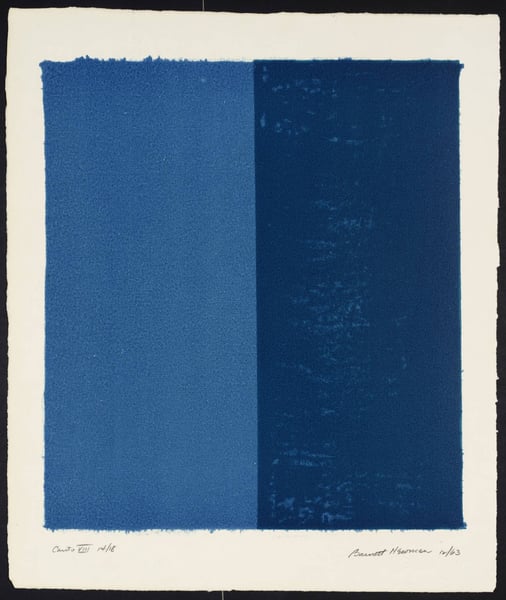
Barnett Newman’s “Canto VIII” (c. 1963–64) stands as a quintessential example of Color Field Painting and a landmark in mid‑20th-century abstraction. Executed during the artist’s mature period, the work belongs to his celebrated Canto series—a group of canvases named after the epic poetic divisions of Dante’s Divine Comedy, underscoring Newman’s ambition to evoke the sublime and the infinite through pure color and form.
Formal Innovation: The “Zip” as a Spatial Threshold
At first glance, the painting presents a vast, unmodulated field of intense color—here, likely a deep, resonant blue or a luminous red (depending on the specific “Canto VIII” in question). However, the work’s true significance lies in Newman’s signature “zip”: a thin, vertical band of a contrasting hue that runs from the top to the bottom edge of the canvas. Unlike the gestural drips of contemporaneous Abstract Expressionists, Newman’s zip is crisp, deliberate, and almost architectural. It does not merely divide the canvas; it activates the entire field, creating a dynamic tension between the zip and the surrounding color. The zip becomes a threshold—a point of entry that both separates and unites the expansive fields, forcing the viewer to experience the painting in a single, holistic glance.
Breaking with Abstract Expressionism
Newman’s approach represented a radical departure from the painterly, emotional intensity of the New York School. While Jackson Pollock or Willem de Kooning relied on energetic brushwork to convey existential struggle, Newman sought a meditative, transcendent experience. In “Canto VIII,” the absence of gesture, texture, or figuration pushes the work toward a purity of sensation. The color itself carries the emotional weight; Newman famously described his large-scale color fields as “a place” rather than a picture—a phenomenological arena where the viewer’s presence completes the work. This emphasis on scale and environment makes “Canto VIII” a precursor to Minimalism and a key influence on later artists like Donald Judd and Frank Stella, who would further reduce form to its essential components.
The Sublime in Abstraction
Newman was deeply influenced by the concept of the sublime—an overwhelming, awe-inspiring encounter with vastness and power. In “Canto VIII,” the monumental scale (typically six to eight feet in height) and the stark simplicity of the zip create a visual equivalent to standing before a canyon or an endless horizon. The zip, often described as a “bolt of lightning” or a “vertical seam,” introduces a sense of drama and rupture within the serene color field. This duality—calm expanse versus sudden, sharp interruption—mirrors the philosophical tension between chaos and order, finitude and infinity. It is this ability to evoke the sublime without resorting to narrative or symbolism that marks Newman’s work as groundbreaking.
Legacy within Color Field Painting
As a leading figure of the Color Field movement, Newman, alongside Mark Rothko and Clyfford Still, redefined abstraction by prioritizing chromatic relationships and optical effect. However, “Canto VIII” is particularly significant because it demonstrates Newman’s mature synthesis of the two poles of his practice: the all‑over color field and the defining vertical line. Where Rothko’s soft, hovering rectangles invite immersive contemplation, Newman’s zips demand a more active, intellectual engagement—a dialogue between the painting’s literal surface and its metaphysical implications.
In summary, “Canto VIII” is significant not only as a masterful work of Color Field painting but also as a pivotal statement in the history of abstraction. It embodies Newman’s quest to create a modern equivalent of the sublime, stripping art down to its most irreducible elements—color, edge, and space—while nevertheless achieving profound emotional and spiritual resonance. Through works like this, Newman expanded the possibilities of abstract art, influencing generations of artists to think of painting as an encounter, not merely an object.
Museum / Gallery
Visually similar
20 works with related composition and palette
Canto VII
Barnett Newman
Canto IX
Barnett Newman
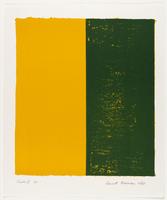
Canto X
Barnett Newman
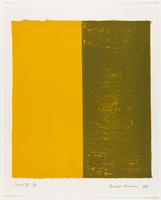
Canto XIII
Barnett Newman
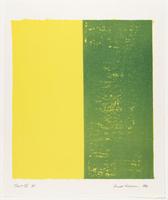
Canto XII
Barnett Newman
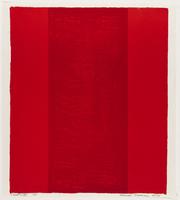
Canto XV
Barnett Newman
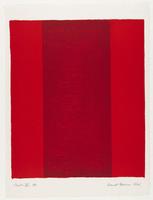
Canto XVI
Barnett Newman
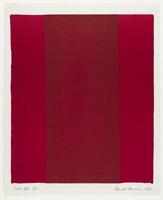
Canto XIV
Barnett Newman
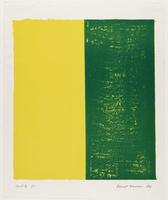
Canto XI
Barnett Newman
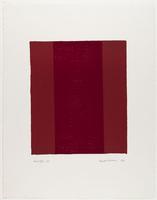
Canto XVIII
Barnett Newman
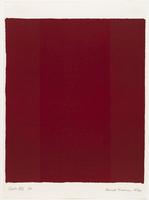
Canto XVII
Barnett Newman
Broad Stripe: 6
Sherrie Levine
Green Stance
Warren Rohrer
Blues, Reds
John Hoyland
Red Baron
Gene Davis
Untitled
Peter Joseph
467/67
Rupprecht Geiger
Untitled
Anne Truitt
"Untitled"
Kosakov Dimitrij
Red, Blue
John Hoyland