
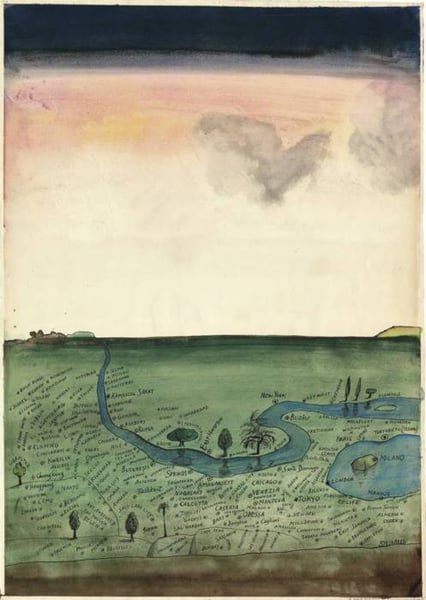
Экспертный разбор работы «Autogeography» художника Saul Steinberg
Стиль: Expressionism · Жанр: landscape
Expert Analysis of "Autogeography" by Saul Steinberg
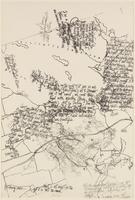
Despite Saul Steinberg’s well-known reputation as a satirical draftsman for The New Yorker, the supplied facts classify "Autogeography" as an Expressionist landscape—a designation that immediately reorients the work’s significance. Under this lens, the painting becomes a powerful example of how Expressionism can transform a conventional genre (landscape) into a subjective, emotionally charged psychological terrain.
Significance within Expressionism:
Expressionism prioritizes the artist’s inner experience over objective representation. In "Autogeography," Steinberg achieves this by treating the landscape not as a literal place but as a cartography of the self. The title itself—a fusion of “autobiography” and “geography”—signals a radical redefinition of landscape: it is a map of memory, identity, and emotional states. The distorted, gestural lines and deliberately idiosyncratic spatial logic (hallmarks of Steinberg’s hand, here infused with Expressionist intensity) create a sense of unease and introspection. The work eschews realistic perspective for a flattened, almost childlike schematism, yet this very simplicity conveys a dense, personal narrative—a hallmark of Expressionist rebellion against naturalism.
Genre Transformation:
By labeling it a landscape, the analysis forces us to see Steinberg’s piece as a subversion of the genre. Traditional landscapes depict physical spaces; Steinberg’s depicts a psychic space. The “geography” is made up of fragmented symbols, wandering lines, and ambiguous markers, suggesting a terrain shaped by memory and desire rather than topography. This aligns with the Expressionist goal of making the invisible visible—in this case, the interior landscape of the artist’s mind. The work’s significance lies in how it stretches the boundaries of landscape painting to include autobiography, prediction, and satire, all while retaining the raw emotional charge central to Expressionist aesthetics.
Legacy:
"Autogeography" stands as a pivotal work that bridges Steinberg’s signature wit with the emotional urgency of Expressionism. It demonstrates that a landscape can be inward, chaotic, and deeply personal—an idea that influenced later conceptual and postmodern cartographic art. The piece’s enduring importance is its ability to make the act of mapping oneself feel both vulnerable and liberating, using the language of Expressionism to chart the uncharted territory of the contemporary self.
Визуально похожие
20 работ с близкой композицией и палитрой
Cosmic Map
Bruno Munari
Monhegan (study)
Nicholas Roerich
Coast Ledenets
Nicholas Roerich
Monhegan (study)
Nicholas Roerich
Monhegan (study)
Nicholas Roerich
Sketch for a World map Part 1 (Americas, Pacific)
Oyvind Fahlstrom
Fishing Boats at Sea
Vincent van Gogh
Monhegan (study)
Nicholas Roerich
Armenia
Martiros Sarian
Lake Thun from the path to the plate Schynigen
Ferdinand Hodler
Landscape near Pisa
Leonardo da Vinci
Bleu optimiste
Wols
Armenian Landscape
Martiros Sarian
Plan of the existing factories in the Villa Adriana, with a dedication to St. M Stanislaus Augustus, King of Poland
Giovanni Battista Piranesi
Sketch of a Tree against Clouds with Colour Annotations
Vincent van Gogh
Sin título
Wols
Corfe Castle Village
Frances Hodgkins
Lake Thun from the path to the plate Schynigen
Ferdinand Hodler
Green Landscape with Houses and Road
Alfred Wallis
Mushroom Book Plate X
John Cage