
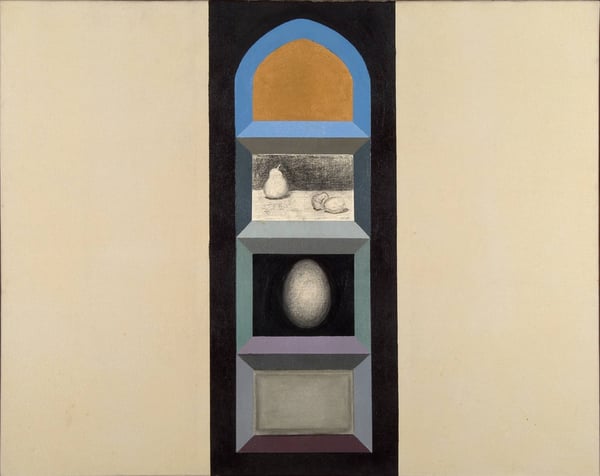
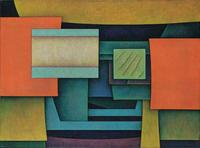
Shrine (for R.K.) II, 1963
Analisi esperta di Shrine (for R.K.) II, 1963 di Miriam Schapiro
Stile: Feminist Art · Genere: figurative
Analysis of "Shrine (for R.K.) II, 1963" by Miriam Schapiro
Miriam Schapiro’s Shrine (for R.K.) II stands as a pivotal early work within the Feminist Art movement, prefiguring many of the thematic and formal concerns that would define her later career and the movement at large. Created in 1963, the piece belongs to a period when Schapiro was beginning to move away from strict abstraction toward a more personal, narrative-driven figurative language—a shift that would become central to feminist art’s emphasis on subjective experience and the reclaiming of overlooked histories.
Significance within Feminist Art and Its Period
-
Proto-Feminist Personal Iconography
Even before the full emergence of the feminist art movement in the late 1960s and 1970s, Schapiro here employs the format of a “shrine”—a sacred, intimate space traditionally associated with domesticity, memory, and female ritual. The dedication “for R.K.” suggests a private act of commemoration, likely referencing a real person (possibly the artist Robert Kushner, though uncertain). By framing a personal tribute as a sacred object, Schapiro elevates the everyday and the emotional—a key feminist strategy later codified by artists like Judy Chicago and Faith Ringgold. -
Figurative as a Site of Resistance
At a time when Abstract Expressionism and Color Field painting still dominated the male-centric art world, Schapiro’s choice of figurative representation was itself a quiet rebellion. The figurative elements in Shrine (for R.K.) II are not literal portraits but symbolic, abstracted forms that hint at the body and personal narrative. This hybrid approach—mixing figuration with abstraction—allowed Schapiro to speak to female experience without being relegated to the “lesser” category of decorative or narrative art. -
Anticipation of Pattern and Decoration
Though this work predates Schapiro’s famous Femmages and Pattern and Decoration pieces of the 1970s, the shrine format already hints at a reverence for craft, repetition, and ornamentation—elements that would later become hallmarks of feminist art’s reclamation of “women’s work.” The act of making a shrine is itself a ritualistic, labor-intensive process, aligning the piece with the domestic arts that feminist artists would later champion. -
Gender and the Sacred
By naming the piece a “shrine,” Schapiro implicitly critiques the exclusion of women from both religious and art-historical canonization. Shrines are typically devoted to saints or martyrs; here, the honoree is an individual designated only by initials, inviting viewers to consider who gets remembered and who does the remembering. This questioning of value and legacy became a central pillar of feminist art.
In sum, Shrine (for R.K.) II is significant as a transitional work that merges personal emotion with a nascent feminist critique, using the language of the figurative to assert the importance of private experience and to challenge the hierarchies of both art and society. It marks Schapiro’s early embrace of the very strategies that would help define Feminist Art as a transformative force.
Genere
Stile
Visivamente simili
20 opere con composizione e palette affini
The House
Miriam Schapiro
Landscape Composition (Objects in Relation)
Paul Nash
Illustration for Nichita Stanescu's Epica Magna
Sorin Dumitrescu
Three Forms on Pink and Brown
Paule Vézelay
Botella Y Frutero Sobre Una Mesa
Maria Blanchard
My Room Has Two Doors
Kay Sage
Composition No. 37
Friedrich Vordemberge-Gildewart
Still Life with Pears
Alexandru Ciucurencu
F1
Pierre Daura
Geometric Composition
Georges Valmier
Still Life
Salvador Dali
Red Eggs
Petre Abrudan
The Unseen Side of the Moon
Vasile Dobrian
Variation IX
Leo Leuppi
Still Life. Centrifugal Expansion of Colors.
Gino Severini
Proun 23, No.6
El Lissitzky
The eggs on the dresser
Felice Casorati
Bortnyik Sándor, Térformációk
Sandor Bortnyik
Composition Geometrique
S. H. Raza
Legendary Landscape (Azul y Naranja)
Gunther Gerzso