Expertenanalyse zu Friedrich Vordemberge-Gildewarts Composition No. 37
Stil: Concretism · Genre: abstract
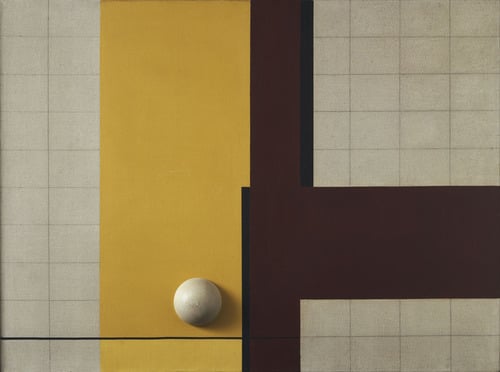
Expert Analysis: "Composition No. 37" by Friedrich Vordemberge-Gildewart
Within the strict parameters of Concretism—a movement that sought to purge art of all allusion, emotion, and narrative in favor of pure, rational form—Friedrich Vordemberge-Gildewart’s Composition No. 37 stands as a quintessential example of the style’s rigorous ideals. As an abstract work, it adheres to the concretist doctrine that an artwork should be its own reality, not a representation of something else.
The significance of this piece lies in its embodiment of concretism’s core principles: absolute clarity, geometric precision, and a deliberate, almost mathematical arrangement of elemental visual components. Vordemberge-Gildewart, a key figure in the De Stijl and abstract-concrete circles, consistently reduced his vocabulary to straight lines, right angles, primary colors (red, yellow, blue), and non-colors (black, white, gray). In Composition No. 37, these elements are deployed not as symbols but as self-sufficient objects—planes and lines that interact on the flat surface to create a balanced, yet dynamic, visual tension. The title’s use of a number (“No. 37”) further underscores the concretist emphasis on system, seriality, and the removal of subjective, literary content.
What makes this work especially significant within its period is its uncompromising commitment to objectivity. At a time when many abstract artists still retained ties to nature or emotion, Vordemberge-Gildewart’s concretism demanded that the painting be nothing more than what it is: a composition of form and color. Composition No. 37 thereby functions as a pure, autonomous object—a visual equation in which the viewer is invited to perceive order, harmony, and the inherent beauty of structured space, free from external references. This radical approach influenced the development of concrete art and helped define the rationalist strand of geometric abstraction in the mid-20th century.
Visuell ähnlich
20 Werke mit ähnlicher Komposition und Farbpalette
Geometric Shapes in Space
Nadia Khodossiévitch-Léger
Untitled
Bruno Munari
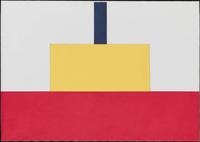
Castle CCCXXXIII 15.7.01
Bob Law
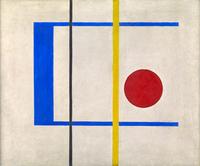
Early Geometric
Burgoyne Diller
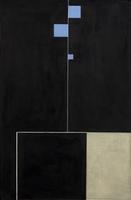
Dreiformvariation
Carl Buchheister
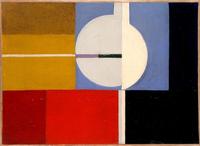
F1
Pierre Daura
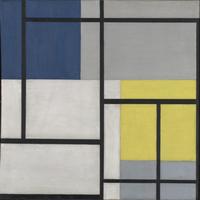
Simultaneous Composition XXIV
Theo van Doesburg
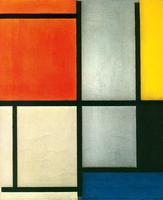
Tableau 3 with Orange -Red, Yellow, Black, Blue and Gray
Piet Mondrian
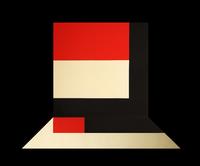
Last Tangle
Leo Valledor
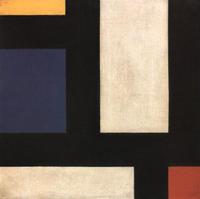
Counter Composition IV
Theo van Doesburg
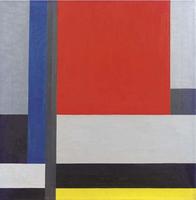
Composition néo-plastique 5a
Cesar Domela
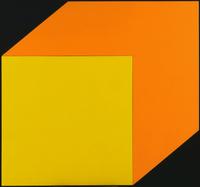
Yellow Orange
Ellsworth Kelly
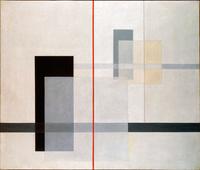
K VII
Laszlo Moholy-Nagy
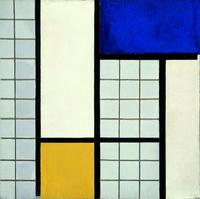
Composition with half values
Theo van Doesburg
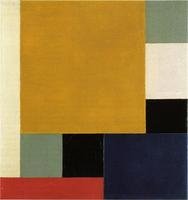
Composition XXII
Theo van Doesburg
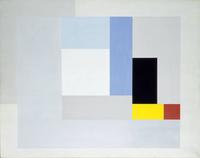
June 1937 (painting)
Ben Nicholson
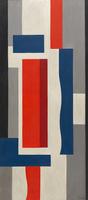
Peinture murale (Mural Painting)
Fernand Leger
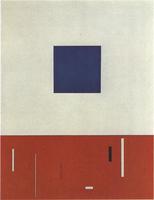
Composition No. 211
Friedrich Vordemberge-Gildewart
SDED - XXII
George Adrian Panaitisor
Untitled
Ivan Serpa