Expertenanalyse zu John McLaughlins Number 13,
Stil: Minimalism · Genre: abstract
Analysis of "Number 13" by John McLaughlin
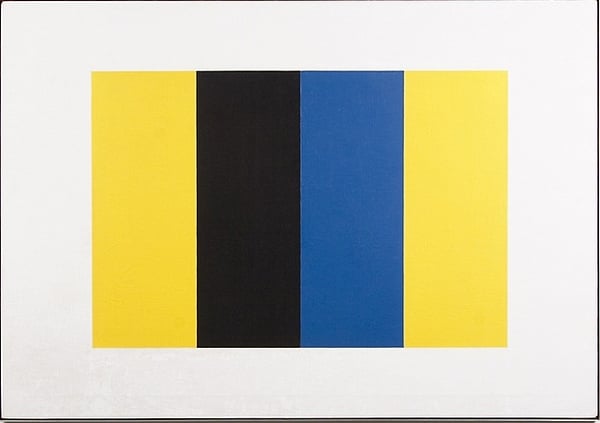
John McLaughlin’s Number 13 is a hallmark of Minimalist abstraction, a movement that sought to strip art to its most essential formal elements. As an abstract work, it renounces any narrative or representational content, focusing instead on pure geometry, color, and spatial relationships.
McLaughlin, a key figure in West Coast Minimalism, often employed rigid, hard-edged forms—typically rectilinear blocks or bands—arranged asymmetrically across a flat, monochromatic field. In Number 13, this reductive approach (characteristic of Minimalism) creates a taut, contemplative visual experience. The painting’s significance lies in its radical simplicity: every compositional decision is deliberate, eliminating any decorative or expressive excess. The stark interaction of shapes and negative space invites the viewer to engage with the work as an object of perception rather than interpretation.
Within the Minimalist canon, McLaughlin’s pieces stand out for their rigorous balance and quiet tension—achieved through subtle asymmetries and precise proportioning. Number 13 exemplifies how Minimalist abstraction can achieve profound visual impact through restraint, making it a vital contribution to post-war American art.
Visuell ähnlich
20 Werke mit ähnlicher Komposition und Farbpalette
Untitled (farbfeld)
Gunther Forg
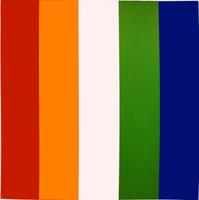
Red Orange White Green Blue
Ellsworth Kelly
Lisbon
Antonio Palolo
Untitled
Rubem Ludolf
Summer Table
Brice Marden
Elements V
Brice Marden
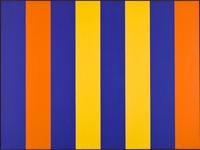
Orange-Blue Space
Guido Molinari
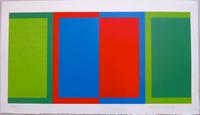
Untitled
Rubem Ludolf
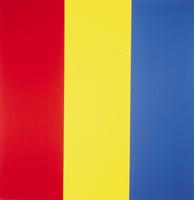
Red Yellow Blue Painting No. 1
Brice Marden
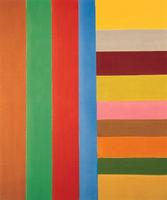
Down and Across
Jack Bush
Parallèles bleues
Guido Molinari
Diffusion of Two Groups of Colour
Richard Paul Lohse
V.S.
Karl Benjamin
Sevastipol
Doug Ohlson
Dichotomic Organization: Stripes
Lorser Feitelson
Peep Show
Doug Ohlson
Range
Brice Marden
Roma
Guido Molinari
Untitled
Friedrich Vordemberge-Gildewart
Seriel bleu-ocre
Guido Molinari