Untitled
Analisi esperta di Untitled di Rubem Ludolf
Stile: Concretism · Genere: abstract
Expert Analysis: "Untitled" by Rubem Ludolf (Concretism, Abstract)
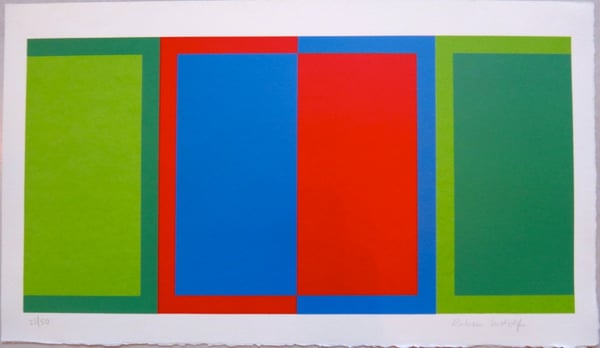
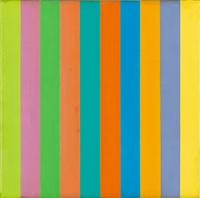
As an untitled geometric abstraction by Rubem Ludolf, this work stands as a quintessential example of Brazilian Concretism (often called Arte Concreta), a movement that emerged in São Paulo and Rio de Janeiro in the 1950s. The piece’s significance lies in its rigorous adherence to the movement’s core tenets: a total rejection of figuration, symbolism, and emotional expression in favor of pure, self-referential visual language. Ludolf, a key figure in the second generation of Concretists, here demonstrates how form, color, and spatial relationships become the sole subjects of the artwork.
Formal Precision and Optical Impact
Following Concretist principles derived from Max Bill and the Swiss-Brazilian tradition, Ludolf likely employs precise, hard-edged geometric forms—circles, squares, rectangles, or lines—arranged in a balanced but dynamic composition. The absence of a title forces the viewer to engage directly with the visual syntax: the interaction of positive and negative shapes, the tension between flatness and depth, and the rhythmic repetition of modular elements. Color is used not for descriptive or expressive purposes but as a structural component, often limited to primary hues (red, blue, yellow) plus black and white, to enhance clarity and perceptual vibration.
Significance within the Concretist Movement
Ludolf’s work is significant because it bridges the early Concretist emphasis on rational, mathematical order with a more playful, subtly organic sensibility that foreshadows the Neo-Concrete breakaway (led by artists like Lygia Clark and Hélio Oiticica). While strictly non-representational, his compositions often introduce slight asymmetries or overlapping planes that generate a sense of movement and optical illusion—an effect known as op art or kinetic perception, which became a hallmark of later Brazilian geometric abstraction. This untitled piece, therefore, encapsulates the moment when Concretism evolved from a cold, systematic doctrine toward a more sensuous, participatory visual experience, all while maintaining its allegiance to abstraction and form.
Conclusion
In "Untitled," Rubem Ludolf achieves the Concretist ideal of an autonomous object that creates its own reality through pure visual relationships. The work’s significance resides not in any narrative or external reference, but in its disciplined exploration of color, line, and space—a testament to the movement’s belief that art should be as concrete and self-sufficient as a mathematical equation or an architectural structure.
Visivamente simili
20 opere con composizione e palette affini
Untitled
Rubem Ludolf
Number 13,
John McLaughlin
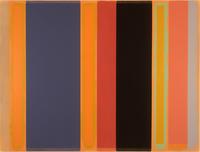
Sevastipol
Doug Ohlson
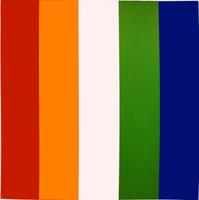
Red Orange White Green Blue
Ellsworth Kelly
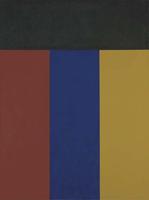
Elements V
Brice Marden

Untitled (farbfeld)
Gunther Forg
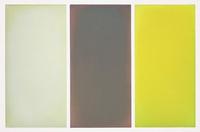
Autumn Aspen
Anne Appleby
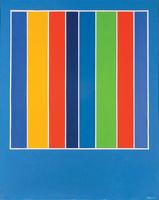
Lisbon
Antonio Palolo
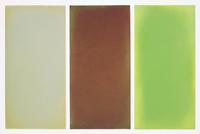
Spring Aspen
Anne Appleby
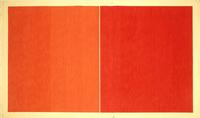
Red Baron
Gene Davis
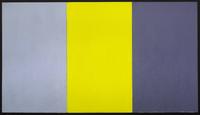
Summer Table
Brice Marden
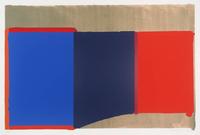
Blues, Reds
John Hoyland
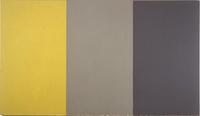
Range
Brice Marden
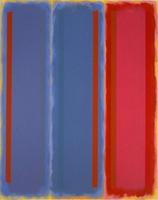
Wink
Doug Ohlson
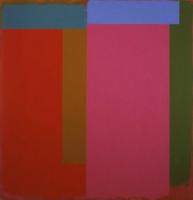
Marker California
Doug Ohlson
Winter Aspen
Anne Appleby
28.5.66
John Hoyland
Red Yellow Blue
Brice Marden
Looking Glass
Gene Davis
Diffusion of Two Groups of Colour
Richard Paul Lohse