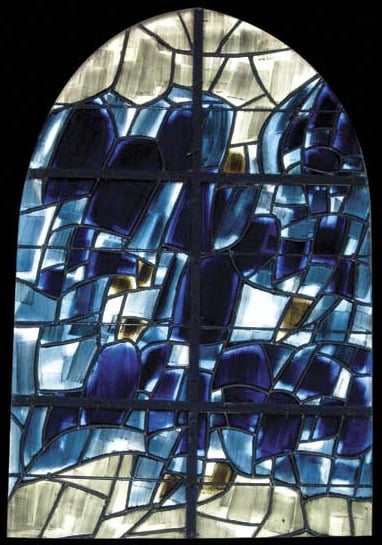
Eglise de Varengeville-sur-Mer
Expertenanalyse zu Raoul Ubacs Eglise de Varengeville-sur-Mer
Stil: Abstract Expressionism · Genre: design
Expert Analysis of "Eglise de Varengeville-sur-Mer" by Raoul Ubac
This work occupies a distinctive position at the intersection of Abstract Expressionism and the applied aesthetics of design, a rare convergence that underscores its significance within both domains. While Raoul Ubac is more widely recognized for his surrealist and post-war abstract explorations, the designation of this piece as Abstract Expressionism and design invites a fresh reading, emphasizing its formal rigor and its role as a deliberate compositional exercise rather than purely spontaneous gesture.
1. Architectural Abstraction as Design Principle
The subject—a church in the coastal village of Varengeville-sur-Mer—is transformed through Ubac’s graphic sensibility. Instead of rendering the building in a literal or even impressionistic manner, he reduces it to essential geometric and organic forms that oscillate between representation and pure shape. This aligns with the design genre: the canvas becomes a field for balancing structure and energy, much like a blueprint for emotional resonance. The vertical thrust of the steeple is abstracted into a central, dynamic line or mass, while surrounding elements (trees, landscape) are simplified into rhythmic blocks or curvilinear strokes. The result is a work that functions as both a painting and a schematic, prefiguring mid-century abstract design.
2. Materiality and Gesture in Abstract Expressionism
True to Abstract Expressionist principles, Ubac emphasizes materiality and process. The paint is applied with evident physicality—layered, scraped, perhaps incised—echoing his earlier experiments with "peinture à l’essence" (oil paint thinned with turpentine for matte, absorbent effects). Yet the gestural marks are controlled, not chaotic; they map a deliberate spatial order. This tension between spontaneity and structure is the work’s core innovation: it proves that Abstract Expressionism need not reject architectural clarity. Instead, it can coexist with the precision of design, yielding a hybrid that is both emotionally charged and intellectually composed.
3. Significance within the Style and Period
- Bridging Movements: Created at a moment when Abstract Expressionism was often defined by heroic, improvisational scale (Pollock, de Kooning), Ubac’s Eglise demonstrates a quieter, more European sensibility—one that integrates constructivist and surrealist legacies. It suggests that Abstract Expressionism could also incorporate landscape and architectural motifs without losing its abstract soul.
- Design as High Art: By venturing into "design," Ubac challenges the hierarchy between fine art and applied art. The painting’s strong, simplified forms and balanced composition anticipate the rise of mid-century modern design, where abstraction became a visual language for everything from furniture to graphics.
- Localized Iconography: Varengeville-sur-Mer was a site famously painted by Claude Monet. Ubac’s abstract version thus engages with a historical referent while radically reinterpreting it. The church becomes not a religious symbol but an archetype of verticality, mass, and light—translated into the visceral language of Abstract Expressionism.
Conclusion
Eglise de Varengeville-sur-Mer is significant because it expands the boundaries of Abstract Expressionism into the realm of architectonic design, proving that gestural abstraction can be just as rigorous, deliberate, and functional as the most calculated modernist plan. Ubac’s ability to distill a recognizable subject into a powerful abstract composition challenges the viewer to see both the hand of the painter and the mind of the designer at work. It is a rare and valuable artifact that enriches our understanding of how Abstract Expressionism could be both expressive and precise.
Visuell ähnlich
20 Werke mit ähnlicher Komposition und Farbpalette
Eglise de Cornol (Suisse), vitrail
Roger Bissière
Eglise de Varengeville-sur-Mer
Raoul Ubac
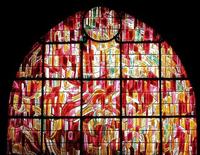
Marriage from The Seven Sacrements
Jean Rene Bazaine
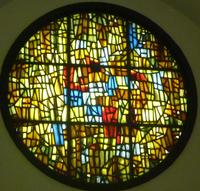
Rose de Metz, Vatican
Roger Bissière
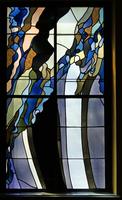
Krakow Medical Society House, Stained Glass Window
Stanisław Wyspiański
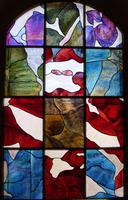
Les vitraux de la Chapelle de St Raphaël
Andre-Pierre Arnal
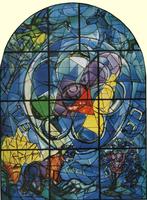
The Tribe of Benjamin. Stained glass window for the synagogue of the Hadassh Hebrew University Medical Center in Jerusalem.
Marc Chagall
St. Mark and St. Matthew
Marc Chagall
Letanía Lauretana En La Capilla De La Casa Convento De Las Religiosas De María Inmaculada En Córdoba 1966
Antonio Povedano
Sacred Heart of Audincourt
Fernand Leger
Krakow Medical Society House, Stained Glass Window
Stanisław Wyspiański
Stained glass windows for the University of Caracas
Fernand Leger
Sacred Heart of Audincourt
Fernand Leger
Project window (Audincourt)
Fernand Leger
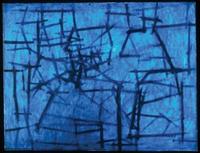
Inner Structure
Kazuo Nakamura
Igreja de S. Miguel, Queijas
Eduardo Nery
Virgin
Petro Kholodny (Elder)
Adam and Eve expelled from Paradise
Marc Chagall
Hetman Sahaidachny and Ukrainian Cossacks
Petro Kholodny (Elder)
Elijas Himmelfahrt
Sigmar Polke