
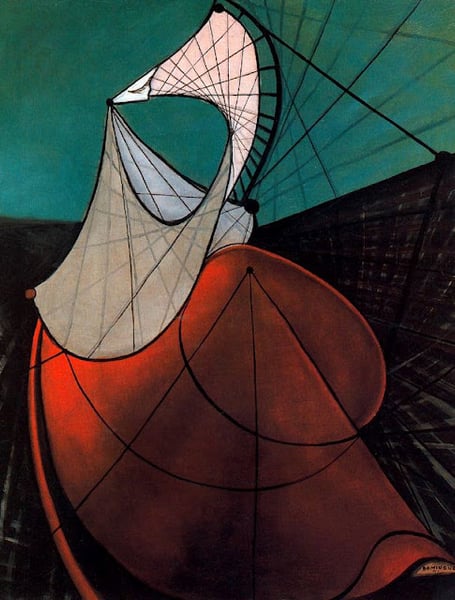
Analisi esperta di Mujer di Oscar Dominguez
Stile: Cubism · Genere: figurative
Artwork Analysis: "Mujer" by Óscar Domínguez
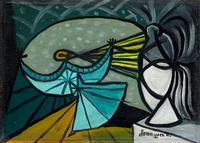
Óscar Domínguez’s “Mujer” exemplifies a fascinating intersection of Cubist structure and figurative expression. Though the artist is best known for his later Surrealist works, this piece anchors itself firmly in the Cubist tradition—demonstrating the movement’s continued relevance in the 1930s and Domínguez’s own early engagement with its formal innovations.
Significance within Cubism
-
Fragmentation and Multiple Perspectives: True to Cubist principles, Domínguez breaks down the female figure (mujer means “woman” in Spanish) into geometric facets and intersecting planes. The face and body are presented from multiple viewpoints simultaneously—a hallmark of analytical and synthetic Cubism—challenging traditional notions of a single, fixed perspective. This technique allows the viewer to perceive the subject in a more dynamic, almost sculptural way.
-
Synthesis of Figuration and Abstraction: Despite the radical deconstruction, the work remains unmistakably figurative. Domínguez never loses the essential human form, instead using Cubist abstraction to amplify psychological and emotional resonance. The figure’s angularity and simplified features convey a sense of modern, urban solitude, bridging the gap between pure formalism and expressive content.
-
Personal and Cultural Context: Domínguez, a Spanish-born artist working in Paris, brings a distinctive Iberian sensibility to Cubism. The strong, rhythmic lines and earthy tonalities hint at the influence of both African sculpture (so central to early Cubism) and Spanish folk traditions. “Mujer” thus becomes a marker of Cubism’s international expansion and its ability to absorb diverse cultural vocabularies.
Why It Matters
“Mujer” is significant not only as a textbook example of Cubist method but also as a precursor to Domínguez’s later Surrealist experiments. Here, the fragmentation of form already suggests a hidden, dreamlike world beneath the surface. The tension between geometric order and organic femininity makes this work a compelling testament to Cubism’s enduring power to transform how we see—and feel—the human figure.
Genere
Stile
Visivamente simili
20 opere con composizione e palette affini
Monde nostalgique #3
Jean-Paul Jerome
Planet Mercury passing in front of the Sun
Giacomo Balla
The Cathedral
Artin Demirci
Sketch for the ballet by Igor Stravinsky: Fireworks (Feu d'artifice)
Giacomo Balla
What goes up, comes back down
Linde Martin
On Brooklyn Bridge
Albert Gleizes
Abstract Cubistic Composition
Anatol Petrytsky
Planet Mercury passing in front of the Sun
Giacomo Balla
Planet Mercury passing in front of the Sun
Giacomo Balla
Multiplication par Kariokynese
Enrico Donati
Composition (Winning Red)
Alexander Rodchenko
Composition
El Lissitzky
Niu de cendra
Modest Cuixart
From now on, a red line ...1970
Alekos Kontopoulos
Guglielmo Marconi
Enrico Prampolini
Murailles de verre
Jean-Paul Jerome
Landscape
Giacomo Balla
Bild
Pablo Picasso
Egg Beater No. 4
Stuart Davis
Girl with a Skipping Rope
Oscar Dominguez