
Deskundige analyse van Morning in the Sudeten Mountains van Caspar David Friedrich
Stijl: Romanticism · Genre: landscape
Expert Analysis of "Morning in the Sudeten Mountains" by Caspar David Friedrich
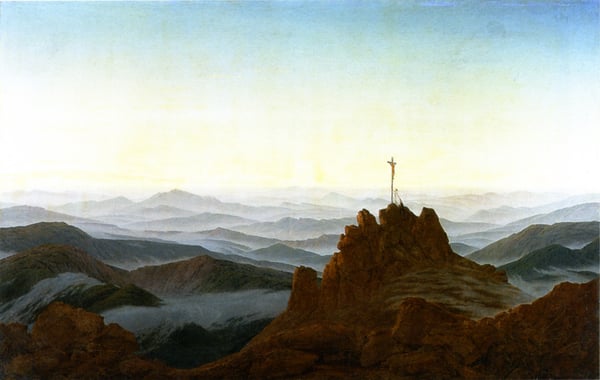
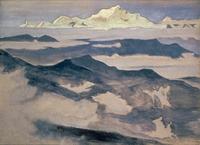
As a landscape painting firmly rooted in the Romantic style, Caspar David Friedrich's Morning in the Sudeten Mountains is a quintessential example of how the movement used nature as a vessel for deep emotional and spiritual reflection. The work's significance lies in its ability to transform a specific geographical location—the Sudeten Mountains—into a universal symbol of the sublime and the transcendent.
Friedrich, a master of German Romanticism, consistently eschewed mere topographical accuracy in favor of imbuing his landscapes with metaphysical weight. In this piece, the morning setting is not simply a time of day but a metaphor for spiritual awakening and the promise of renewal. The artist’s characteristic use of light—soft, diffused, and emerging from a hazy horizon—would likely create a luminous atmosphere that dissolves the boundary between the earthly and the divine. This treatment of dawn is typical of Friedrich’s interest in liminal moments (twilight, fog, dusk), where the natural world appears poised between the tangible and the infinite.
The choice of the Sudeten Mountains, a rugged range in Central Europe, is also telling. For Friedrich, mountains were not obstacles but pathways to the sublime—vast, ancient, and indifferent to human scale. By focusing on their peaks and valleys in the early light, he invites the viewer to contemplate their own smallness and the overwhelming power of nature. This aligns perfectly with Romanticism’s emphasis on emotion over reason and the individual’s awe before the wilderness.
What makes Morning in the Sudeten Mountains significant within its style and period is its quiet, contemplative power. Unlike the dramatic, storm-choked landscapes of some Romantics, Friedrich achieves the sublime through stillness. The scene likely lacks any narrative action or human figures (or, if present, they would be minuscule), focusing entirely on the play of morning light across rock and forest. This reduction of detail to essential elements—sky, mountain, light, mist—elevates the painting from a mere view to a meditation on creation and existence.
In essence, the artwork encapsulates Romanticism’s core belief: that nature is the most direct conduit to the divine. Friedrich’s Morning in the Sudeten Mountains does not just depict a landscape; it offers an experience of reverence, making it a landmark work that helped define how 19th-century art explored spiritual interiority through the external world.
Museum / Gallery
Visueel vergelijkbaar
20 werken met verwante compositie en kleurenpalet
Morning in Riesengebirge
Caspar David Friedrich
Cross in the Wilderness
Frederic Edwin Church

Zarathustra
Nicholas Roerich

Landscape
Carlos Orozco Romero

Sunrise up in the Mountains
Fujishima Takeji

Study to "Teacher's Testament'
Nicholas Roerich
The road in the Sinai after the storm
Karl Bryullov

Scene from 'The Last of the Mohicans', by James Fenimore Cooper
Thomas Cole

Scene from The Last of the Mohicans Cora Kneeling at the Feet of Tanemund
Thomas Cole

Hudson River Sketch
Asher Brown Durand

Morning, Looking East over the Hudson Valley from Catskill Mountains
Frederic Edwin Church
Mountain Stream in Caucasia
Hugo Simberg

Coastal landscape on the Gulf of Naples
August Ahlborn

Mountain Landscape
Werner Peiner
On the Doorstep (Hobbit)
Alan Lee

Bohemian Landscape
Caspar David Friedrich
Høyfjellslandskap Med Opptrekkende Uvær
Hans Gude
Range of the Caucasus mountains
Ivan Aivazovsky
Evening
Nicholas Roerich

Study of the summits of northern Italy
Oswald Achenbach