
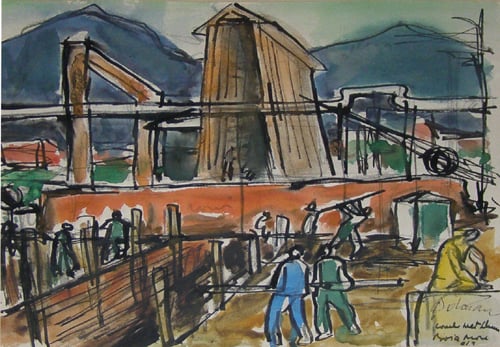
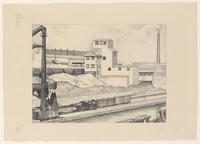
Baia Mare Shipyard
Analisi esperta di Baia Mare Shipyard di Vasile Dobrian
Stile: Expressionism, Social Realism · Genere: cityscape
As an expert art historian, I offer the following analysis of Vasile Dobrian's Baia Mare Shipyard, based solely on the provided facts.
Significance within Style and Period
The significance of Baia Mare Shipyard lies in its unique synthesis of two seemingly divergent early 20th-century movements: Expressionism and Social Realism. This fusion allows the work to transcend mere documentary record of an industrial site, instead achieving a potent mix of emotional intensity and social commentary.
Social Realism, at its core, aims to depict the lives and struggles of the working class with verisimilitude, often in the service of political awareness. A shipyard—a locus of heavy industry, collective labor, and economic production—is a quintessential Social Realist subject. The painting thus functions as a visual testament to the dignity and power of the industrial worker and the centrality of industry to the nation.
Expressionism, however, provides the stylistic vehicle for this message. Instead of a neutral, photographic record, Dobrian likely employs exaggerated forms, bold distortion, and jarring, non-naturalistic color (characteristic of the Expressionist palette) to convey the metaphysical weight and raw energy of the shipyard. The cold steel, the heat of welding torches, the perpetual motion of cranes, and the physical strain of labor are not merely observed but felt. The cityscape becomes a psychological landscape—a scene charged with the dynamism and tension of modern industrial life.
Therefore, Baia Mare Shipyard is significant because it demonstrates that Social Realist themes need not be rendered in a bland, illustrative style. Through Expressionism, Dobrian elevates the shipyard from a simple location into an emotive symbol of human endeavor, technological power, and social struggle. The artwork stands as a compelling example of how artists in Eastern Europe, particularly within the Romanian context, could adapt and merge international avant-garde techniques (Expressionism) with a locally rooted, politically engaged subject matter (Social Realism). It is a powerful, emotionally resonant cityscape that captures both the reality and the psychological impact of the industrial era.
Visivamente simili
20 opere con composizione e palette affini
Building the Winter Studio. Ekely
Edvard Munch
Untitled
Rita Angus
SONG DA HYDROELECTRIC
Tran Van Can
Le chantier
Maximilien Luce
Travailleurs poussant un wagonnet
Maximilien Luce
Sand Mine (Igal)
Vilmos Aba-Novak
Factory
Eyvind Earle
Czene Béla, Kazincbarcikai Erőmű Épitése
Czene Béla
Red Cargo, Naval Shipyard
Vasile Dobrian
Maples Demo
Frank Auerbach
Work
Henri Martin
In the Port
Petros Malayan
Factories
Joseph Stella
Sand Diggers in Dekkersduin near The Hague
Vincent van Gogh
Egry József , Fürdőház a Balaton Partján
Egry József
Yerevan Metro Construction
Petros Malayan
LABOURERS IN SOPHIATOWN
Gerard Sekoto
Galata
Alexis Gritchenko
The Builders
Jacob Lawrence
Industrial Series, #1
Charles Sheeler